Sometime around 1846, an unknown photographer made a daguerreotype of a dog. The National Science and Media Museum in Bradford holds a version of this image, and they have noted, with appropriate dry pleasure, that the dog’s head is blurred. The dog moved during the exposure. The resulting image is partly a photograph of a specific animal and partly a ghost, the motion-smear of a creature that had no interest in the project being conducted around it.
That blurred head is the whole history of pet photography in one detail. The human desire to preserve the animal collides with the animal’s total indifference to being preserved. The technology improved. The problem never went away.
The formal period: pets as subjects
Early photography required long exposure times, careful staging, and a cooperative subject. Pets provided none of this. The miracle of early pet photography is not that it was done well but that it was done at all. People wanted images of their animals badly enough to sit with a squirming dog in a studio for several minutes and hope for a usable result.
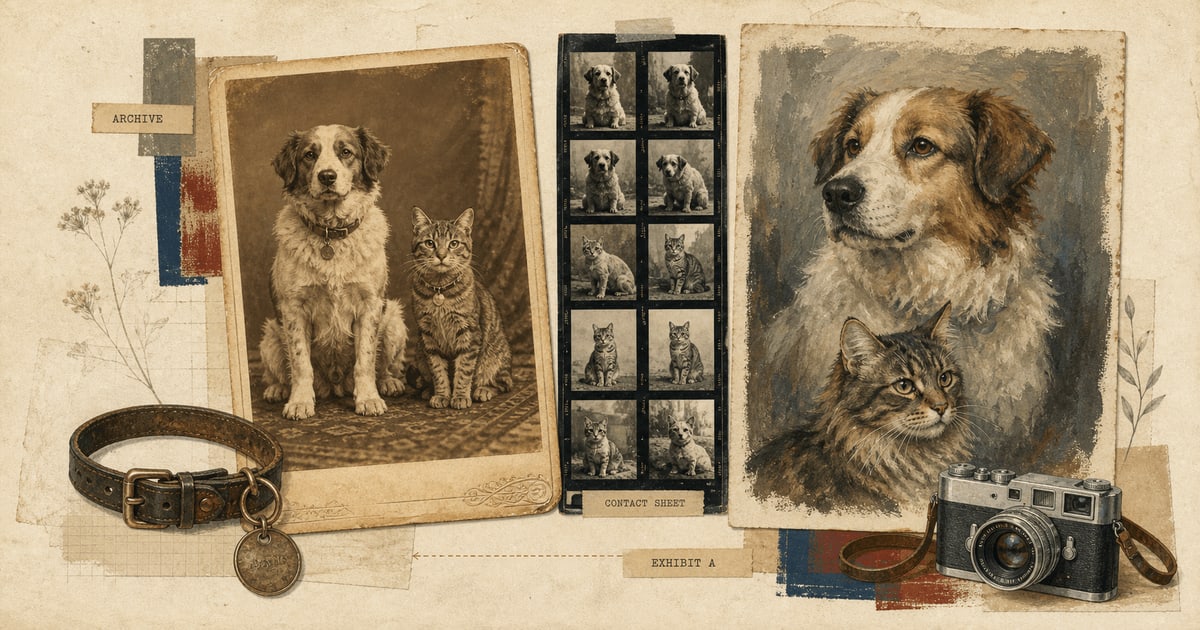
The studio pet photograph of the 1850s and 1860s borrowed heavily from the visual conventions of human portraiture: chairs, draped fabric, backdrops suggesting a genteel domestic interior, the animal positioned to suggest composure it did not feel. Many of these images are stiff in ways that look comic now, the dog perched improbably on a velvet chair, the cat caught in the half-second before it jumped off the prop table, the owner’s hands just visible at the edges trying to hold something still.
But formal they were. The formal portrait, whether of a person or an animal, makes a specific claim: this subject deserved visual attention. In the Victorian middle-class household, commissioning even a modest photograph was an act of social significance. You did not do it casually. You did it for births, marriages, deaths, and occasionally, with some self-consciousness about the indulgence, for dogs.
The Victoria and Albert Museum’s holdings include several nineteenth-century pet photographs that read as straight domestic portraiture: the animal framed and centered, often with identifying accessories like a collar or favorite toy, lit to show the eyes and coat. These are not snapshots. They are considered images made by people who believed the subject mattered.
The Kodak turn: pets in family life
George Eastman’s introduction of the Kodak roll-film camera in 1888, and the Brownie in 1900, did to photography what the industrial press did to books: it removed the technical and financial barriers and made production available to people who were not professionals. The results, for pet memory, were immediate.
Family photograph albums from the early twentieth century show pets appearing not as the sole subject of a formal sitting but as part of the visual record of household life. The dog at the beach. The cat on the Christmas chair. The dog beside the children at various ages, a kind of informal time-lapse of both the children and the animal. The pet was now photographed the same way the family was: constantly, casually, in the middle of everything.
This matters for memory in a specific way. The formal portrait makes an argument. The family snapshot makes a record. The argument says: this subject had importance. The record says: this subject was present, again and again, in the ordinary days. Both are needed for grief, but for most of history, only the formal argument version was accessible to ordinary people with ordinary animals.
Geoffrey Batchen, in Forget Me Not: Photography and Remembrance (Princeton Architectural Press, 2004), examines how popular photography changed the texture of memory and mourning in the twentieth century. He is writing primarily about human subjects, but his observations apply directly to the pet record: the accumulation of casual images creates a different relationship to loss than the single formal portrait does. You are not losing an important subject. You are losing a presence that was in the frame of every ordinary day.
The phone camera: abundance without ceremony
The contemporary pet photograph is something categorically different from anything that preceded it.
A midrange smartphone from 2023 can capture 48 megapixels at 60 frames per second in adequate light with no preparation, no cost per image, and no ceremony required. The result is that pet owners now accumulate photographs the way they used to accumulate hair: constantly, without intending to, and with occasional alarm at the total volume.
Most of these photographs are not good. Some are barely photographs. A nose, out of focus. A sleeping mass of fur with no discernible orientation. The dog looking away at the exact moment the shutter fired. The cat whose eyes are always half-closed because the timer was too slow. These images fail to meet any technical standard of portraiture and are often among the most treasured things a person owns after a pet dies.
The reason for this is simple and was not obvious until the phone camera made it universal: ordinary photographs preserve context. The blurry image of a dog sleeping on the kitchen floor also contains the kitchen floor, which is the specific kitchen floor of a specific house in specific years of a person’s life. The cat half-behind the curtain contains the curtains, which were bought at a specific store during a specific period, and looking at the photograph now returns the cat along with the light in that room and the temperature of that afternoon. Bad photos can be time machines in ways that technically perfect photos sometimes are not.
This changes grief in a specific way. Pre-phone owners who lost a pet had, typically, a handful of images: perhaps one formal sitting, a few family snapshots, whatever happened to be taken on film. After the pet died, the visual archive was finite. You went through it once and then it was gone through.
The modern owner has, potentially, thousands of images. The grief encounters not a small pile of photographs but an endless scroll that keeps surfacing the animal in different contexts: asleep on a Tuesday, caught mid-yawn, sitting in the sunny patch that no longer catches the light the same way since the neighbor’s tree grew up. The archive of casual images is both a consolation and a problem. It gives grief something to do with its hands. It also does not let you finish.
What the archive does and does not do for the portrait artist
More photographs do not automatically produce better reference material for a commissioned portrait. They often produce the opposite problem: too many images, most of them inconsistent, with the clearest technical examples being emotionally inert and the most emotionally important images technically unusable.
What an artist actually needs is narrower than most clients expect. A clear face photograph, ideally taken at eye level in natural daylight with the animal alert and the eyes visible. A photograph showing true coat coloring without the color distortion of indoor artificial light or phone camera processing. And something that captures the animal’s characteristic posture or expression, which is often not a posed photograph at all but something caught sideways in the middle of a mundane moment.
The emotionally important photograph, the one taken three days before the pet died, or the one that came up randomly on a phone notification at a terrible moment, may be dark, blurred, or shot from an unflattering angle. It is still useful. An experienced artist can use a technically weak image for the feeling it contains while using cleaner supporting images to recover the structural facts: the ear shape, the eye color, the markings, the body proportion. The archive that the phone camera produced makes this triangulation possible in a way it wasn’t for a Victorian owner with one formal sitting in hand.
The job is not to pick the best photograph. The job is to understand what each photograph contributes and tell the artist what the goal is. A portrait that captures the character of the animal needs different reference material than a portrait that is primarily a record of markings. Both are legitimate. The artist needs to know which one you are after.
Why portraiture still has a function
Photography did not replace pet portraiture. It changed what portraiture is for.
A photograph is evidence. A portrait is an interpretation. Photography captures what was in front of the lens during a fraction of a second. A custom portrait can synthesize multiple references, correct the distortions of indoor lighting, simplify a distracting background, and draw attention to the features that made the animal recognizable to the people who loved it.
This is especially important for memorial portraits. The camera roll after a pet dies contains hundreds of true images, each capturing a different version of the animal in different conditions. None of them, individually, contains the whole animal. The portrait is the attempt to make something that does: one image, drawn from many, that holds still long enough for the feeling to settle.
For reference photos for a commission at Pet on Canvas, our guide on taking better reference photos for your pet portrait covers the technical details. The short version: natural light, eye level, and at least one image where the animal was not expecting the camera.
Sources
- National Science and Media Museum, Bradford. “Hidden Treasures of Our Collections: Dog-erreotype.” blog.scienceandmediamuseum.org.uk, accessed 2025.
- Batchen, Geoffrey. Forget Me Not: Photography and Remembrance. Princeton Architectural Press, 2004.
- Victoria and Albert Museum. “Pet portraits at the V&A.” vam.ac.uk, 2019.
- Zakia, Richard D. Perception and Imaging: Photography as a Way of Seeing. 4th ed. Focal Press, 2013.
- Burns, Stanley B. Sleeping Beauty: Memorial Photography in America. Twelvetrees Press, 1990. (Context for photographic memorial practice.)
- The Metropolitan Museum of Art, Department of Photographs. “The Dawn of Photography: French Daguerreotypes, 1839-1855.” Catalogue essay, 2003.
Welcome perk
Free expedited delivery on your first portrait
Get your digital proof in 1-2 business days instead of 2-3, free on your first portrait. Normally a $10 upgrade.
No spam. Just the perk and the occasional new style or guide.
Check your inbox for your code.