
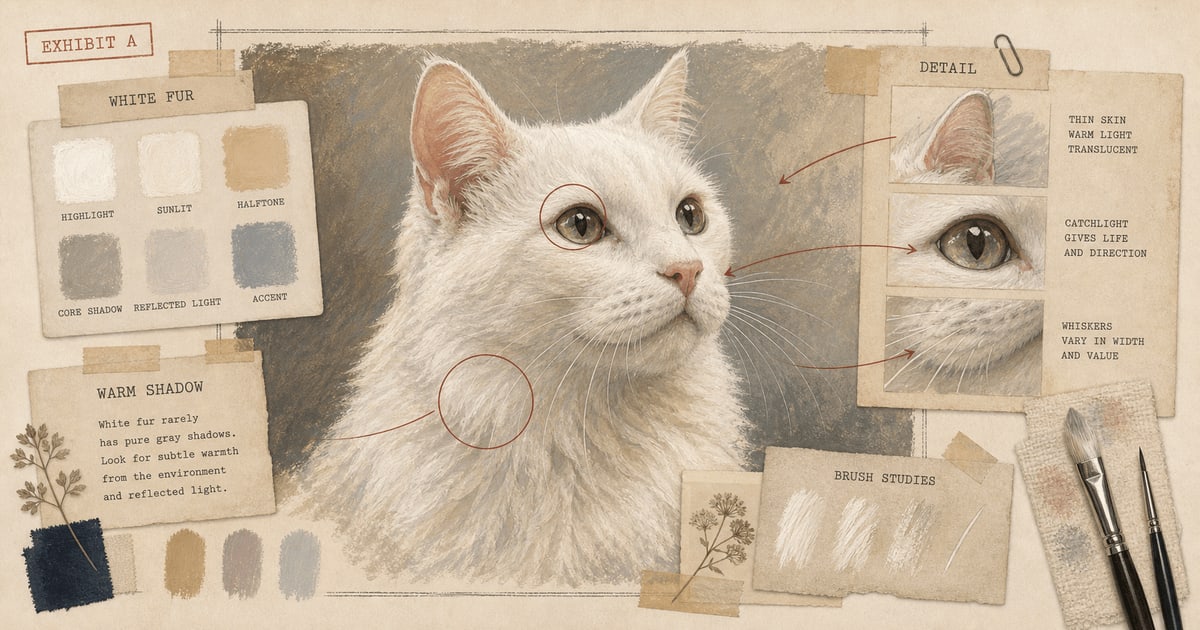
A white cat is the inverse problem of a black dog. Where the black coat threatens to collapse into a featureless void, the white coat threatens to blow out to pure paper-white and lose all sense of form. The technical solutions mirror each other: keep the value range compressed, use chromatic variation inside what looks “white,” and let color contrast carry the structural information that absolute value cannot.
The plain answer: never use pure white for the highlights, render the shadows in cool grays with warm hints, treat the pink ears and nose as load-bearing local color, and let the eyes do the strongest contrast work. A well-painted white cat is a study in restraint.
What “white” actually is
A white coat is not a single value. Even in clean white fur, the value range from highlight to shadow spans roughly two full stops of brightness in real lighting conditions. The illusion of whiteness is created by the painter or photographer compressing that range and shifting it toward the top of the value scale, not by painting everything at maximum brightness.
If you put a white cat next to a sheet of unpainted paper, the cat is darker than the paper almost everywhere. This is why a portrait of a white cat painted with pure white highlights tends to look flat: the painter has used the absolute lightest possible value for the coat, leaving nothing brighter for the painting’s actual highlights.
The working rule, mirror image of the black-dog rule: the lightest part of the cat is not the lightest part of the painting. Reserve pure white (or the medium’s brightest value) for the catch-light in the eye, for a tiny accent on the nose or whisker tip, for the brightest specular highlight on one or two structural points. Everything else, including most of the coat, sits below that.
Shadow color on white fur
White fur in shadow is a perfect place to use color, because the eye is not distracted by chroma in the lighter values. Working approaches:
- Cool gray shadows: Payne’s gray, or a mix of ultramarine blue and burnt sienna in the right ratio, gives a neutral cool dark. This is the workhorse for shadow on white fur in cool light (north-facing window, overcast day).
- Warm gray shadows: raw umber thinned, or burnt sienna with a touch of ultramarine, gives a warmer dark suitable for shadow on white fur in warm light (tungsten lamp, late afternoon sun).
- Blue-cast shadows: a touch of ultramarine or cerulean in the shadow areas, especially for white cats photographed against a window or in open shade. The blue cast is what the eye actually sees when fur is in shadow under a blue sky.
- Violet shadows: a hint of dioxazine purple or alizarin + ultramarine in the deepest shadow folds. Reads as elegant and luminous in watercolor especially.
The principle: shadow on white is colored shadow, not gray shadow. Pure neutral gray makes white fur look dirty. Slightly cool, slightly warm, or slightly violet keeps the white reading as white but adds the dimensionality the form needs.
Highlights that are not white
The lightest values on a white coat are typically:
- A warm cream or pale yellow-white on the top planes where warm light hits
- A cool blue-white or pale violet-white where cool light or sky light hits
- A nearly-white but barely-tinted value across most of the lit side of the coat
- A genuine pure white (or paper-white in watercolor) only at very small accents
The temperature of the highlight should match the light source. Warm light gives warm highlights and cool shadows. Cool light gives cool highlights and warm shadows. This is one of the foundational color-temperature principles in painting, codified in different ways by Josef Albers (Interaction of Color, 1963) and Johannes Itten (The Art of Color, 1961). The painter’s job is to figure out which light is hitting the subject and then commit to the corresponding temperature scheme.
The pink anchors: ears, nose, paw pads
On a white cat, the pink local color of the ears, nose, and paw pads is doing more work than it looks like it is doing. These small pink areas are the warmest, most chromatic regions on the entire animal. They give the eye somewhere to land. They are also where the painter can most clearly establish lighting (an ear backlit by a window glows a translucent pink, an ear in shadow goes cooler and slightly mauve).
Working palette suggestions:
- Ear interiors in warm light: cadmium red light or quinacridone rose, thinned, with a touch of yellow ochre. For a backlit ear, lean into the warmth.
- Nose: usually a slightly cooler pink than the ears, with a hint of violet or gray in the shadow areas. The nostril holes are a small but useful dark accent.
- Paw pads (if visible): similar to ear interiors but often slightly more muted, with more brown undertone.
A white cat painting without these chromatic anchors tends to feel washed out. The pink is structural, not decorative.
Eye color as the contrast point
White cats famously come with a few distinct eye colors:
- Blue: common in white cats, particularly purebreds. Strong contrast against the white coat. Can be painted in cerulean, ultramarine, or a Prussian blue depending on the actual color.
- Gold or amber: warm and contrasting against the cool whites. Paint in raw sienna, yellow ochre, or a touch of cadmium yellow with the right neutralizing partner.
- Odd-eyed (heterochromia): one blue, one gold. Striking and historically associated with white cats specifically (the W gene that produces all-white coat is also associated with eye color variation and, sometimes, deafness).
- Green: less common but striking, can be painted in a viridian/yellow ochre mix or sap green with a cool touch.
The eyes on a white cat are typically the strongest chroma and strongest contrast in the entire painting. They are doing the work of anchoring the composition that, on a darker animal, would be spread across the face. The painter has to commit to them. A muddy eye color on a white cat ruins the painting more than it would on a tabby.
Long-haired vs short-haired white cats
A long-haired white cat (Persian, Turkish Angora, Maine Coon white) gives the painter texture in addition to color. The fur breaks the light into countless small variations. Working approach: use loose, directional brush or pencil strokes that follow the fur’s actual growth direction, build up the lit side in many small light strokes, leave shadow areas more solid.
A short-haired white cat (Oriental Shorthair, white Domestic Shorthair, Burmilla) gives the painter form more cleanly but less surface variation. Working approach: rely more on subtle value modeling, treat the body more like a sculpted form, use whisker placement and ear edges as the most visible “lines.”
For long-haired whites, the ear tufts and chest ruff are major features. They catch light beautifully and are where the painting can show real virtuosity. Including them in the reference photo (rather than cropping them out) is worth doing.
Reference photo guidance for white cats
The photographic problem is the inverse of the black-dog problem. Camera meters tend to under-expose white subjects to bring them toward middle gray, dulling them. The fix:
- Use exposure compensation +1 to +2 stops to preserve the white as white.
- Shoot in indirect window light, not direct sun. Direct sun on a white cat blows out the coat and creates a paper-flat blob with no fur texture.
- Slightly underexpose from “ideal” (-1/3 to -1/2 stop) to preserve highlight detail. You can recover shadow detail in post; you cannot recover blown highlights.
- Avoid white backgrounds. A white cat on a white sofa loses all edge definition. A white cat on a darker (mid-gray, warm wood, dark fabric) background reads cleanly.
- Use a shallow depth of field if possible. Separates the cat from the background and gives the painter clearer subject information.
Our broader reference photo tips cover the basics, and the cat-specific guidance above is what you add on top.
What to brief the artist on
For a white cat commission, useful information to include:
- The cat’s actual eye color (not the camera’s version of it; cameras misread blues especially)
- The temperature of the light in your favorite reference photo (was it morning window light, afternoon sun, lamp light?)
- The actual pink tone of the ears and nose (some white cats have pale pink, some have a more apricot tone)
- Long-hair or short-hair, with reference photos that show the typical fur texture
- Any color in the coat you want preserved (some “white” cats have faint cream or apricot patches that are part of how they look in life)
The order process accommodates these details, and the pricing page covers the size options. White cats often photograph beautifully at the 16x20 size, which gives enough surface area for the subtle modeling to read clearly.
The bottom line
A white cat is a discipline. The painter has to resist using the medium’s strongest white where it would be tempting, has to color the shadows carefully, has to make the pink anchors and the eye color carry the chromatic weight. The result, when handled well, is one of the more elegant kinds of pet portrait, because the restraint shows.
The cat will look like the cat if the painter respects what white actually does in light. Pure paper-white skipped only where it earns the visit. Everything else slightly tinted, slightly modeled, slightly held back.
Welcome perk
Free expedited delivery on your first portrait
Get your digital proof in 1-2 business days instead of 2-3, free on your first portrait. Normally a $10 upgrade.
No spam. Just the perk and the occasional new style or guide.
Check your inbox for your code.