
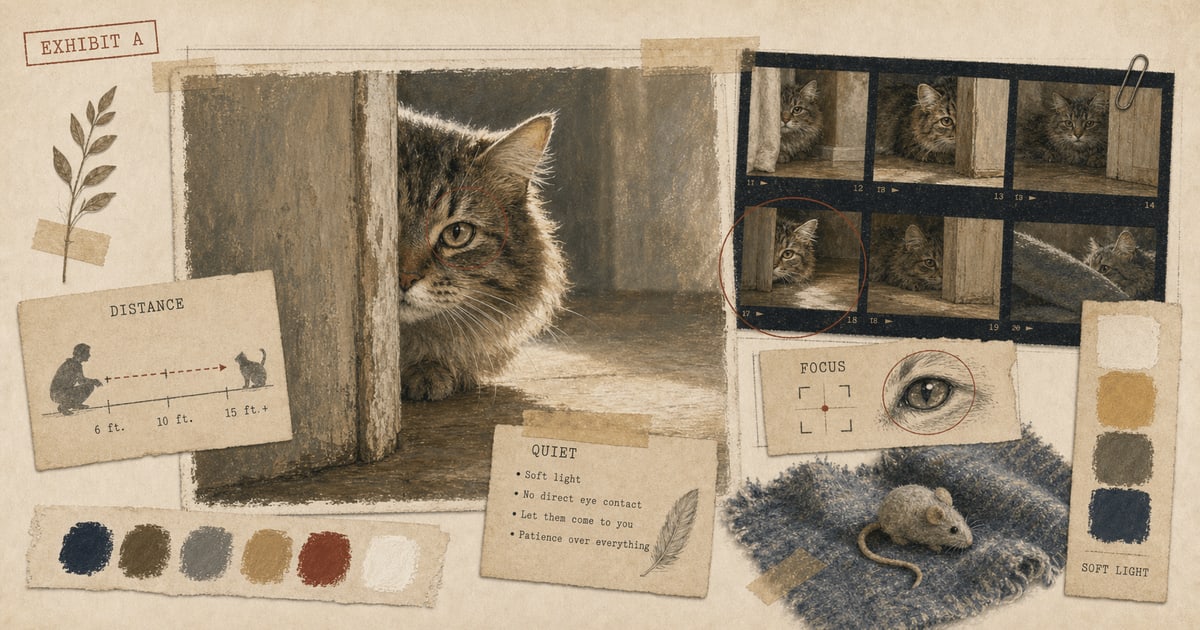
A shy pet does not pose. Pointing a phone at a fearful dog or an avoidant cat tells the animal that something is being asked of them, and the response is usually to leave, freeze, or look away. The photo you get is flat-eared, half-turned, eyes wide. It is not a usable reference, and it is not a good moment for the pet either.
The fix is to stop asking. The best photos of shy pets are usually the ones the pet did not know about.
Here is the working approach: increase distance between the pet and the camera, use ambient light without flash, place the camera or yourself in a position the pet does not register as confrontational, and wait. Treats can help, but only if the pet associates them with safety, not with the camera.
Why Forcing a Pose Backfires
Applied animal behavior research, including work by Patricia McConnell and others writing on stress signals in companion animals, identifies a consistent set of behaviors that indicate a dog or cat is uncomfortable: turning the head away, lip licking, yawning out of context, lowered body posture, ears pinned back, tail tucked. These are stress signals.
Forcing a stationary pose for a photo produces all of them in a sensitive pet. The animal is being asked to hold still while a thing is pointed at them. They cannot leave. They cannot do the thing they would prefer (move away, look at something else, sniff the floor). They are stuck.
The photo records the stress. The artist receives a reference where the ears are back and the eyes are wide and the pet looks anxious, because they were.
This is also why “ignore them and they will do something natural” works better than “wait, look, sit, stay.” The natural moment is the one where the pet has forgotten about the camera.
Distance Is the Single Most Effective Tool
Most pets have a tolerance distance. Within that distance, they register the camera as something to deal with. Outside that distance, they ignore it.
For very shy pets, that distance can be ten feet or more. Standing across the room with a phone is less confrontational than crouching three feet away. The phone’s zoom can handle the difference.
Modern phone cameras with 2x or 3x optical zoom (or computational zoom that uses multiple lenses) produce usable reference photos at distances that would have been impossible a decade ago. The 2x or 3x zoom is roughly equivalent to a 50mm to 70mm lens on a full-frame camera, which is a flattering range for portraiture. The 5x or 10x zoom on flagship phones gets into telephoto territory (around 100mm equivalent), which is excellent for shy pets because the camera can be far away.
The pet sees a person standing on the other side of the room. The person is not approaching. The phone is not pointed at them in any obvious way. The pet relaxes. The photo happens.
Ambient Light Beats Flash, Always
Flash startles shy pets. Even the flash from a phone is bright enough to make a sensitive animal flinch, and once they have associated the camera with the bright light, every subsequent attempt to photograph them gets harder.
Use natural ambient light. Daylight through a window. Open shade outdoors. A well-lit room. The camera has to be at the limits of what the light allows, but the photo will be of a relaxed pet rather than a flinching one.
If the room is too dark for the camera to capture without flash, the room is too dark for the photo. Move the pet’s activity (resting, treat-taking) to a brighter spot, or wait for better light, rather than forcing flash.
Placing the Camera Where the Pet Will Come
Some shy pets have favorite spots. A windowsill, a particular chair, a sunny patch on the floor, a bed in the corner. The pet goes there reliably to rest or look out the window.
Set up for the photo where the pet already wants to be. Get into position before the pet arrives, with the camera framed and ready, and wait. When the pet settles into the spot, take photos quietly. They will tolerate the camera in their preferred location far better than they will tolerate being moved to where the light is good.
A treat can be useful if it can be placed in the spot ahead of time, so the pet finds it on arrival and stays put while eating. Avoid using treats as a lure to bring the pet toward the camera. The shy pet will be suspicious of the lure, and the photo will record the suspicion.
Practical Tactics
Some tactics that work across most shy pets.
Get on the floor. A person crouched on the floor with a phone is less imposing than a person standing over the pet. Even small differences in height matter.
Avoid eye contact with the pet through the camera. A shy pet often reads direct eye contact, even mediated through a phone screen, as confrontational. Hold the phone slightly to the side, watch the screen, and let the pet face the camera lens without you facing them.
Use burst mode. Hold down the shutter for two seconds and let the camera fire a sequence. The pet’s expression changes constantly. Among twenty rapid frames, one will be the one you want.
Ignore the pet between shots. Lower the camera. Look somewhere else. Resume photographing only when the pet has settled again. Pets read sustained attention as a signal that something is happening.
Try multiple sessions across multiple days. A single photo session with a shy pet might produce nothing usable. Three short sessions of five minutes each, spread across a week, will usually produce at least one keeper.
What the Artist Actually Needs
The reference photo for a shy pet does not need to be a glamour shot. It needs to be clear enough to see the eyes, the structure of the face, the coat color, and the general posture.
A pet curled in a window, ignoring the camera, can be the right reference. The artist can render the pet looking forward in the final portrait even if the reference shows them in profile. What the artist cannot do is invent an eye structure or a coat color from a blurry, flinching photo.
Send multiple photos. Tell the artist which one is most representative. Mention if the pet is shy and the reference is the best you could get without distressing them. The artist will work with what they have.
For more on what to send and how to frame the request, see /blog/what-to-tell-artist-pet-portrait-order.
The Scent Trick
One technique worth trying, separately documented in our guide on this topic: use scent rather than sound to get a shy pet to direct their attention.
Saying the pet’s name draws attention but also creates expectation, which a shy pet experiences as pressure. A familiar scent (a treat, a worn shirt, a favorite toy) draws attention without the social pressure of being addressed.
Hold the scent source near the camera. The pet will orient toward it. The orientation is brief but it is enough for a photo.
Full method in /blog/stop-saying-their-name-use-scent-for-better-photos.
When to Stop
If the pet has shown stress signals for more than a minute or two, stop. Put the camera away. Try again tomorrow. The portrait can wait. The pet’s relationship with the camera (and with you holding the camera) is worth more than any single reference photo.
The best reference photos of shy pets are taken patiently, over time, in low-pressure moments. The portrait artist would rather receive one good candid than ten stressed staged photos. Place the order when you have a photo that shows your pet as they actually are, calm enough to look like themselves.
Welcome perk
Free expedited delivery on your first portrait
Get your digital proof in 1-2 business days instead of 2-3, free on your first portrait. Normally a $10 upgrade.
No spam. Just the perk and the occasional new style or guide.
Check your inbox for your code.