
In three controlled experiments, people who performed a ritual after a loss, even one invented on the spot for the study, reported less grief afterward than people who did nothing. It didn’t matter whether they believed a ritual would help before they tried it. It worked anyway.
That finding comes from Michael Norton and Francesca Gino, published in the Journal of Experimental Psychology: General in 2014. None of their three experiments involved losing a pet. The losses they studied were the death of a loved one, the end of a romantic relationship, and losing money in an unclaimed lottery ticket. But the mechanism they identified doesn’t obviously depend on the category of what was lost, and it’s worth being upfront that this is a reasonable extension of their finding to pet loss, not a study that measured pet loss directly.
Participants who reflected on rituals they’d already performed, or who were assigned to invent and complete a new one for the experiment, reported lower levels of grief than participants who didn’t. Norton and Gino’s own explanation is specific: “increased feelings of control after rituals mediated the link between use of rituals and reduced grief.” A ritual, in other words, seems to work less because of what it contains and more because doing it hands a small amount of agency back to someone in a situation that otherwise offers none.
A pet’s death rarely leaves room for that kind of control while it’s actually happening. The timing of a decline, the schedule of an emergency vet visit, the moment a euthanasia appointment gets set, all of it tends to be dictated by the animal’s body and the clinic’s calendar rather than chosen. A ritual performed afterward, on your own schedule and in your own kitchen, is one of the only parts of the whole experience you get to design from nothing. Nobody assigns it to you. Nobody schedules it for you. That may be closer to the actual mechanism than the word “ritual” suggests on its own.
The content of the ritual mattered less than doing one
The part of the study worth sitting with is that belief wasn’t a requirement. People who doubted, going in, that a ritual would do anything for them still reported less grief after performing one. That rules out the easy explanation that this is just a placebo effect produced by expecting comfort and then feeling what you expected to feel. The benefit tracked the act itself.
This matters for anyone assuming a home memorial only counts if it follows a tradition, a religion, or a script passed down from somewhere else. Norton and Gino’s participants were, by definition, doing something that had never been done before, something with no cultural weight or inherited meaning attached to it at all. It still worked. A newly invented fifteen-minute routine in your kitchen carries the same evidenced mechanism as a centuries-old funeral rite: it restores a sliver of control over something that otherwise happened to you without your consent.
It also means the feeling that a solo, improvised ritual is somehow the lesser option, the one you settle for when there’s no time to plan anything more formal, isn’t supported by what was actually measured. Nothing in the mechanism Norton and Gino describe depends on an audience. The felt sense of control their studies tracked came from performing the ritual, not from anyone else watching you do it. A memorial that consists of you alone, ten minutes, and something said out loud to an empty room is not a diminished version of a larger one. It’s a complete one.
What a small memorial can actually look like
There’s no itemized, clinically endorsed list of what a home pet memorial should include, and no veterinary or psychological body in the research here claims to have written one. What exists instead is permission, backed by evidence, to keep it as plain as it needs to be.
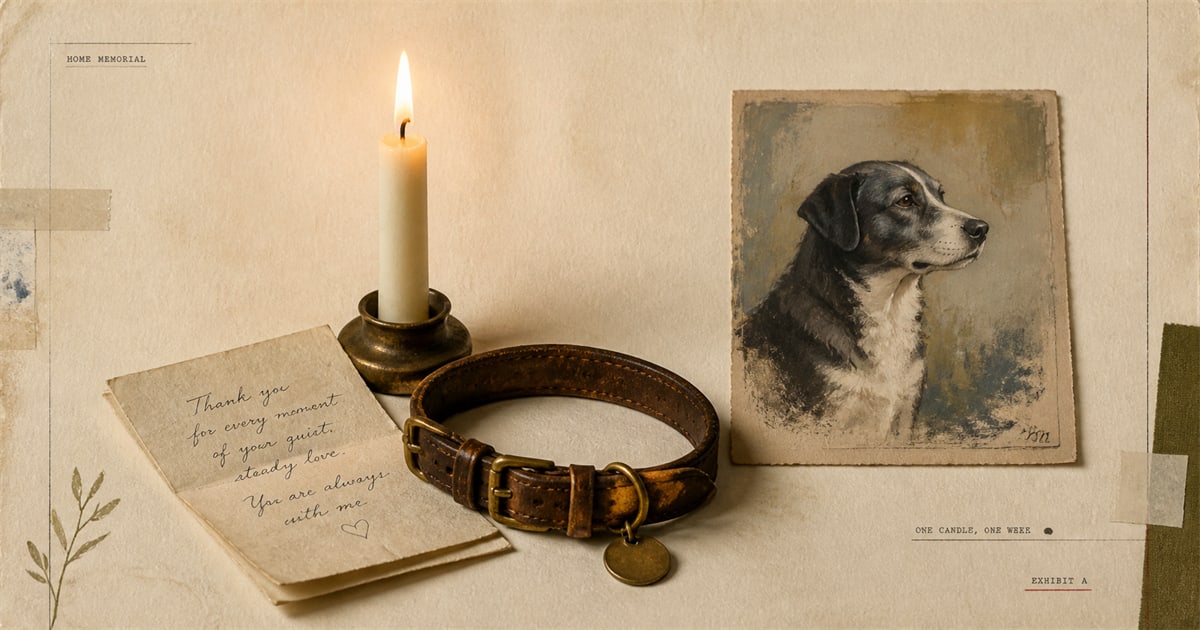
Some people light a candle at the same time each evening for a week. Some read something aloud, a note, a poem, the pet’s name and the years, to an empty room or to family gathered for the occasion. Some walk a route the animal used to walk. Some simply sit with one photograph, chosen in advance, instead of scrolling through hundreds on a phone. None of these is more legitimate than the others, and the research doesn’t rank them. What the ritual contains is your call to make. That it happens, deliberately and on purpose, is the part that seems to matter.
A few build the ritual around an object instead of an action: holding the collar for a few minutes before deciding where it goes, setting the food bowl out one last time before it gets put away for good, keeping a leash coiled somewhere visible for a week rather than dealing with it immediately. None of this is prescribed by any source cited here. It’s simply what closes something, for some people, better than a candle or a reading does. The object doesn’t need to be kept forever for the ritual to have worked. It just needs to be handled once, on purpose, instead of quietly disappearing into a drawer.
The ASPCA’s own end-of-life guidance touches this from a different angle, framing memorialization less as a solitary act than a social one: “It can help to memorialize your pet in a way that includes others who cared about him or her. Friends and family can help form a support network.” It doesn’t specify a method, and it isn’t a hotline or a structured program, only a general nudge to loop other people in if there are other people who loved the animal too. A small at-home gathering, even just two or three people who knew the pet, fits that guidance without needing to be an event.
That can be as small as texting the two or three people who knew the animal and asking them to be on a call for ten minutes while you say something out loud, or as involved as sitting the whole family down at the same table with the same photo in the middle of it. The guidance doesn’t specify a size for the group, and there’s no reason to assume bigger performs better. What it points at instead is witnessing: grief that stays entirely inside one person’s head is harder to revisit and harder to share later than grief that happened, even briefly, in front of somebody else who was there for it too.
There’s no required day
One thing worth saying plainly: nothing in this research suggests a memorial has to happen on a specific day, or within a specific window, to count. Some people plan one the week the pet dies. Others wait until the anniversary, or until a quiet weekend months later when the timing finally feels bearable. The ritual’s benefit, per the mechanism Norton and Gino describe, comes from performing it, not from performing it on schedule.
Some people also repeat it. A candle lit once the week of the death can become a candle lit every year on that date, turning a single invented ritual into a small tradition of one’s own making rather than one borrowed from somewhere else. Norton and Gino’s experiments measured a ritual performed once, not a ritual repeated annually, so it would overreach to say their data covers year two or year ten directly. But nothing in the control-based mechanism they identify suggests that benefit would stop being available the second time around. If a ritual works because doing it restores a sense of agency over the loss, there’s no obvious reason that restoration expires after a single use.
A place for the portrait, if you want one
For some people, the object at the center of a small home memorial ends up being a portrait rather than a candle or a reading. If you’re planning to have one made, there’s no requirement to wait for a specific occasion to order it, and no reason it has to arrive fully framed and finished before you can start planning around it. A digital portrait starts at $24.99 and a canvas from $49.99, with a proof to review before anything is finalized, so it’s possible to plan the memorial and the portrait on parallel timelines rather than waiting on one to begin the other.
What the research actually offers here isn’t comfort dressed up as science. It’s a fairly plain finding: doing something, on purpose, about a loss that otherwise leaves you with nothing to do, measurably helps. You don’t need it to be the right something. You need it to be yours.
Sources
- Norton, M.I., & Gino, F. “Rituals alleviate grieving for loved ones, lovers, and lotteries.” Journal of Experimental Psychology: General, 143(1), 266-272, 2014. DOI: 10.1037/a0031772
- ASPCA. “End of Life Care.” aspca.org
Welcome perk
Free expedited delivery on your first portrait
Get your digital proof in 1-2 business days instead of 2-3, free on your first portrait. Normally a $10 upgrade.
No spam. Just the perk and the occasional new style or guide.
Check your inbox for your code.