
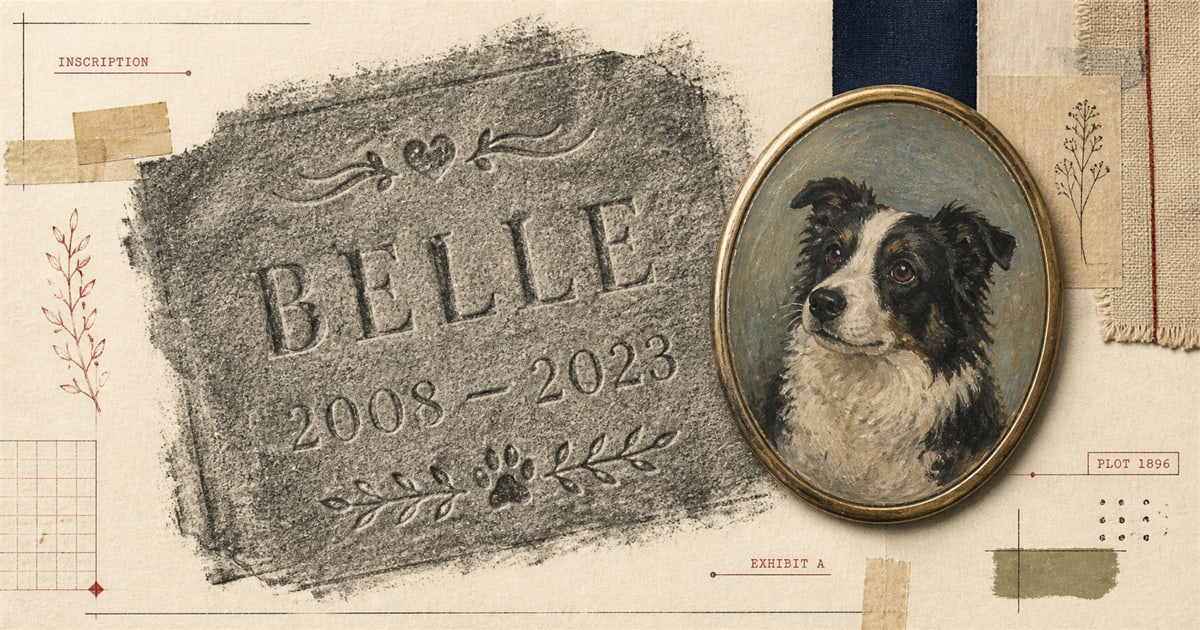
At Ilford Animal Cemetery in London, there is a headstone for a cat who served the British government from 1947 to 1964. It reads, in full: “Peter the Home Office Cat.” Nothing else. Not even correctly, as it happens: the engraving misstates his start date by two years, an error nobody has ever bothered to fix. It is one of the plainer stones in the ground there, and it is also, somehow, complete.
That’s the first useful thing a person staring at a blank memorial order form can learn from the historical record: there isn’t a formula. There’s a wide, genuinely documented range, and most of it is more interesting than the templates a monument company will hand you.
No industry body publishes a character limit or a required structure for a pet epitaph, and it shows. What follows below is not a set of rules. It’s what people, given a blank space and a real animal to write about, have actually chosen to carve.
Two cemeteries, and no agreement on the shape
Hartsdale Pet Cemetery in Westchester, New York, is the oldest continuously operating pet cemetery in the United States. It began in 1896, when a veterinary surgeon named Dr. Samuel Johnson offered part of his apple orchard as a burial place for a grieving client’s dog. What started as one favor for one client is now more than 80,000 interments across five acres, and in 2012 it was added to the National Register of Historic Places, reference number 12000535, recognized for its significance in social history and landscape architecture. That’s a federal body deciding that a pet cemetery’s grounds and headstones were worth preserving as a historical record, not just a comforting one. Eighty thousand families wrote something on eighty thousand stones, over more than a century, and the range of what they chose to say is the entire subject of this post.
Ilford, in London, is the UK counterpart in age and scale. It was established in 1928 by the PDSA on St Swithin’s farm and holds at least 3,000 individually named graves: mostly cats and dogs, but also pigeons, budgerigars, horses, and at least one monkey, named Ginger. Twelve recipients of the Dickin Medal, the UK’s animal equivalent of the Victoria Cross, are buried there, including Able Seacat Simon of HMS Amethyst, the only cat ever to receive it, and a carrier pigeon named Mary of Exeter.
Neither cemetery enforces a house style. Both are full of people who wrote whatever they meant, decades apart from each other, on two different continents, with no shared style guide between them. If there were a natural, correct way to phrase a pet epitaph, a hundred years of independent choices at two of the oldest pet cemeteries in the world would have converged on something closer to one. They didn’t.
What the range actually looks like
At Hartsdale, a guide dog named Yahtzee has a stone that reads “My Guiding Angel.” A dog named Sandy gets the flatly declarative “the best dog in America.” A cat named Woodstock has “one hell of a cat often mistaken for a meatloaf,” which is the kind of line that only makes sense if you knew the cat. A dog named Grumpy has the more formal “His sympathetic love and understanding enriched our lives.” A 1917 mausoleum built for a spaniel carries a full sentence: “My Little TrueLove Hearts, Who Would Lick the Hand That Had No Food to Offer.”
The most elaborate stone at Hartsdale belongs to a lion cub, not a dog or cat at all. Goldfleck, owned by the Hungarian Princess Elisabeth Vilma Lwoff-Parlaghy, has a white marble headstone reading: “Buried beneath this stone is the beautiful young lion Goldfleck, whose death was sincerely mourned by his mistress Princess Lvoff-Parlagie, New York, 1912.” Notice what that inscription does that most of the others don’t. It names the mourner, not just the mourned.
Hartsdale’s War Dog Memorial, a bronze statue of a World War I era dog atop a soldier’s helmet, was unveiled in 1923 to honor military working dogs specifically. Dogs from later conflicts are buried near it too, including Scamp from the Second World War and a dog named Joachim from Vietnam. The memorial is proof that a cemetery’s writing doesn’t have to be personal to be sincere. Sometimes the inscription is for a category of service, not a single animal.
Ilford’s collection of Dickin Medal recipients works the same way from a different angle. Simon of HMS Amethyst, the only cat ever to receive the medal, and Mary of Exeter, a decorated carrier pigeon, are both buried there among family cats, dogs, and budgerigars, not set apart in any separate honored section. The writing at Ilford doesn’t need to elevate its most decorated residents above the rest of the grounds. Being buried there at all, next to Peter the Home Office Cat and everyone else, was already the honor.
The three things that actually recur
Strip away the range and a loose pattern does show up, and it’s the one a memorial-industry inscription guide names directly: the pet’s name, birth and death dates if you want them, and a short line, a poem, a prayer, a passage, or a plain statement of what the animal was. The tone of that short line runs from plain (“Rest in Peace: My Best Friend Forever”) to playful wordplay (“My Pawsitively Purrfect Friend Will Never Be Forgotten”), and the historical record backs up that both registers are equally normal, not one more dignified than the other.
Where you’re writing matters more than what’s fashionable. A headstone invites something closer to Goldfleck’s full sentence, since stone is permanent and the space is usually generous. A smaller plaque, an urn, or a paw print keepsake pushes naturally toward Peter’s model: a name, maybe a title or a role, and nothing padded in to fill space that doesn’t need filling. Neither format asks you to perform grief at a particular length. They just have different amounts of room.
If you’re stuck
Pick one memory or one trait and write toward that, rather than toward what you think a headstone is supposed to sound like. “Peter the Home Office Cat” works because it tells you exactly who he was to the people who wrote it: a fact, stated once, left alone. Goldfleck’s epitaph works for the opposite reason, because it says who mourned him and how much. Both are on the historical record. Neither is more correct than the other.
If the memorial in question is a portrait rather than a stone, the same freedom applies, and there’s a small practical note worth knowing: a name and set of dates can usually be added to a memorial portrait at no extra charge, the same short line a headstone would carry, just rendered instead of engraved. It doesn’t need to be more than that.
It also doesn’t need to be finished in one sitting. Write a line down. Leave it. Come back to it in a day or a week and see if it still sounds like the animal you’re writing about, or like a phrase you reached for because it seemed like the kind of thing a memorial says. Goldfleck’s epitaph reads like someone who sat with it. Peter’s reads like someone who didn’t need to. Both are still standing, decades later, doing their job.
Write the line that’s true. Nobody who visits Hartsdale or Ilford is checking it against a template.
Sources
- Roadtrippers Magazine. “At America’s first pet cemetery, beloved animals… find a peaceful resting place.” roadtrippers.com
- US National Park Service. National Register of Historic Places database, reference #12000535. npgallery.nps.gov
- 6sqft. “Did you know the world’s oldest pet cemetery is in Westchester, New York?” 6sqft.com
- The London Dead. “They say animals don’t worry…” (Ilford Animal Cemetery history). thelondondead.blogspot.com
- Memorials.com Info Center. “Cat and Dog Epitaphs.” memorials.com
Welcome perk
Free expedited delivery on your first portrait
Get your digital proof in 1-2 business days instead of 2-3, free on your first portrait. Normally a $10 upgrade.
No spam. Just the perk and the occasional new style or guide.
Check your inbox for your code.