
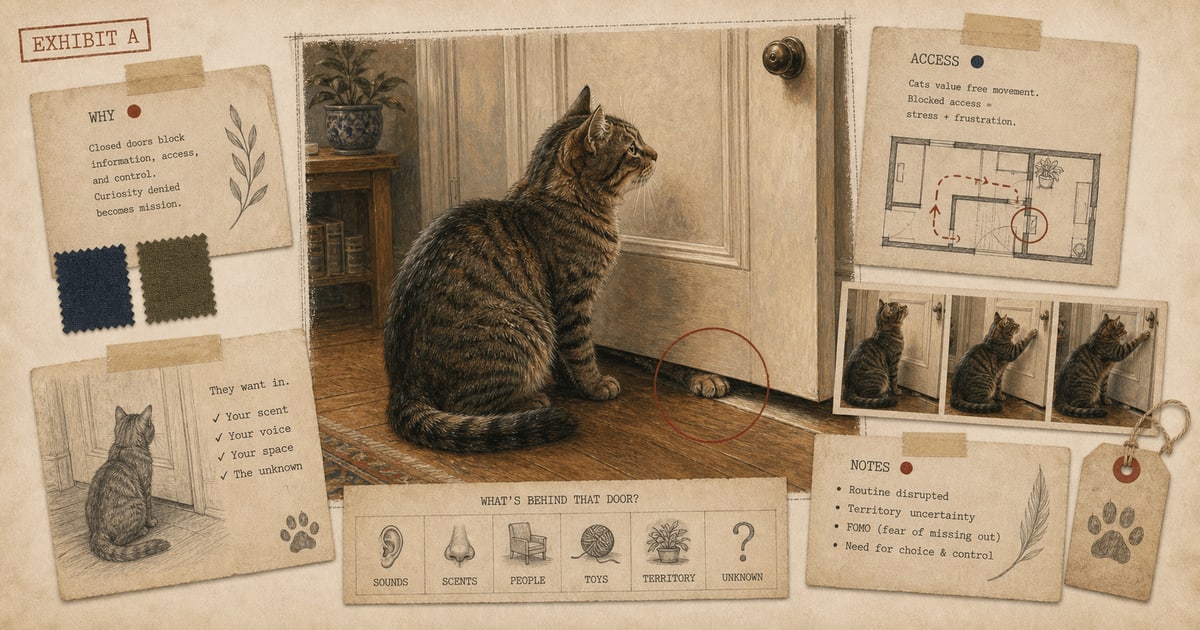
You close the bathroom door. Within a minute there is a paw under it, then a chirp, then a structured complaint that escalates if ignored. The same cat that has been ignoring this room for hours suddenly needs to be in it. The same cat that watches you cook with mild interest is now offended by a flat panel of wood.
The standard internet take is that cats hate being told what to do. This is broadly true and also unhelpful as an explanation. The better answer comes from feline ethology, specifically the literature on territory, perceived control, and the unusual social ecology of Felis catus compared to other domesticated species.
The short answer: cats map their territory through scent and sight, and a closed door breaks the map. It removes an option, hides information, and contradicts the cat’s ongoing project of knowing where everything is.
Cats Are Not Pack Animals
This is worth stating clearly because so much pet-behavior writing collapses cats and dogs into the same category. Dogs descend from a highly social pack-hunting canid. Cats descend from Felis silvestris lybica, the Near Eastern wildcat, established in Carlos Driscoll and colleagues’ 2007 Science paper as the single ancestor of the domestic cat. Wildcats are solitary hunters with overlapping but largely individualized territories. They are not pack animals. They are not even strongly social animals, in the way that term gets used for canids or primates.
What domestication did to cats is interesting in its own right. It produced an animal capable of tolerating high densities of conspecifics and humans, but it did not turn cats into pack animals. John Bradshaw covers this in detail in Cat Sense (Basic Books, 2013) and in The Behaviour of the Domestic Cat (CABI, 2nd ed., 2012, with Sarah Brown). The domestic cat’s social style is closer to a flexible toleration of neighbors than to a pack structure. The territory remains central.
This is the foundation. A cat’s territory is not background. It is the cat’s primary frame of reference for nearly everything else.
How Cats Map Territory
A free-ranging cat spends a meaningful portion of its waking time patrolling, scent-checking, and re-marking the edges and key features of its territory. The cat’s brain treats this as a map maintenance problem. Where are the food sources, the safe resting places, the elevated lookout points, the rival cats, the conflict-free transit corridors? Information about these changes regularly, and the cat updates the map by walking it.
Indoor cats do the same thing on a compressed scale. Your apartment or house is the entire mapped territory. The cat knows the location and history of every door, every elevated surface, every chair the dog has slept on, every spot where you spilled tuna in 2024. The patrol behavior is reduced but not eliminated. Cats still walk the perimeter, still revisit favored spots, still pay attention to which doors are open or closed.
A closed door is a discontinuity in the map. The cat’s brain registers it as an information gap and an option removed simultaneously. The cat may not be desperate to enter the bathroom. The cat is responding to the door’s status change.
The AAFP Five Pillars and Perceived Control
The most influential modern statement of feline environmental needs is the 2013 AAFP and ISFM Feline Environmental Needs Guidelines, published by Sarah Ellis and colleagues in the Journal of Feline Medicine and Surgery. The guidelines describe five pillars of a healthy feline environment:
- A safe place.
- Multiple and separated key environmental resources (food, water, toileting, scratching, play, resting, sleeping).
- Opportunity for play and predatory behavior.
- Positive, consistent, and predictable human-cat social interaction.
- An environment that respects the importance of the cat’s sense of smell.
The piece relevant here is the framing around “a perceived sense of control over the environment,” which the guidelines treat as a cross-cutting requirement. Cats cope well when they can choose where to go, where to retreat to, and which interactions to enter. They cope poorly when those choices are taken away.
A closed door reduces perceived control. It is not catastrophic in any single instance, but it is irritating in the way that any small removal of agency is irritating to an animal that depends on agency for stability.
Why Some Doors Are Worse Than Others
Cats do not protest every closed door equally. Pay attention and you will see a pattern. The doors that produce the most consistent objection are:
- Doors to rooms the cat regularly uses (bathroom, bedroom).
- Doors that close behind a person the cat is bonded with.
- Doors that close after the cat saw something interesting on the other side.
- Doors that close abruptly after being open for a stretch.
Doors that the cat has never seen open, or that close to rooms the cat does not particularly care about, get less response. This is consistent with the perceived-control reading: the cat is not objecting to all closed doors as a class. The cat is objecting to a specific recent removal of access from its known map.
Cornell Feline Health Center notes that this kind of context-specific behavior is typical of cats, and that interpreting it as generalized stubbornness misses what is actually going on. The behavior is responsive to information change.
What to Do About It
You do not have to leave every door open. Cats can adjust to consistent rules. The two adjustments that help most are:
Predictability. If the bedroom door is closed every night at the same time, the cat learns the pattern and complains less. If the door is closed unpredictably, the cat reacts more strongly because the pattern is the closure itself.
Compensating access. If the cat is shut out of one room, having another high-value option available reduces the loss. A favored window perch, a cat tree near where you are working, a clean litter box not in the room behind the door. The AAFP guidelines call this resource separation and it directly addresses the perceived-control problem.
Punishing the door protest is the worst option. It pairs your presence with negative consequence and weakens the relationship without changing the underlying motivation. Bradshaw is direct on this: punishment is rarely effective in cats and frequently counterproductive.
When It Is Not About the Door
Excessive vocalization at doors that goes far beyond the cat’s baseline, especially in older cats, can be a sign of something else. Hyperthyroidism, cognitive dysfunction, hypertension, and hearing loss can all increase nighttime vocalization in particular. The Cornell Feline Health Center and the MSD Veterinary Manual both flag persistent unexplained yowling as worth a vet visit, especially in cats over ten.
If the door protest is new, intense, and out of character, the door is probably not the actual problem. If the protest has been there since kittenhood and just continues, the door is the problem and the cat is being a cat.
Sources
- Bradshaw, John, Cat Sense: How the New Feline Science Can Make You a Better Friend to Your Pet (Basic Books, 2013).
- Brown, Sarah L. and Bradshaw, John W. S., The Behaviour of the Domestic Cat (CABI, 2nd ed., 2012).
- Ellis, S. L. H., et al., “AAFP and ISFM Feline Environmental Needs Guidelines”, Journal of Feline Medicine and Surgery, 2013.
- Driscoll, C. A., et al., “The Near Eastern origin of cat domestication”, Science, 2007.
- Cornell Feline Health Center, “Feline Behavior Problems”.
Welcome perk
Free expedited proof on your first portrait
Your proof in 1-2 business days instead of 2-3, free on your first portrait. Normally $10.
The code, then an occasional new style or guide.
Check your inbox for your code.