
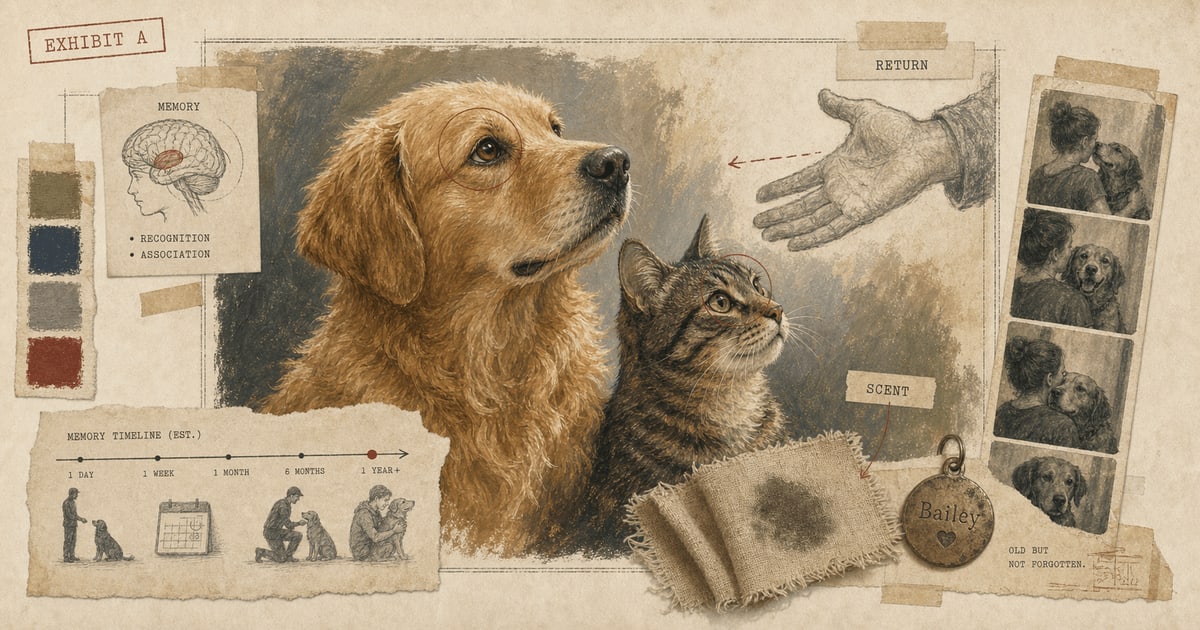
The internet has a steady supply of videos in which a dog loses composure on seeing a person it has not seen in years. These are not faked, but they do not prove what the captions claim. Pet memory is more layered, more reliable in some dimensions, and more limited in others, than the warm version of the story suggests.
The honest answer: pets recognize known humans across long absences. Dogs in particular use multiple cue channels (scent, voice, gait, face) and the recognition can persist for years. What is harder to establish is whether pets “remember” in the sense humans mean: a conscious recall of a specific past episode. The evidence for episodic-like memory in dogs exists but is recent and modest.
Recognition is not the same as remembering
In cognitive psychology, recognition and recall are distinct. Recognition is “I have encountered this before.” Recall is “I can reconstruct the encounter.” Recognition is much easier and is documented across many species. Recall, in the sense of episodic memory (“I remember Tuesday afternoon”), was long assumed to be uniquely human. The honest current view is: probably not unique, but hard to test.
When a dog loses composure at the door because someone it knew years ago has returned, recognition is doing the work. The dog has matched a complex multi-sensory pattern (this scent, this voice, this gait, this face) against a stored representation. That match is firing through old reward circuits. The dog is not necessarily recalling a specific past walk. The dog is recognizing the person and responding to the accumulated history.
This distinction matters because the recognition version is well-supported and the recall version is overclaimed in popular framing.
What dogs use to recognize people
Dogs are pattern-matchers with extraordinary scent. Alexandra Horowitz, in Inside of a Dog (2009), describes the dog’s olfactory world as being as information-dense as the human visual world. A familiar human gives off a stable scent signature that includes diet, soap, hormones, and individual chemistry. Even after long absences, that signature is more stable than appearance.
Voice is another reliable channel. Dogs can recognize an individual human voice and discriminate between voices saying the same words. Gait, the way a particular person walks, is also recognizable: dogs respond to known walks from down the block before the visual face is resolvable.
Face recognition in dogs is real but appears to be less reliable than scent or voice. Studies using two-alternative forced-choice tasks have shown dogs can pick familiar faces out of pairs, but the effect is weaker than the corresponding scent task.
This is why a dog will often greet you correctly even if you have changed your appearance: shaved your head, grown a beard, returned from chemotherapy. The other channels are intact.
What cats use to recognize people
Cats use voice strongly. A 2013 study by Saito and Shinozuka showed cats can discriminate their owner’s voice from a stranger’s, though they often choose not to demonstrate this dramatically. (Cats have a long history of knowing things and acting like they do not.)
Saito and colleagues followed up in 2019 with a study in Scientific Reports showing domestic cats discriminate their own names from other similar-sounding words. The cats had to be tested in their own homes, with their own owners, with their normal level of cat indifference, but the effect was real and statistically robust.
Cats also use scent, posture, and routine. They are particularly sensitive to behavioral patterns: what time you come home, where you sit, when you fill the food bowl. A cat returning to a person after long separation often re-attaches to the routine first and the person second, which can look like coldness and is closer to “rebuilding the model.”
Episodic-like memory in dogs
Claudia Fugazza, Ákos Pogány and Ádám Miklósi published a 2016 paper in Current Biology using the “Do as I Do” paradigm. Dogs trained on this paradigm can imitate a human action on command (“do what I did”). The team showed that dogs could imitate an action even after a delay during which they had not been told that a memory test was coming.
This is significant because incidental encoding (remembering something you were not specifically asked to remember) is a hallmark of episodic-like memory. The dogs remembered “what the human did” without having been cued in advance that the information mattered.
The authors are careful to call this “episodic-like” rather than “episodic” because we cannot ask the dog whether the memory feels like a re-experience the way human episodic memories do. But the behavioral signature is consistent with episodic memory.
The retention intervals tested were short (around one minute). Whether this kind of memory persists for years, the way recognition memory does, has not been established.
Long-term recognition: what is plausible
It is plausible, based on the recognition literature, that dogs can recognize people they have not seen in many years. Anecdotal cases of dogs recognizing returning soldiers, fostered humans, and old friends are consistent with the science. Recognition memory tends to be very durable across species; it is more efficient to remember “I have met this individual before” than to re-evaluate from scratch each time.
What is less clear: how the recognition feels to the dog. We project a rush of memory and feeling onto the dog at the moment of reunion. The dog is doing something real. We do not know exactly what.
The same caution applies to cats. Cats clearly recognize returning humans. The behavioral signature is often quieter than the dog version (a tail-up, a chirp, a lengthy press of head against shin) but it is unmistakable to anyone who knows the individual cat.
The honest version
Pets remember the people they have lived with. They remember them through multiple channels. They probably hold something like episodic traces of significant past events, at least in the short term. The recognition itself can last for years.
What pets probably do not do is sit and recall specific past walks or visits the way you might. They live primarily in a present that is shaped by what they have learned, scented, heard, and felt across the time they have been alive.
This is enough. The dog at the door is not staging a Hallmark scene. The dog is responding to the return of a known person. Whatever recognition feels like from the inside of a dog, it is doing work, and the work is real.
A note about memorial portraits
People sometimes commission portraits of a pet who is no longer alive, in part because the pet’s recognition of them is now memory only on the human side. There is a quiet symmetry to this. The pet recognized you reliably for years using channels you could not perceive. The painting holds your version of that recognition: what the face looked like, what the eyes did, what the loaf or stand or curl on the chair was that you would know across any room.
If a memorial portrait is something you are thinking about, the order page and our guidance on reference photos might help. There is no rush. The recognition does not go away.
Sources
- Fugazza, C., Pogány, Á., Miklósi, Á., “Recall of others’ actions after incidental encoding reveals episodic-like memory in dogs,” Current Biology, 2016
- Saito, A., Shinozuka, K., Ito, Y., Hasegawa, T., “Domestic cats (Felis catus) discriminate their names from other words,” Scientific Reports, 2019
- Horowitz, A., Inside of a Dog (2009), chapters on canine olfaction and memory
- Bradshaw, J., Cat Sense (2013), chapters on cat social recognition
Welcome perk
Free expedited delivery on your first portrait
Get your digital proof in 1-2 business days instead of 2-3, free on your first portrait. Normally a $10 upgrade.
No spam. Just the perk and the occasional new style or guide.
Check your inbox for your code.