
In a December 2022 Ipsos poll of 1,023 U.S. adults, a plurality, 41%, said they start taking down their decorations in the first week of January.
Keep that number in mind before you type anything into the order notes.
The short answer
Say you’re ordering a portrait of your sister’s dog for Christmas. The notes box is open. You’ve typed “add a Santa hat” and stopped there.
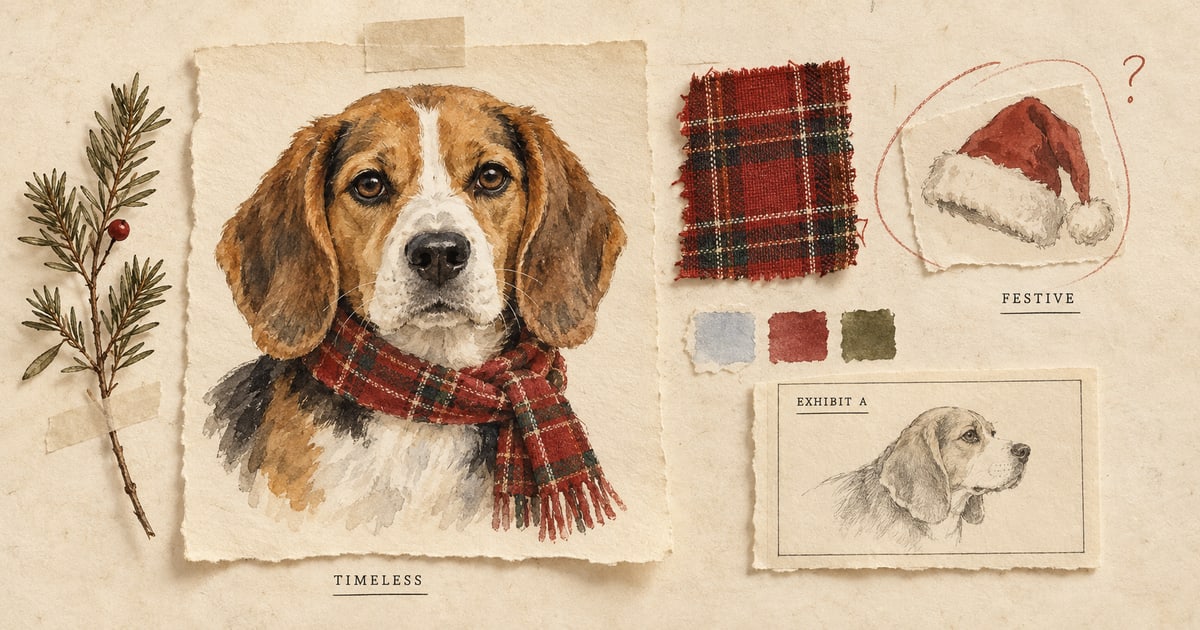
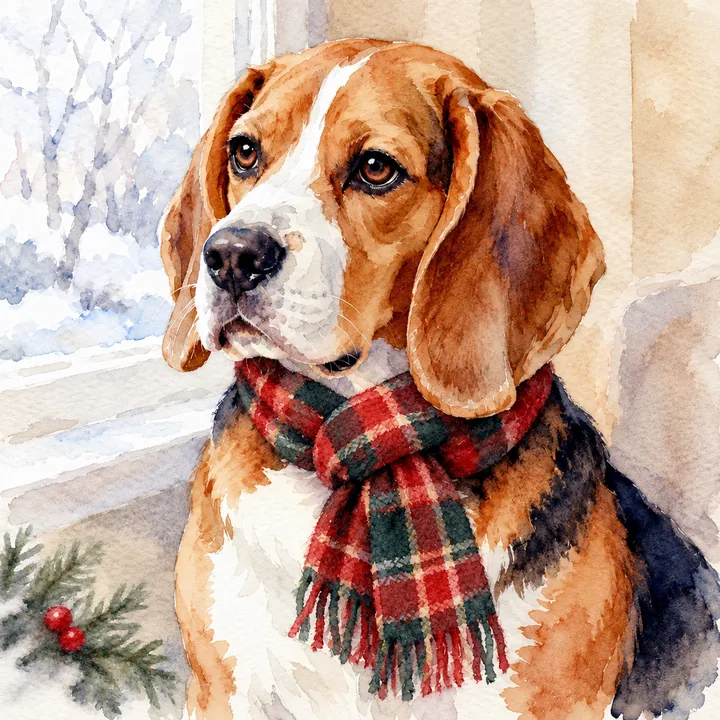
Make it festive, but only a little. Ask for one winter accent the dog could wear or sit near on any cold day: a red collar, a plaid scarf, a sprig of greenery at the edge of the frame, cold light from a window. Leave the costume out.
The reason fits in one line. The tree comes down in January, and the portrait stays up the other eleven months.
What January does to Christmas
Ipsos ran its poll from December 9 to 11, more than two weeks before Christmas. The answer was already January. Many people keep an older rule, too. Writing for Countryfile, Pat Kinsella notes that “many people still hold with the superstition that festive decorations must be taken down by 6 January, the twelfth day after Christmas Day.”
So in a lot of houses, by the second week of January, December is back in boxes. The ornaments are back in newspaper. The lights are knotted in a bin in the closet. The wreath is off the door, and the door is bare again.
The portrait is still on the wall. It’s there in March, when the window light goes flat and white. It’s there in July, over a couch with the air conditioner running. If the dog in it is wearing a Santa hat, the hat is there in July too.
A Christmas gift gets opened on one morning. A portrait gets looked at for years, mostly in months that aren’t December.
The Christmas pictures that lasted
It’s fair to ask whether the Christmas pictures people remember were full of Christmas. The two best-known early ones weren’t, really.
In 1843 Henry Cole had a Christmas card made. According to the V&A, he “commissioned a printer to transfer the design onto cards, printing a thousand copies.” The centre of the design showed “three generations of the Cole family raising a toast in a central, hand-coloured panel.” It was “offered for sale at a shilling a piece, which was expensive at the time,” and “the venture was judged a commercial flop.” People still know it as the first commercial Christmas card. What sits in the middle of it is a family holding up their glasses.
In 1886 Louis Wain drew “A Kitten’s Christmas Party” for the Christmas Number of the Illustrated London News, volume 89, page 24. Wikipedia says that “his fame became established with the publication in the 1886 Christmas edition of The Illustrated London News of his first drawing of anthropomorphised cats.” The V&A’s record of the drawing describes it in four words: “Eleven drawings of kittens.”
Both pictures were made for Christmas. In both, who is in the picture fills the middle of it. A family, glasses raised. A crowd of kittens. The season is the occasion, and the faces are why anyone still looks.
What a Santa hat does to the likeness
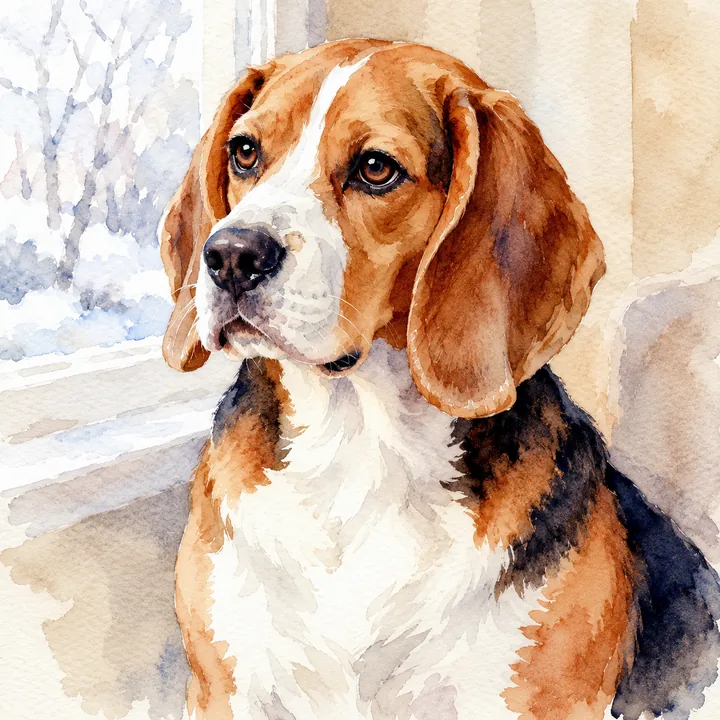
Start with the outline. Much of a dog’s outline is the ears and the top of the head: how high the ears sit, how wide apart, whether one folds and the other doesn’t, the slope from the forehead back to the skull. That’s the part your sister would pick out from across a dog park.
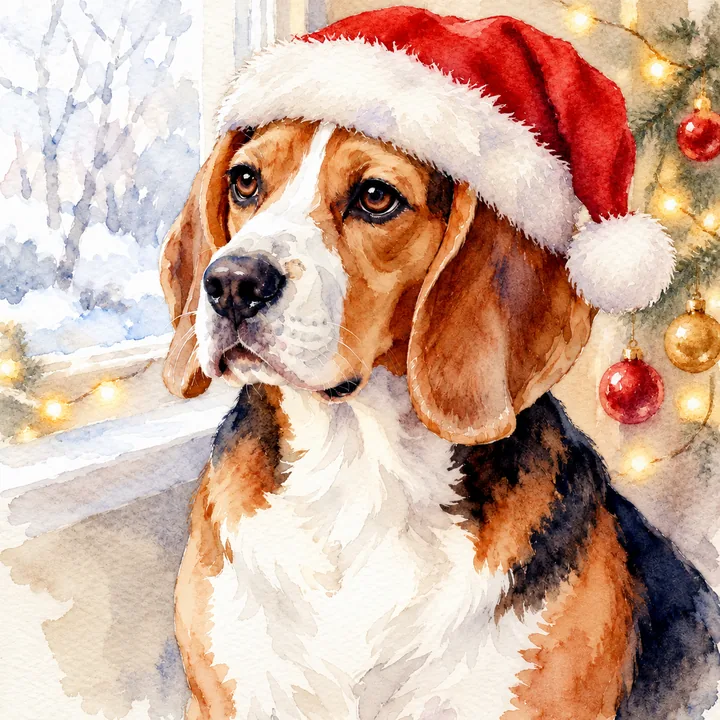
A Santa hat sits right there. The hat goes on, and it covers the top of the head. The white brim runs across the forehead, where a stripe or a blaze or a pale spot usually is. The pom-pom hangs off one side, about where an ear should be.
From a distance it looks fine for about a second. Then you see that the ears, the one feature that sets her dog apart from every other brown-eyed dog, are under red cloth. The face below keeps a perfectly level expression and does its best.
The eyes and muzzle can only do so much without the frame around them. Lots of dogs have brown eyes and a dark nose. Not many have your sister’s dog’s ears. Take those away, and what’s left is a nice picture of a dog in a hat. It may not quite be her dog.
The likeness lives in the face and the markings, and the festive part should never cover them.
What to ask for instead
The accents that survive January all sit away from the face.
A collar or a scarf sits below it. A red collar reads as Christmas in December and as a red collar in April. A plaid scarf reads as a cold day. Either one leaves the ears, forehead and eyes alone, and gives the bottom of the portrait some color.
Greenery or a ribbon goes at the edge of the frame. A sprig of pine in one lower corner. A loop of ribbon along the side. They’re small, off to the side, and easy to look past once the holidays are over.
Light works too, and it’s the quietest choice. Winter light through a window reads cold, blue-white, a little hard on the side of the face it reaches. If the original photo is a dog lying by a window in December, that light is already a winter picture. It doesn’t need anything added.
Then there’s color. Red is strong. Next to a red or orange coat, a red collar or red ribbon competes with the fur, and the two reds blur together. A golden or rust-colored dog often looks better with green, plaid, or nothing. Next to a black, white or grey coat, red stands out cleanly, and a small amount goes a long way.
If the portrait is a pencil sketch, keep it simpler still. A sketch can carry one colored accent, such as a red collar against the grey lines, or none at all. One is plenty.
When the hat is the right call
Some people want a picture that only goes up in December. They have a box for it, next to the stockings, and it comes out the day after Thanksgiving every year. If your sister is that person, the costume is the right call. Ask for the hat.
Just ask for it to sit back on the head, or off to one side, so the ears stay clear and the forehead shows. The dog can wear the hat as long as it’s still recognizably her dog under it.
Putting it in the order notes
The order form has an optional notes field, filled in before checkout, and that’s where this gets decided. Write it in one plain sentence, something like a request for a red collar, no hat, and the ears left clear. Then look for it on the proof and ask for it smaller or gone if it competes with the face, since revisions are included before approval. Check the Christmas order-by dates before you start.
Eleven drawings of kittens
Wain drew “A Kitten’s Christmas Party” in wash and pencil. It ran in a Christmas number, for a Christmas audience, and it made his name.
In 1914 Sir William Ingram gave the drawing to the V&A. The record lists the volume, the page, and the medium. It describes the drawing as eleven drawings of kittens.
Sources
Welcome perk
Free expedited delivery on your first portrait
Get your digital proof in 1-2 business days instead of 2-3, free on your first portrait. Normally a $10 upgrade.
No spam. Just the perk and the occasional new style or guide.
Check your inbox for your code.