Pat Goodmann, a wolf researcher at Wolf Park in Indiana, spent years observing a specific pattern: a wolf finds something strongly scented, rolls in it with obvious intensity, returns to the pack, and the other wolves immediately investigate the roller’s fur. Then some of them go find the source and roll in it themselves. She described this in detail across multiple published observations in the 1980s and 1990s, and her notes built the most credible hypothesis currently available for why dogs and wolves do one of their most universally despised behaviors.
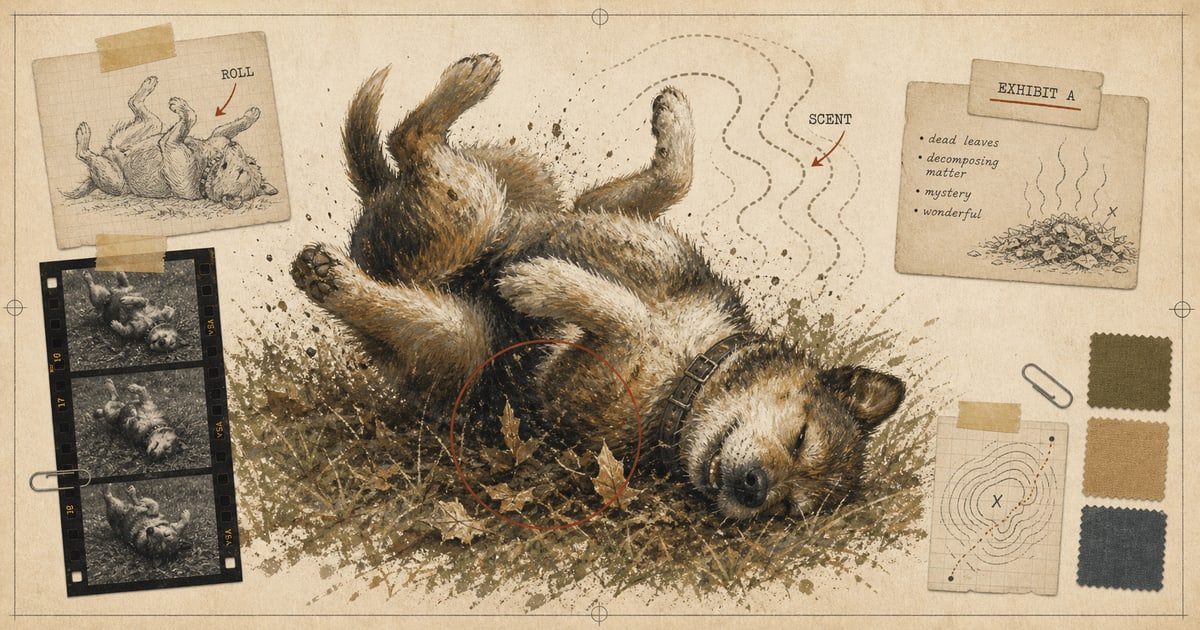
The behavior itself is unmistakable. The dog locates something dead, or fermented, or otherwise deeply offensive to human sensibilities. It does not eat it. It lowers one shoulder, drops the side of its neck and face into the substance, and grinds with something approaching religious devotion. The back may get involved. The eyes go half-shut. The expression is the closest a dog ever gets to serene. Then the dog stands, shakes once, and trots back to you wearing what it has found like an announcement.
You are now bathing the dog. The dog cannot understand why.
The anatomy of the behavior
Before the hypotheses, it helps to know what the behavior looks like across species and what that distribution implies. Wolves do it. Coyotes do it. Foxes do it. Domestic dogs of every breed and size do it. A toy poodle in a suburban backyard and a timber wolf in Manitoba are running the same motor program when they lower a shoulder into something rotting. The behavior is conserved across Canidae, which means it is genuinely old and was almost certainly adaptive in the ancestral environment.
The motor pattern is specific: it is not just lying down. The dog positions the neck and shoulder as the primary contact point, then works the cheek, then sometimes the back and flank. It is directional, targeted, and distinct from scratching or rolling for dryness. The animal often sniffs the source extensively before rolling, pauses, and may return to sniff and roll again in separate passes. This is not an accidental behavior. Something triggers it, and then it runs.
The information hypothesis: bringing news home
Goodmann’s observations at Wolf Park support what has come to be called the social information hypothesis. When a wolf rolls in a novel scent and returns to the pack, the other wolves’ response is not disgust. It is intense olfactory interest. They read the roller’s fur. Some then backtrack the roller’s path to find the source. In a hunting social context, this is meaningful: a pack member who has located carrion, a territorial marker from a rival pack, or something else worth investigating can broadcast that information via scent on their own body without having to lead the others there directly.
This framing does not require conscious intent. The wolf does not think “I will carry this news home.” The behavior just needs to have produced useful outcomes often enough, over enough generations, to be preserved. If the wolves that rolled in interesting scents helped their pack locate food sources more efficiently than wolves that did not, rolling got selected for.
Domestic dogs preserve the behavior even in contexts where it cannot serve this function, because there is no pack to inform and no territory to navigate. The motor program is still present. When one dog in a multi-dog household rolls in something and returns, the other dogs investigate intently. The behavior still triggers the response it was designed to trigger. The function just has no downstream payoff in a house.
The camouflage hypothesis: covering the hunter’s scent
The older hypothesis, and the one most people have heard, is that rolling in prey scent masks the predator’s own odor. A wolf that smells like elk droppings is harder for an elk to detect than a wolf that smells like a wolf. The disguise could provide the approach advantage that makes the difference between a successful hunt and a missed one.
This is an intuitively satisfying explanation and it has been in the literature for a long time. The problem is that the predicted behavior does not match the observed behavior. If scent camouflage were the function, the choice of substance should be strategic: roll in what your prey smells like. But wolves and dogs roll in everything. Decomposing fish. Fox scat. Engine oil. Human food waste. Perfumes. None of these substances provide relevant camouflage for any prey species. If a wolf is hunting elk and it rolls in fox droppings, the camouflage hypothesis has no explanation for that choice.
Coppinger and Coppinger note this problem in Dogs: A Startling New Understanding of Canine Origin, Behavior & Evolution, pointing out that the hypothesis presupposes a strategic selectivity that the actual behavior does not show. The camouflage explanation may apply in some subset of cases. As a complete account, it does not fit.
The sensory pleasure hypothesis: it just feels good
The third hypothesis is the least flattering and, for that reason, rarely gets the attention it probably deserves. Strong olfactory stimulation may simply be pleasurable for an animal whose primary sensory channel is its nose.
Consider what the dog’s olfactory system actually is. Dogs have roughly 300 million olfactory receptors to a human’s six million, and the brain region devoted to analyzing smell is proportionally forty times larger. Scent is the dog’s dominant mode of experiencing the world. Where humans process reality primarily through vision, dogs process it primarily through olfactory information. For this kind of brain, encountering a powerful, complex scent is not just informative. It may be intensely stimulating in a way that has no human analogue.
The behavioral profile of scent rolling is consistent with an animal experiencing something rewarding for its own sake. The intensity of engagement. The repeated passes. The obvious focus. The half-closed eyes. These are not signs of an animal doing a job. They match the behavioral signature of an animal doing something it finds highly reinforcing.
Behaviors that are intrinsically rewarding tend to be resistant to suppression. Punishing a dog after the fact accomplishes nothing because the reward of the rolling has already been delivered. The dog does not connect the punishment to the behavior that caused it hours ago, and even if it did, the sensory payoff of rolling is immediate and high. This is why management, not correction, is the practical answer.
What the uncertainty actually looks like
These three hypotheses are not mutually exclusive. The proximate mechanism (it feels good, which is why the behavior gets performed and repeated) can coexist with a distal evolutionary function (it transmits information, or masks scent, or both). Behaviors regularly have multiple explanations at different levels of analysis.
What is worth being honest about is that none of these hypotheses has been tested with the kind of controlled experiments that would resolve the question definitively. Goodmann’s wolf-park observations are detailed and credible, but they are naturalistic observations, not controlled experiments with matched conditions. The camouflage hypothesis has intuitive appeal but no supporting data. The pleasure hypothesis fits the behavioral data but has not been examined neurologically.
The AKC, Patricia McConnell, and most serious dog behaviorists land somewhere in the “we’re not certain, but information-transfer is the most plausible” camp. That is probably the right epistemological position: lean toward Goodmann’s explanation, acknowledge the others, hold the whole thing loosely.
What to do about it
The practical answer is management. Dogs that roll in things do not stop because you express disappointment. The behavior is deeply reinforced and, from the dog’s perspective, entirely appropriate. Watch for the specific pre-roll sequence: the dog locates something, stops, stiffens slightly, lowers the nose to sniff, then begins shifting weight toward the shoulder. That shoulder-dip moment is your window. A leash prevents the completion of the sequence before it can deliver its reward.
Known triggers depend on your environment. Beach walks produce dead fish. Trail walks in spring produce fox and coyote scat. Any area with wildlife produces carrion. On a long, off-leash walk in wooded terrain, accept that you may be bathing the dog when you get home. This is the price of owning an animal whose nose is running a completely different operating system than yours.
The bath removes the smell. It appears to have no effect whatsoever on the behavior.
There is something worth noticing in the gap between your reaction to what the dog just did and the dog’s expression while doing it. The dog was completely absorbed, focused, and satisfied. You are annoyed and reaching for the shampoo. The dog experienced this event as a high point. The olfactory world your dog occupies is one you cannot enter and cannot entirely police. Rolling in something terrible is, from inside that world, a reasonable thing to do.
A dog mid-roll is not a portrait subject; the face is buried. But the moment before, when the dog has located the source and is investigating with ears forward and complete attention, is one of the most honest and specific expressions a dog makes. A custom pet portrait catching that alert-and-investigating look captures something real about who the animal is when it thinks no one is watching. Those are often the truest pictures.
Sources
- Goodmann, P. A. “Scent rolling in wolves.” Wolf Park field reports, 1989-1994.
- Coppinger, R., and Coppinger, L. Dogs: A Startling New Understanding of Canine Origin, Behavior & Evolution. Scribner, 2001.
- Horowitz, A. Inside of a Dog: What Dogs See, Smell, and Know. Scribner, 2009.
- McConnell, P. The Other End of the Leash: Why We Do What We Do Around Dogs. Ballantine, 2002.
- Mech, L. D., and Boitani, L., eds. Wolves: Behavior, Ecology, and Conservation. University of Chicago Press, 2003.
- Craven, B. A., Paterson, E. G., and Settles, G. S. “The fluid dynamics of canine olfaction: unique nasal airflow patterns as an explanation of macrosmia.” Journal of the Royal Society Interface 7, no. 47 (2010): 933-943.
Welcome perk
Free expedited delivery on your first portrait
Get your digital proof in 1-2 business days instead of 2-3, free on your first portrait. Normally a $10 upgrade.
No spam. Just the perk and the occasional new style or guide.
Check your inbox for your code.