
In 1999, archaeologists excavating a Neolithic village site at Quanhucun in Shaanxi Province, China, found the bones of two cats buried deliberately near human remains. Carbon dating placed the site at roughly 5,300 years ago. The cats were Prionailurus bengalensis, leopard cats, not the Near Eastern wildcat (Felis silvestris lybica) that gave rise to all domestic cats. The researchers, led by Yaowu Hu of the Chinese Academy of Sciences, found stable isotope evidence suggesting the cats had been eating millet-based foods, meaning they were living partly off the agricultural settlement’s food supply and pest populations. One of the leopard cats appeared to be elderly, an animal that had been kept and fed well past its natural peak hunting condition.
The finding complicated the established domestication narrative considerably. The consensus view had been that cat domestication occurred once, in the Near East, around 10,000 years ago, coincident with the rise of grain agriculture in the Fertile Crescent. Hu’s discovery suggested that in China, a completely separate felid species had independently entered the same commensal relationship with farmers thousands of years later, filling the same ecological niche.
What is notable about this is what it says about the job. The cat’s original working relationship with humans was not created by human effort. It was created by the nature of the job itself. Wherever humans stored grain, rodents came. Wherever rodents concentrated, small felids followed. The architecture of agriculture kept producing the same outcome in different places with different cats.
The Near Eastern Origin
The standard domestication story begins with Felis silvestris lybica, the African wildcat, in the Fertile Crescent roughly 10,000 years ago. The genetic evidence, particularly the landmark 2007 study by Driscoll and colleagues published in Science, established that all domestic cats descend from a single Near Eastern wildcat population. The transition from wild hunting cat to something approaching domestic cat happened in the context of early farming settlements, where rodent control was not a perk but an economic necessity.
Stored grain was wealth. Rodent damage to stored grain was catastrophic in a subsistence economy. A small felid predator capable of controlling rodent populations in granaries was worth tolerating, feeding, and allowing to settle nearby, regardless of the cat’s feelings about the arrangement.
The key distinction between cat domestication and dog domestication is the degree of human intervention. Dogs were actively selected, shaped, trained, and given directed work. Their domestication was a collaboration in which humans made decisions about which animals reproduced and what behavior was required. Cats, by contrast, did not need to be trained to hunt rodents. They already did it. The human contribution was largely to build granaries and not interfere.
The result was a domestication that looked different at every stage from the dog model: less morphological change, less behavioral modification, less dependency. Domestic cats and African wildcats are still genetically and morphologically very similar. The cat changed less in the process because the process required less change.
How the Job Traveled
The genetic record traces cat dispersal across the ancient world in two major waves. The first wave, documented in Ottoni and colleagues’ 2017 study in Nature Ecology & Evolution, followed early farming populations out of the Near East through the Mediterranean and central Asia. The second wave, more clearly associated with Egyptian domestic cats, spread through maritime trade routes beginning roughly 1,500 years ago.
The Egyptian phase is significant because it coincided with the cultural and religious prestige cats gained during the Late Period, the centuries of Bastet worship and extensive cat mummification. But the dispersal mechanism was largely commercial. Grain ships needed rodent control. Cats that were willing to work on boats were cargo in the functional sense, animals carried aboard because they were useful.
Roman-period archaeological sites across the Mediterranean, from Britain to North Africa, contain cat remains that carry the genetic signature of Egyptian domestic cats. The cat did not spread by walking. It spread by ship, via the trade routes that connected the ancient world, because ships carried food and food attracted rodents and rodents justified cats.
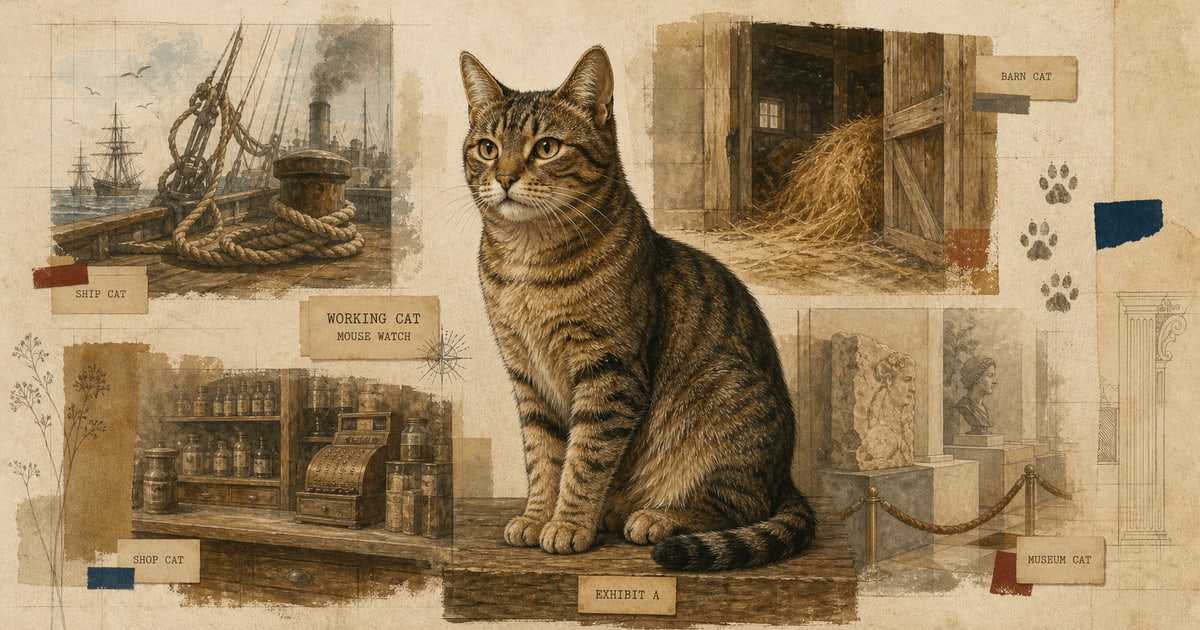
Ship cats were a practical fixture of maritime life for millennia. The Royal Museums Greenwich have documented ship cats as a consistent feature of British naval and merchant vessels, with records going back to at least the medieval period. These animals were not mascots, originally. They were pest management in a context where uncontrolled rodent populations could destroy cargo, damage rigging, and spread disease. That they also became mascots was secondary to the function, though by the nineteenth and twentieth centuries the line between working animal and ship’s personality had blurred considerably.
Simon the Cat, a tabby who served on HMS Amethyst during the 1949 Yangtze Incident, was wounded during shelling, received veterinary treatment, and was later awarded the Dickin Medal, the military honor for animal gallantry. Simon is the only cat to have received it. He was officially listed as a naval rating and given a service record. The Royal Navy, which ran empires and defeated armadas, documented its cat’s rank and commendations. This is the working cat’s historical trajectory in miniature: enters as pest control, exits as an institution.
The Museum Cat Problem
The Hermitage Museum in St. Petersburg is the most famous case of institutional cat culture in the world, but it is not the only one.
The tradition of cats in the Hermitage traces to the eighteenth century, when Empress Elizabeth Petrovna decreed that cats be kept in the palace to control rodents in its art stores and building infrastructure. The decree was practical: a large building containing thousands of rooms, extensive wooden structures, and irreplaceable art needed rodent management. Cats were the available technology.
Over the subsequent two and a half centuries, the Hermitage cats became one of the museum’s defining features, appearing in publications, merchandise, and visitor guides. The museum eventually established a formal cat management program, including veterinary care, a basement facility for the cat colony, and a small budget for their maintenance. The cats are not officially allowed in the gallery spaces, a rule the cats observe when they choose to.
Bookstore cats, library cats, brewery cats, and shop cats follow the same arc. The animal arrives because of a practical problem, often rodent-related, often climate-related in older stone buildings, and over time becomes identified with the institution itself. Customers ask after the cat. The cat appears in reviews. The absence of the cat is noted and lamented. The working function becomes embedded in the institution’s identity in a way that is genuinely difficult to quantify but clearly real.
The most famous bookstore cat in American literary history may be Hodge, the Cat of Wigmore Street, though that is the name of a famous cat in London, not New York. The actual American equivalent was the succession of cats at the Strand Bookstore in Manhattan, each one managing rodents and managing the store’s personality simultaneously.
The Modern Working Cat
Trap-neuter-return programs, increasingly common in urban areas since the 1980s, created a new category of working cat: the feral colony cat whose job is pest control in warehouses, public spaces, shipyards, and commercial properties. The Cats at Work program, operating in Chicago and several other major American cities, formally places working cat colonies in commercial settings and documents their rodent-control efficacy.
The evidence for effectiveness is reasonable though not uniformly rigorous. Studies by Gary Patronek and colleagues have documented rodent population control in settings with managed feral cat colonies. A 2019 study at a Texas veterinary school documented significant rodent reduction following the introduction of working cats. The cats are not achieving exterminator-level control, but they are suppressing rodent populations in ways that matter to food storage operations, where even modest rodent reduction translates to real economic benefit.
The working cat has not been made obsolete by modernization. It has been reclassified, formalized, and in some cases given nonprofit infrastructure. The cat itself has not changed its approach.
What This Means for a Portrait
A working cat carries a different weight than a pampered companion cat, and the portrait should reflect that without turning the animal into a cartoon of roughness.
The barn cat who spent twelve years sleeping in hay and hunting at night has a particular face: often weathered, often notched at the ear from territorial disputes, often extremely composed in the specific way of animals who have managed serious outdoor conditions. That composure is earned and it reads differently than the composed stillness of an indoor cat on a velvet chair.
The shop cat who belongs to a place rather than a person often has a different relationship to the camera: less anxious about attention, more accustomed to strangers, sometimes more relaxed with a direct look. The workplace cat has been evaluated by hundreds of people and found them all acceptable. That is confidence of a specific kind.
For a working-cat portrait, the reference photos that matter most are: one clear face photo in natural light, one full-body shot showing the cat’s actual build and coat, and one environmental photo that establishes the context. The environmental photo does not need to be beautiful. It needs to be honest: the barn doorway, the counter, the loading dock, the office chair that was technically meant for a person. The artist can abstract or simplify the background. But without knowing the context, the portrait risks becoming generic, a good painting of a cat rather than a portrait of this cat and what it did.
The working cat has always lived in the gap between utility and personality. It arrived to do a job. It stayed because it became impossible to imagine the place without it. That is a kind of loyalty, delivered entirely on the cat’s own terms.
Sources
- Yaowu Hu et al., “Earliest evidence for commensal processes of cat domestication,” PNAS, 2014.
- Carlos Driscoll et al., “The Near Eastern Origin of Cat Domestication,” Science, 2007.
- Claudio Ottoni et al., “The palaeogenetics of cat dispersal in the ancient world,” Nature Ecology & Evolution, 2017.
- Royal Museums Greenwich, “Simon the cat, HMS Amethyst,” collections and maritime history documentation.
- Hermitage Museum, “The Hermitage Cats,” institutional history.
- Gary Patronek, “Free-Roaming and Feral Cats: Their Impact on Wildlife and Human Beings,” Journal of the American Veterinary Medical Association, 1998.
- Zach Shumpert et al., “The impact of a managed cat colony program on rodent activity in a large urban university,” Frontiers in Ecology and Evolution, 2019.
Welcome perk
Free expedited delivery on your first portrait
Get your digital proof in 1-2 business days instead of 2-3, free on your first portrait. Normally a $10 upgrade.
No spam. Just the perk and the occasional new style or guide.
Check your inbox for your code.