In 1959, Walt Disney’s animators had a technical problem, and it looked exactly like a Dalmatian: too many spots, in shapes that never repeat, needing to land in the same place on the same dog in every single frame it appeared in. An animator named Ub Iwerks had spent years chasing a fix, wiring a modified photocopier into the production line so a pencil drawing could transfer straight onto a clear plastic cel without a person re-inking every line by hand. The process, xerography, got a small tryout in the thorn forest of Sleeping Beauty that year and a fuller test in Goliath II the next. By 1961, Disney used it for most of the animation in One Hundred and One Dalmatians, the first film the studio had ever attempted with an entire cast of patterned animals.
The timing wasn’t an accident. Disney was in financial trouble after Sleeping Beauty underperformed at the box office, and animator Chuck Jones later said the studio finished 101 Dalmatians for roughly half of what hand-inking every dog, and every one of its spots, would have cost by traditional methods. Art director Ken Anderson pushed the process further than a drawing shortcut: he ran it straight onto the transparent cels themselves, then worked with color stylist Walt Peregoy to layer that graphic black linework over flat painted backgrounds. That combination, xeroxed line over painted color, is why the film still looks unlike anything else Disney made before or after it.
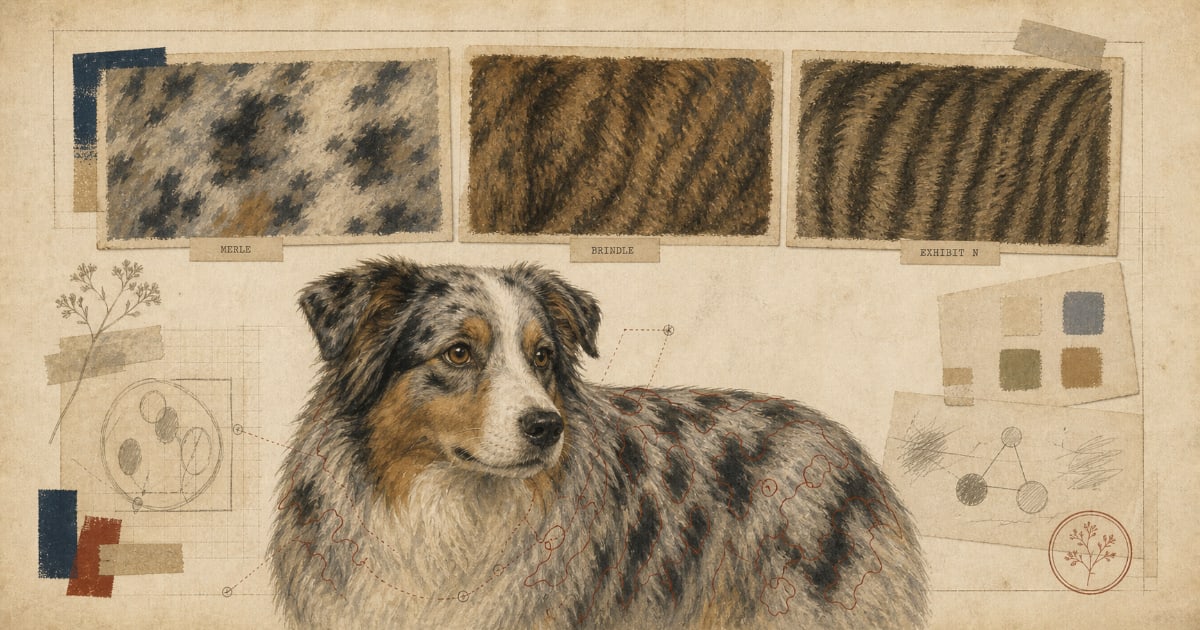
Anime inherited the same problem Disney solved with a photocopier, and mostly it still solves it the same way: by simplifying. A pattern that repeats, a solid coat, an even pair of ears, costs nothing extra to redraw a thousand times. A pattern that doesn’t repeat is expensive in exactly the way a Dalmatian was expensive in 1959. Every cel needs its own version of it, drawn by hand or governed by a model sheet precise enough that dozens of different animators land the same blotch in the same place. Digital ink and paint removed the physical cel decades ago, but it didn’t remove the underlying cost. Flat color regions bounded by clean lines are still cheaper to keep consistent than an irregular pattern is, which is a production fact before it’s ever an aesthetic one. Merle, brindle, and tabby are three separate, well-documented genes, and each one breaks that cheap consistency in a different way.
The mutation behind the blotches
Merle looks like an accident of paint, but it has an address. In 2006, Leigh Anne Clark, Jacquelyn Wahl, Christine Rees, and Keith Murphy sequenced the DNA of merle dogs and found a short piece of mobile genetic material, a SINE retrotransposon, sitting exactly at the boundary between intron 10 and exon 11 of a gene called SILV, on the dog’s tenth chromosome. Their paper ran in the Proceedings of the National Academy of Sciences, and the same insertion turned up again and again across breeds that share almost no recent ancestry: Shetland Sheepdogs, Border Collies, Australian Shepherds, Dachshunds, Great Danes, Catahoula Leopard Dogs, and Chihuahuas among them. It’s one mutation, appearing independently across a family tree that otherwise has little in common, which is why a merle Australian Shepherd’s gray-and-black patchwork and a merle Dachshund’s liver-and-tan version are the same genetic event wearing two different base coats.
A 2018 follow-up by Langevin, Synkova, Jancuskova, and Pekova sorted merle alleles by how long that inserted stretch of DNA actually runs, and found roughly six functional categories, ranging from no visible effect at all up to full classic merle. Length matters because merle is incompletely dominant. One copy produces the pattern. Two copies produce something more extreme, and that “more extreme” is where the genetics stops being decorative.
A switch, not a shape
Brindle isn’t a variant of merle and doesn’t behave like one. In 2007, a team including Stanford’s Gregory Barsh identified the gene behind it as CBD103, a beta-defensin sitting at an entirely separate part of the genome, the K locus. Its protein binds to the melanocortin 1 receptor, the same receptor that switches a hair follicle between producing dark eumelanin and lighter pheomelanin. Brindle striping is that switch flipping on and off, hair by hair, across the coat, which is why a brindle Boxer looks striped rather than blotched. Merle breaks a pattern into patches. Brindle breaks a color into a rhythm.
That distinction is a different kind of problem for a stylized medium than merle is. A blotch can be simplified into fewer, larger blotches without losing the read entirely. A stripe pattern running at the scale of individual hairs can’t be simplified the same way. It either gets reduced to a handful of graphic stripes standing in for the whole coat, or it gets dropped in favor of a solid base color with a suggestion of texture underneath. Both are real decisions an artist makes on purpose, not an accident of laziness.
The gene that also makes a king cheetah
Tabby cats are the same category of problem again, with a better punchline. The mackerel stripe, thin and vertical, the ancestral pattern, versus the classic blotched swirl, thick and curved with a bullseye on the flank, comes down to a single gene called Taqpep, identified in a 2012 Science paper by a large team led by Christopher Kaelin and the same Gregory Barsh from the brindle paper five years earlier. Taqpep lays down a periodic pre-pattern in the skin before birth, and a second gene, endothelin 3, sustains it through every hair-growth cycle afterward. Specific loss-of-function mutations in Taqpep, ones the paper names directly, labeled W841X and S59X, turn the ancestral mackerel stripe into the thick blotched swirl seen on roughly four out of five tabby cats today, including a Maine Coon curled up on a windowsill.
Here’s the part worth remembering: the same gene, mutated a different way, produces the king cheetah, a rare wild cheetah with blotches and stripes replacing its normal even spotting. Kaelin’s team found a specific frameshift mutation, labeled N977Kfs110, tracking precisely with the king phenotype in captive cheetahs. The gene deciding whether a random house cat gets narrow stripes or wide swirls is the same gene deciding whether a cheetah, an entirely different species in the cat family, gets ordinary spots or a coat rare enough to have earned its own name.
Getting the double merle statistic right
None of this is only decorative. Breed two merle dogs together and, by ordinary Mendelian odds, about a quarter of the resulting litter inherits two copies of the SILV insertion instead of one, a condition called double merle. Double merle carries a real cost. A 1977 study of Dachshunds by Reetz, Stecker, and Wegner is the source most often cited for what that cost actually looks like: 54.6% of double-merle dogs showed some degree of deafness, with 9.1% deaf in both ears, against no such findings in the non-merle dogs studied alongside them. A later, unpublished study across five more breeds, Shetland Sheepdogs, Australian Shepherds, Collies, Great Danes, and Catahoula Leopard Dogs, found comparable numbers. The mechanism traces back to melanocytes, the same pigment cells that build coat color and separately handle unrelated development work inside the eye and inner ear. Suppress them for the sake of a pattern and a dog can end up with eye defects and hearing loss for the identical underlying reason. The UK Kennel Club stopped registering puppies from merle-to-merle breedings in 2013 specifically over this risk.
It’s worth being precise about what that does and doesn’t mean. A single-copy merle dog, the kind almost every merle pet actually is, isn’t unhealthy because of its pattern. The risk sits specifically in pairing two merle carriers, deliberately or by accident, not in the pattern itself. An earlier post on photographing these coats goes further into that distinction, and into getting even light on a coat like this in the first place.
What an anime portrait keeps
None of this means an anime portrait owes a coat photographic accuracy it can’t structurally deliver, and it doesn’t need to. A cel-shaded style built on clean lines and a handful of flat tones was never going to reproduce every hair-level shift a real coat performs. What it can do, and what a rushed or generic version won’t bother with, is keep the actual shape of your actual pattern: where the merle patches genuinely sit, which side the brindle stripes run heavier, whether the tabby’s blotches meet in that particular bullseye on the flank. That’s the gap between an anime portrait that reads as a stylized version of your specific pet and one that reads as a stylized version of “a spotted dog.” The anime style page has more on how that translates from a reference photo. The pattern staring back from the photo you send in isn’t random, and neither is the amount of work it takes to draw it the same way twice.
Sources
- Clark, L.A., Wahl, J.M., Rees, C.A., & Murphy, K.E. “Retrotransposon insertion in SILV is responsible for merle patterning of the domestic dog.” Proceedings of the National Academy of Sciences, 2006, 103(5): 1376-1381. doi.org/10.1073/pnas.0506940103
- Candille, S.I., et al. “A β-Defensin Mutation Causes Black Coat Color in Domestic Dogs.” Science, 2007, 318(5855): 1418-1423. PMID 17947548.
- Kaelin, C.B., et al. “Specifying and Sustaining Pigmentation Patterns in Domestic and Wild Cats.” Science, 2012, 337(6101): 1536-1541. doi.org/10.1126/science.1220893
- Wikipedia, “Merle (dog coat)”
- Wikipedia, “101 Dalmatians (1961 film)”
- Wikipedia, “Tabby cat”
Welcome perk
Free expedited delivery on your first portrait
Get your digital proof in 1-2 business days instead of 2-3, free on your first portrait. Normally a $10 upgrade.
No spam. Just the perk and the occasional new style or guide.
Check your inbox for your code.