
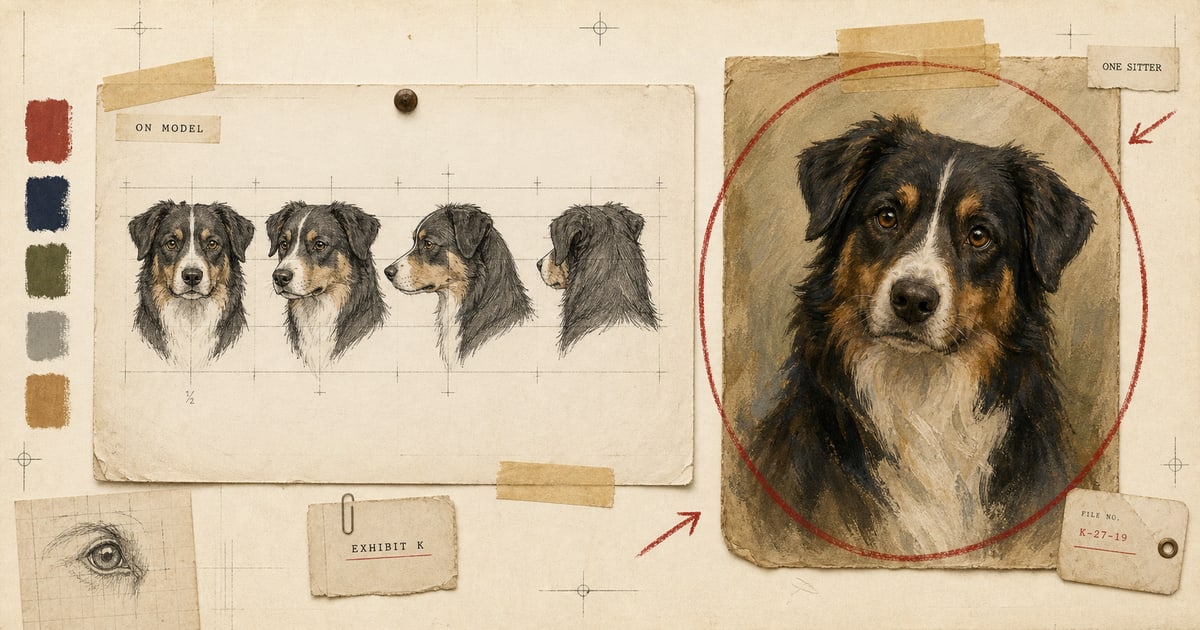
A model sheet for an anime character usually shows the same person four times: front, back, profile, three-quarter. Then a page of expressions, calm through furious. Then a page of hands, and sometimes feet, and how the hair behaves in wind versus stillness. It gets handed to every animator who will touch the production, sometimes hundreds of people across one season, and its entire purpose is to guarantee that the drawing on episode nineteen matches the drawing on episode two, made by someone who has never met whoever designed the character in the first place. The Japanese production term for this document is settei, “setting,” the same idea as the setting on a dial. It sets the character so other people can reproduce her.
The document built to survive being copied
The industry shorthand for getting this right is “on model”: every drawing looks like it came from one hand, even though hundreds of hands touched it. One of the checks animators use is almost insultingly simple. Black out the character, kill every interior line, and ask whether the pose still reads as that character rather than some other blob with the same outline. This is the silhouette test, part of the “staging” principle inside the twelve principles of animation that Disney animators Frank Thomas and Ollie Johnston set down in their 1981 book The Illusion of Life: Disney Animation. A character that fails the silhouette test is not a character yet. It is a drawing that happens to be labeled with a name, waiting for someone to make the name true.
A portrait is built to do the opposite
A portrait’s job is the reverse of a model sheet’s job, not almost the reverse, exactly the reverse. A model sheet exists to be copied. A portrait exists to be about someone who cannot be copied at all. The art historian Shearer West spent her 2004 book Portraiture, in the Oxford History of Art series, on how painters negotiate what she called the problems of representing identity, when the entire premise of the exercise is that the identity sitting in front of them is singular and will not sit for anyone else, ever again. Richard Brilliant made a version of the same argument in 1991, in Portraiture, described by its publisher as the first general theoretical study devoted to the genre, tracing the negotiation between one sitter and one beholder across a range that runs from Botticelli through Rembrandt to Warhol. Neither writer had any reason to think about anime. But the shape of the problem they were describing is the shape of the problem an anime pet portrait has to solve, aimed at a different kind of subject.
There is a philosopher who drew the line more bluntly than either art historian did, though she was writing about characters in novels and plays, not paintings or cartoons. Amélie Rorty, in a 1976 essay collection called The Identities of Persons, separated what she called “characters” from what she called “figures” or “selves.” Characters, in her account, are built from pieces that can be recombined and repeated, which is why, in her words, “a society of characters is in principle a society of repeatable and indeed replaceable individuals.” Figures and selves are not repeatable. They are not assembled from parts that could be reassembled into someone else. Nobody, as far as the available scholarship shows, has made the specific move this piece is making, lining up an animation studio’s character design system against a philosopher’s definition of a non-repeatable self. That move is the argument here, not a reported finding. It is built out of Rorty’s real distinction and a set of checkable facts about how anime gets made. A model sheet manufactures a character in exactly the sense Rorty meant: repeatable, on purpose, by design. Your dog is a figure in her other sense. There has only ever been one of him, and there will not be another.
What anime’s compression is actually solving
So what is a good anime design actually doing, mechanically, when it works. It is compressing an individual into the smallest set of graphic marks that will still read as that individual from across a room, redrawn by a stranger, twenty episodes later. A particular eye shape. A hair silhouette that registers before the face does. A color block, a scar, an accessory that never moves no matter what the scene demands. Toshihiro Kawamoto designed the four leads of Cowboy Bebop, the Sunrise series that began airing on TV Tokyo in April 1998, specifically so the audience could tell four different people apart at a glance inside one crowded frame. That is a recognition problem, solved through economy of information. A pet portrait has the same recognition problem running in the opposite direction. Nobody needs to tell your dog apart from three other characters sharing his shot. They need to look at the finished piece and know, immediately, in a way that would mean nothing to anyone else in the room, that this is unmistakably him and not a competent drawing of a Labrador.
Portraiture has always been the smaller genre
Portraiture has needed to defend this distinction for centuries, because there has always been institutional pressure to make it into something more generic than it is. When the French Académie Royale de Peinture et de Sculpture ranked the categories of painting in 1648, portraiture came in second, below history painting, above landscape, genre scenes, and still life. History painting sat on top because it dealt in things that could be restaged by any sufficiently skilled hand: gods, allegories, a moral scene anyone could repaint with different faces and lose nothing essential. Portraiture ranked lower precisely because it was tied to one actual person and refused to generalize into a lesson. That demotion was the insult built into the ranking, and it is also, nearly four hundred years later, the entire reason a portrait is worth commissioning at all. Nobody hangs a painting of an idea over the mantel. They hang a painting of somebody.
The animator who broke his own model sheet
Anime’s own history contains an argument against its own discipline, and it is worth sitting with rather than smoothing over for a tidier thesis. Yoshinori Kanada, a key animator on Galaxy Express 999 in 1979 and later a collaborator of Hayao Miyazaki’s from Nausicaä of the Valley of the Wind through Princess Mononoke, became influential specifically for breaking model. His drawings were recognizably his, frame to frame, show to show, in a medium built to erase exactly that kind of personal signature. He got influential enough that his loose, expressive linework is credited as one of the inputs into Takashi Murakami’s Superflat art movement decades later. Kanada wanted the drawing to look like him. A pet portrait asks an artist to do something closer to the reverse: not to impose a personal signature onto a shared character, but to bend a shared stylistic language, cel shading, graphic eyes, clean confident line, around one animal who has never been drawn before and belongs to no one else’s model sheet.
The same tool, aimed at the opposite problem
That is the actual case for anime as a pet portrait style, and it has nothing to do with anime being cute or currently fashionable, both of which happen to be true and neither of which is the interesting part. Anime is a drawing system engineered, feature by feature, across decades of weekly television production, to answer one question: what is the smallest number of marks that will make a stranger recognize this specific individual on sight, every time, regardless of who is holding the pen. That is not the toolkit portraiture usually reaches for. Oil paint was never asked to survive being redrawn by a hundred different hands. It turns out to be exactly the toolkit a pet portrait needs anyway, because the actual task, whether you are Kawamoto keeping four bounty hunters legible in one frame or an artist working from a photo of somebody’s dog, is the same task: find the handful of details that are non-negotiably this one animal, and refuse to let go of them no matter what else in the drawing changes. Anime and oil painting are simply making different choices about how many of those details to keep versus how much of the surrounding world to render.
The strange part is which half of the equation turns out to be more fragile. A model sheet exists because a studio assumes its character will be redrawn thousands of times and needs a system engineered to survive that. A dog gets drawn once, or a handful of times, by people who love him, and then he is gone, and the drawings are what remains. Anime’s design conventions have their own logic about faces and bodies built to survive infinite repetition. Nobody built anything to survive the opposite problem: a subject with no repetitions left at all. It just turns out the same tool works for both.
Sources
- Model sheet, Wikipedia
- Portraiture (Oxford History of Art) by Shearer West, Oxford University Press, 2004
- Portraiture by Richard Brilliant, Reaktion Books, 1991
- Amélie Rorty, “The Identities of Persons” (1976), discussed in “What Makes a Person”, The Marginalian
- Yoshinori Kanada, Wikipedia
- Toshihiro Kawamoto, Wikipedia
Welcome perk
Free expedited delivery on your first portrait
Get your digital proof in 1-2 business days instead of 2-3, free on your first portrait. Normally a $10 upgrade.
No spam. Just the perk and the occasional new style or guide.
Check your inbox for your code.