
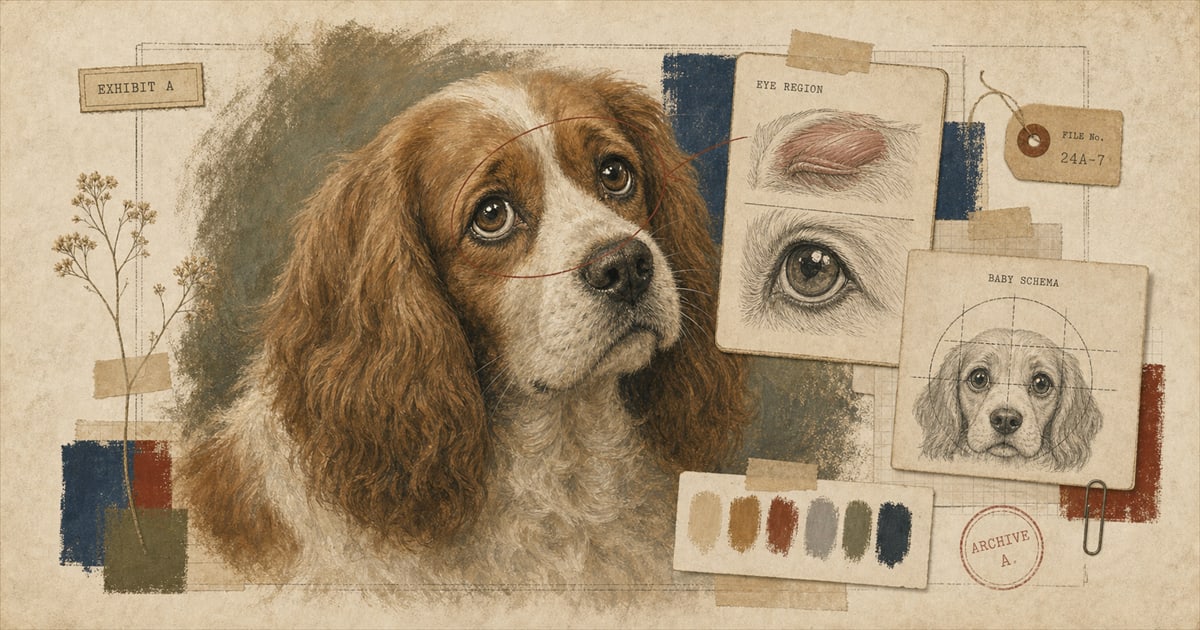
In 2008, a team led by the Oxford neuroscientist Morten Kringelbach put twelve adults into an MEG scanner, a machine that reads the brain’s magnetic activity fast enough to catch a thought forming in real time, and showed them a series of infant and adult faces matched for emotion, size, and attractiveness. A patch of orbitofrontal cortex lit up in response to the baby faces in about 130 milliseconds. That’s roughly the time it takes to blink. It’s faster than the brain regions responsible for consciously recognizing what was just seen. The viewer hasn’t decided this is a baby yet. Something older in the machinery already has.
Kringelbach wasn’t testing anime. He was testing a much older idea: the ethologist Konrad Lorenz’s 1943 concept of Kindchenschema, usually translated as baby schema. Lorenz described a specific bundle of features, a large head relative to the body, a high domed forehead, big eyes set low on the face, round cheeks, short thick limbs, a soft rounded build, clumsy movement, and argued that adult humans respond to that whole bundle with an automatic pull toward affection and caretaking, in whatever creature happens to be wearing it. A seal pup qualifies. A human infant qualifies. So, as it turns out, does a mouse in white gloves: a companion piece on this site covers what happened when a paleontologist got out a ruler and measured Mickey Mouse’s face across five decades of official redesigns.
Anime and manga character design didn’t invent big eyes set low on a small face, a domed skull, a chin that barely registers. It kept turning the same handful of dials Lorenz listed, further than a real human face could plausibly go, across a medium built by different studios in different decades, most of them never citing Lorenz or knowing his name.
The reward circuit doesn’t care if the face is drawn
Cuteness is not vague enjoyment. It shows up in the brain’s reward system the same way food or money does. In a 2009 study in PNAS, Melanie Glocker and colleagues digitally morphed 17 real infant faces up and down in baby-schema intensity, building rounder, higher-foreheaded, bigger-eyed versions of the same babies alongside subtler and unaltered ones. Sixteen women with no children of their own rated the images for cuteness while being scanned. Activity in the nucleus accumbens, a core structure in the brain’s reward circuitry, rose in a straight line with how much baby schema a face carried, and the cuteness ratings tracked right along with it, a result strong enough to clear p < 0.001.
That’s the part worth sitting with. This isn’t a soft emotional reaction that happens to correlate with round faces. The reward system treats a sufficiently baby-shaped face the way it treats a win.
Eyes, specifically, do most of the work
A 2022 study in Frontiers in Psychology isolated one variable out of Lorenz’s whole bundle: eye size alone. Lingshan Yao and colleagues digitally enlarged and shrank the eyes in photographs of adults and infants, across positive, neutral, and negative expressions, and had participants rate cuteness. Bigger eyes read as cuter across every age group and every expression tested, independent of forehead height, cheek roundness, or anything else on Lorenz’s list.
That’s the closest thing to direct evidence for the anime half of this argument, and it’s still one study short of the actual claim. Nobody has run that exact protocol on a drawn face instead of a photographed one, and no peer-reviewed study has put an anime character in front of a scanner the way Kringelbach did with infant photographs. What exists is an honest inference, not a measurement: character designers arrived, through decades of trial, error, and audience reaction, at the same lever neuroscientists later isolated with photo-editing software and a survey. Both landed on eye size. Neither started from the other’s work.
Dogs found the lever first
Here’s where the argument stops being purely inferential, because a living animal ran a version of this experiment for us, with no lab involved.
Dogs have a facial muscle called the levator anguli oculi medialis, or LAOM, that gray wolves mostly don’t. A 2019 study in PNAS by Juliane Kaminski, Bridget Waller, and colleagues dissected the facial anatomy of dogs and wolves side by side and found the LAOM routinely present as a full working muscle in the dogs they examined, while in the wolves it showed up as scant, barely-there fibers. That muscle does one specific thing: it raises the inner eyebrow, a movement researchers code as AU101, which makes the eye look larger and the whole expression more infant-like. Mechanically, it’s the same trick the Frontiers in Psychology eye-enlarging study tested on photographs, except a dog performs it on its own face in real time, with a muscle wolves never bothered to keep.
The payoff for the dog is measurable. A 2013 study in PLOS ONE by Waller and colleagues watched 27 dogs across four UK rehoming shelters during two-minute first encounters with a stranger, scoring how often each dog raised its inner brow. The frequency of that single movement predicted how fast the dog got adopted. Dogs who raised their eyebrows around fifteen times in those two minutes were rehomed in about 28 days on average. Dogs who did it around five times took about 50 days. Half the adoption wait, from one small muscle most wolves don’t have.
A character designer reaching for bigger eyes and a shelter dog raising an inner brow aren’t doing the same thing on purpose. One is drawing. The other is 15,000-plus years of humans deciding which animals got fed, sheltered, and eventually adopted off a shelter floor. But both are pulling the same lever, on the same circuitry, found by two processes that never once consulted each other.
Even the researchers argue about the wiring
It would be tidy to stop there: one universal baby-schema circuit, confirmed in labs, independently rediscovered by dog evolution and by manga artists. The actual state of the science is less tidy, and the person complicating it is one of the same researchers who did the dog work.
In 2024, Bridget Waller, co-author of both the dog-muscle dissection and the shelter-adoption study, published a paper in Proceedings of the Royal Society B with Yuki Kawaguchi arguing that “baby schema” as a scientific term has gotten sloppy. The paper points out that different researchers use it to mean different things, sometimes a fixed category, sometimes a continuous trait bundle, and that the cross-species evidence people cite as settled is thinner than it sounds, with results in non-human primates depending heavily on how each individual study was designed. It also makes a sharper point: most later research, and nearly all pop-science writing about it, narrowed Lorenz’s original 1943 proposal down to a handful of facial features, eyes especially, while Lorenz’s own framework included body shape, skin texture, and the clumsy quality of movement. Somewhere between 1943 and now, the field kept the eyes and quietly dropped most of the rest of Lorenz.
That’s not a reason to throw the argument out. The MEG data, the reward-circuit data, and the eye-size data are each real, replicated, and independently confirmed. It’s a reason to hold the claim at the size it’s actually earned: several separate, solid findings that point the same direction, read by a field that is still arguing, in print, about how clean the lines are.
What this has to do with a portrait
The anime style applied to an actual photograph of your dog or cat isn’t a filter laid over a face. It’s a redraw toward the same handful of features Lorenz named eighty years ago and Kringelbach’s scanner confirmed sixty-five years after that, applied to an animal whose eyebrow muscle may already be doing a version of the same thing to you, unpaid, every time you get home. You can see the style applied to real pets, not stock illustrations, in the portfolio.
None of this makes the pull less real once you can name it. If anything it’s stranger with the mechanism visible: a Viennese ethologist, an Oxford MEG lab, a shelter dog in the UK, and an anime character designer working decades apart from each other kept finding the same three or four knobs on the same old machine, without agreeing, even now, on what the machine actually is.
Sources
- A Specific and Rapid Neural Signature for Parental Instinct, Kringelbach et al., PLOS ONE, 2008.
- Baby schema modulates the brain reward system in nulliparous women, Glocker et al., PNAS, 2009.
- Eye Size Affects Cuteness in Different Facial Expressions and Ages, Yao et al., Frontiers in Psychology, 2022.
- Evolution of facial muscle anatomy in dogs, Kaminski et al., PNAS, 2019.
- Paedomorphic Facial Expressions Give Dogs a Selective Advantage, Waller et al., PLOS ONE, 2013.
- Lorenz’s classic ‘baby schema’: a useful biological concept?, Kawaguchi & Waller, Proceedings of the Royal Society B, 2024.
Welcome perk
Free expedited delivery on your first portrait
Get your digital proof in 1-2 business days instead of 2-3, free on your first portrait. Normally a $10 upgrade.
No spam. Just the perk and the occasional new style or guide.
Check your inbox for your code.