
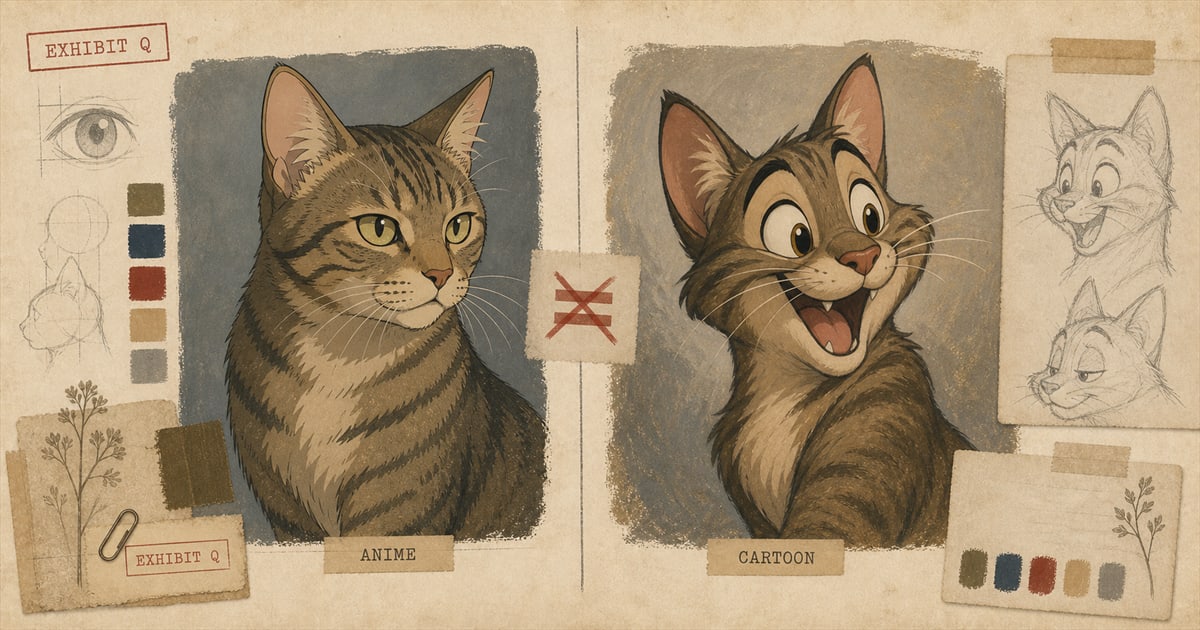
Ask someone what makes anime anime and most people reach for the eyes: big, glassy, catching a light source that is not actually in the frame. That is a real visual habit. It is not the definition the word’s home country uses.
In Japan, “anime” just means animation, no style attached, the way “movie” means movie whether it is a blockbuster or somebody’s phone footage. Japan’s national broadcaster NHK has referred to Western productions like Curious George and The Boss Baby as anime on air, according to journalist Brian Ashcraft’s reporting for Kotaku, the same plain word Japanese viewers use for Attack on Titan. There is no separate Japanese term reserved for “the Japanese kind.” There is just the word for animation, and most of the country uses it for everything with that word in front of it.
The Word Went to English and Came Back Narrower
“Anime” is Japan’s own clipped form of the English word “animation,” filtered through katakana as animēshon and shortened sometime in the 1970s, according to the Online Etymology Dictionary. Before that shortening caught on, Japanese animated shows and films went by names like manga eiga or TV manga. The word did not start as a claim about Japanese-ness at all. It started as a shortcut.
Then it made a second trip. English picked “anime” back up in the 1980s, but not as a synonym for “animation.” Merriam-Webster dates the word’s English debut to 1988 and defines it specifically: “a style of animation originating in Japan that is characterized by stark colorful graphics depicting vibrant characters in action-filled plots often with fantastic or futuristic themes.” That is the narrowing. It happened in English, on the trip back across the ocean, to a word that never carried that restriction at home. A cartoon fan in Tokyo and a cartoon fan in Toledo are using the same four letters for two differently sized categories.
Why the Picture in Your Head Looks the Way It Does
None of that means the visual habits people associate with anime are imaginary. They are real, they trace back to a specific studio and a specific budget crisis, and the story is more interesting than “Japan just draws differently.”
In 1961, Osamu Tezuka founded Mushi Production. Two years later he put Tetsuwan Atomu, known in English as Astro Boy, on Japanese television on a contract priced at 550,000 yen an episode, against production costs running 900,000 to 1,300,000 yen, according to production research summarized by the animation history site Animetudes, citing Japanese animation historians including Nobuyuki Tsugata. Tezuka’s studio could not afford to animate the way American studios did, at roughly twenty-four hand-drawn frames a second. So it did not. Characters held still for stretches, moved on twos or worse, and got redrawn one section at a time, a new mouth stitched onto an unchanged face. By the show’s later run, the studio was reusing whole chunks of old footage outright; one episode recombined material pulled from nine earlier episodes to make something that could air as new.
That is not the tradition Disney’s studio was working in. Frank Thomas and Ollie Johnston, two of Disney’s own veteran animators, codified the American approach in their 1981 book Disney Animation: The Illusion of Life: twelve principles, among them squash and stretch, anticipation, follow-through, and appeal, built around continuous, weighted, physically believable motion. It is the animation industry’s own reference text, still called the animator’s Bible decades later. Tezuka was not failing to hit that standard. He was solving a different problem: how to make a weekly television series when you cannot afford to draw twenty-four unique images a second, ever.
The famous eyes have a similarly specific origin. By the standard account, repeated across multiple anime histories, Tezuka drew on the stylized, sparkling-eyed performers of Japan’s Takarazuka Revue theater troupe, and on the Western cartoons he grew up loving, Disney’s Bambi and Mickey Mouse and Fleischer Studios’ Betty Boop among them. The eyes were not a national trait. They were one artist’s specific set of influences, repeated by the people who apprenticed under him and the people who apprenticed under them, until an industry had a house style built out of one man’s taste and one show’s budget.
A Word for the Technique That Actually Fits It
The media scholar Thomas Lamarre spent a whole book, The Anime Machine, arguing that what Mushi Production invented should not be filed under “cheaper than Disney” at all. He calls it “full limited animation,” a phrase built to hold a contradiction on purpose: limited in frame count, full in what it does with layered artwork sliding past a still camera. Stillness becomes a technique with its own vocabulary rather than an absence of one. A single held frame of a character’s face, camera panning slowly across a painted background, is not Disney animation done badly. It is a different tool, built for a different budget, that anime studios kept using long after they had the money to do otherwise, because by then it was the style, not the workaround.
Think about what a held frame actually asks of a single drawing. A Disney frame has motion doing part of the emotional work: a raised brow mid-movement, a mouth caught between shapes, the eye reading the arc rather than the position. A held frame has no arc to lean on. Whatever the eyes originally borrowed from Takarazuka’s performers or from Disney’s own characters, the convention had somewhere useful to go once it met limited animation’s constraints. An expression that has to sit still on screen for a full second or more, with nothing else in the frame moving, needs to be complete and legible on its own. That is a job the linework and the eyes are well built to carry, and one Disney’s continuously moving faces never had to solve the same way.
There is an accident of fit here worth naming. A portrait is a held frame that never resumes. It has no next drawing to complete the gesture, no camera move to carry the eye, no second of motion to explain what the face is doing. Every problem a held frame creates for an animator is the permanent condition of a portrait. A tradition that spent sixty years learning to make one motionless drawing carry a whole beat of feeling was, without meaning to, solving the portrait problem the entire time.
That is the lineage behind the anime style as a portrait option: cel-style shading, deliberate stillness in a held pose, line work doing the expressive work that continuous motion does in a Disney frame. It is a specific production tradition with a documented origin, not a synonym for “cartoon, but Japanese.”
So What Actually Draws the Line?
Here is where it gets less tidy. Jonathan Clements, one of the field’s most-cited historians, wrote an entire book called Anime: A History that reviewer Casey Brienza, writing in the LSE Review of Books, describes as treating anime not “as a set of texts or tropes” but as a history of the anime industry itself. Clements is not alone. Scholar Rayna Denison’s Anime: A Critical Introduction treats “what is anime” as a live, contested question rather than something to settle in chapter one.
Part of that argument turns on a fact that undercuts the tidy national-style story even further: a large and growing share of the actual frame-by-frame labor on shows made by Japanese studios is now outsourced outside Japan, according to scholar Ian Condry’s research as summarized on the historiography site Animetudes. If the national origin of the artists themselves does not hold as the line, and visual style does not hold either (a Studio Ghibli film’s lush, near-full animation and a stripped-down slice-of-life series share almost nothing on screen), what is left is closer to Clements’ answer: anime is a production lineage and an industry, traced to Tezuka’s budget crisis and Mushi Production’s shortcuts, not a checklist of eyes and cel shading you could apply to anything that resembles it.
Which means the honest answer to “what makes anime not a cartoon” is not a feature list. It is a paper trail. You can draw a line from a 1963 contract dispute over 550,000 yen to the anime style in the order form today, and the portfolio has examples across every style if you want to see how differently the same photo reads once the technique changes underneath it. The line from Tezuka to a portrait ordered this week is real and traceable. The line around what counts as “anime” is still being drawn, by people who study it for a living, and they have not finished arguing about where.
Sources
- “anime,” Online Etymology Dictionary.
- Ashcraft, B. “What ‘Anime’ Means.” Kotaku.
- “Twelve basic principles of animation,” Wikipedia, sourced to Thomas, F. & Johnston, O., Disney Animation: The Illusion of Life (Abbeville Press, 1981).
- Steinberg, M., Anime’s Media Mix: Franchising Toys and Characters in Japan (University of Minnesota Press, 2012).
- Lamarre, T., The Anime Machine: A Media Theory of Animation (University of Minnesota Press, 2009).
- Brienza, C. “Book Review: Anime: A History by Jonathan Clements.” LSE Review of Books, 2014.
- “Defining Anime, Part 1”, Animetudes, 2020.
Welcome perk
Free expedited delivery on your first portrait
Get your digital proof in 1-2 business days instead of 2-3, free on your first portrait. Normally a $10 upgrade.
No spam. Just the perk and the occasional new style or guide.
Check your inbox for your code.