Cel shading has a type. It rewards a face built from a small number of flat, separable color shapes: a patch here, a block there, hard edges between them and nothing blended. Some dog breeds happen to be built almost exactly like that already, their coat pattern doing work an animator would otherwise have to invent from scratch. A few breeds are built the opposite way, their whole identity carried in a texture with no flat plane to trace at all, and one of them, the Chinese Shar-Pei, got that way because of a gene duplication serious enough to also give the breed a fever. Anime style did not choose these breeds on purpose. Their coats got there first.
The Husky’s face was built for this, by accident
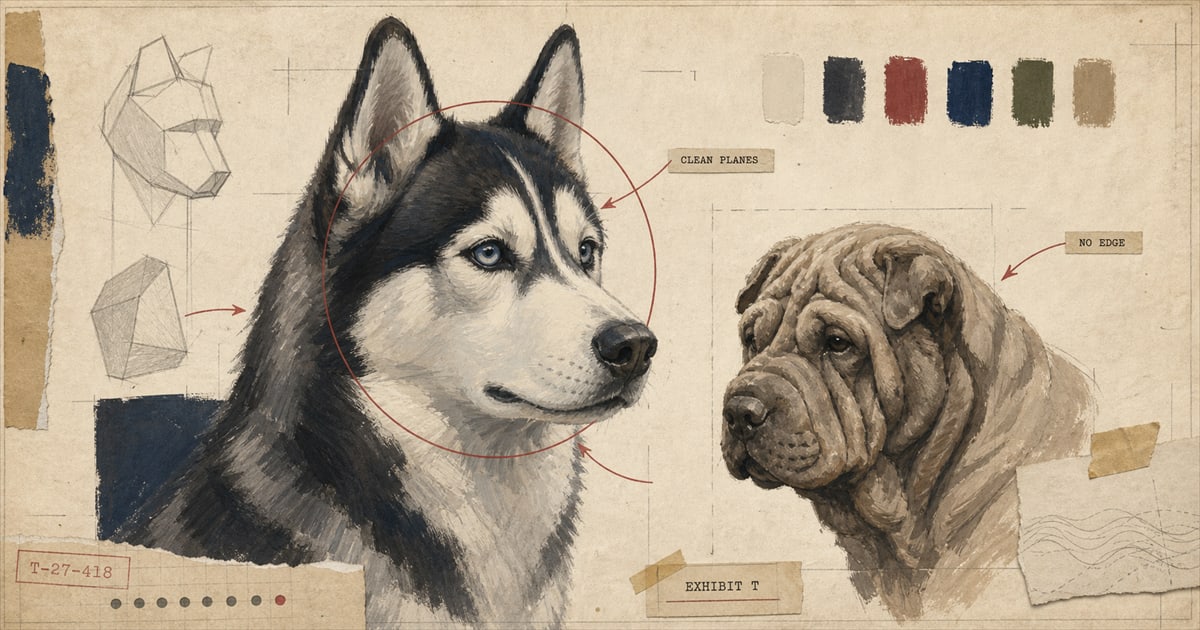
Breed-genetics writers describe the Siberian Husky’s face in language that could double as animation notes: “striking masks, spectacles, and other facial markings occur in wide variety,” according to Siberian Husky Genetics, a coat-color reference cited on the breed’s own Wikipedia page. Those are not official terms. The current American Kennel Club standard for the breed, approved in February 2021, is almost pointedly neutral about markings: “A variety of symmetrical or asymmetrical markings and patterns are common, including piebald. No preference should be given to any allowable color, marking or pattern.” Judges are told not to care. Fans and geneticists keep describing the pattern anyway, because there is something there worth naming: color arriving in distinct blocks around the eyes and muzzle instead of blended fur. That is much closer to how cel shading already works than to how continuous shading works. The Husky’s face reads in flat regions before an artist ever touches it. It is cel-shaded by genetic accident, not by anyone’s design, and the anime version barely has to interpret it.
The rest of the guest list
The same logic covers most of the breeds that translate easily into anime style. The Pembroke Welsh Corgi’s head is, in the AKC standard’s own word, “foxy,” a compact wedge shape the standard names directly instead of leaving to inference. The German Shepherd’s classic two-tone coloring, called a saddle pattern by breeders and geneticists (the current AKC standard’s color section says only that “most colors are permissible” and does not use that word), is another coat that arrives pre-separated into a dark upper block and a lighter lower one. The Dalmatian is the extreme version of the same principle, and the AKC’s own scoring proves it: “color and markings” is worth 25 of the standard’s 100 total judging points, more than any other single category, more than gait, more than head. A Dalmatian is bred, and literally judged, on how well-defined its spots are, “round and well-defined,” the standard specifies, ranging “from the size of a dime to the size of a half-dollar” against a pure white ground. The Samoyed’s expression is not folk description either. The standard names it outright: lips “slightly curved up at the corners of the mouth, giving the ‘Samoyed smile,’” and adds, as if worried a judge might miss the point, that “the expression, referred to as ‘Samoyed expression,’ is very important.” A breed standard that names a facial expression as essential has already done half of an anime colorist’s character design work before the artist opens the file.
Where the plane disappears
Cel shading’s whole method depends on quantizing continuous light into a small number of flat, hard-edged tone blocks. That works cleanly when a form has a small number of readable planes to hang those blocks on: a muzzle, a brow, a saddle of color, a spot. It runs into real trouble on a coat whose defining feature has no flat plane at all. A Puli’s coat does not sit in sections if left alone. The standard says so directly: it “clumps together easily, and if allowed to develop naturally, will form cords in the adult.” A Komondor takes the same trait further: “the coarser hairs of the outer coat trap the softer undercoat, forming permanent, strong cords that are felt-like to the touch. A grown dog is entirely covered with a heavy coat of these tassel-like cords.” There is no single edge to run a highlight along, because the coat is built from hundreds of small cylindrical edges pointed in hundreds of directions. An Old English Sheepdog’s standard asks for a coat “not straight, but shaggy,” with “the whole skull well covered with hair,” which erases exactly the facial landmarks (brow, muzzle bridge, eye socket) that a color-blocked breed hands an artist for free. A Persian cat, in the Cat Fanciers’ Association standard, resists from the opposite direction: a head “round and massive,” a nose “short, snub, and broad,” a coat “long and thick, standing off from the body.” None of it gives a colorist a hard edge. It is all soft transition and no plane.
The Chow Chow resists differently, because its trademark scowl is not fur at all. It is bone and skin: “a marked brow with a padded button of skin just above the inner, upper corner of each eye… a distinct furrow between the eyes,” deep enough that “because of its deep set eyes the Chow has limited peripheral vision.” That is a real anatomical fold, not a flat marking, and it gives a cel-shading colorist the same trouble as the Puli’s cords. There is a crease there, not an edge.
Texture is one way a coat can defeat a flat highlight block. Color is another, and it does not need any wrinkles at all: a black coat carries almost no diffuse light to shade with in the first place, a different fight the same style has to win from the opposite direction.
The Shar-Pei’s wrinkles trace to one gene
The Shar-Pei is the clearest case on either side of this argument, and it deserves to be taken seriously rather than played for a joke, because the biology behind the wrinkles is unusually well understood and unusually consequential. The breed’s official AKC standard describes “loose skin and wrinkles covering the head, neck and body” that are “superabundant in puppies” and may draw back to just the head, neck, and withers in an adult, alongside a coat that is “extremely harsh” and stands off the body, and a tongue that is “solid bluish-black.”
In 2011, a team led by Mia Olsson and Kerstin Lindblad-Toh traced the wrinkling to its source in a paper published in PLOS Genetics: a duplication sitting upstream of a gene called HAS2, which drives the skin to overproduce a molecule called hyaluronan. The study found two versions of the duplication, one 16.1 kilobases long that breeders call “meatmouth,” which produces the deepest wrinkling, and a shorter 14.3 kilobase version tied to the more moderate “traditional” Shar-Pei coat. Dogs carrying the meatmouth duplication had serum hyaluronic acid levels roughly two to five times higher than other breeds.
That same duplication is dose-dependently linked to a real disease, not a cosmetic quirk with a disease attached for effect. Familial Shar-Pei Fever is a recurrent inflammatory fever syndrome in the breed, and Olsson’s team found that the number of copies of the duplication a dog carried predicted it: dogs with six or more copies were mostly affected by fever episodes, dogs with fewer than four copies mostly were not, and the association was statistically overwhelming. The wrinkle gene and the fever gene are the same gene. That is worth sitting with before moving on to why a cel-shaded style has trouble drawing it. The Shar-Pei’s texture is not decoration that a cartoon style happens to render badly. It predisposes the breed to a real illness, one gene duplication away from a face that has become, almost as a side effect, one of the hardest in dogdom to flatten into blocks of color.
What this means for the portrait
None of this is a verdict on which dogs are better. It is only a verdict on which coats a particular rendering technique finds easy to translate. A Shar-Pei, a Chow Chow, a Puli, a Komondor, a Persian cat: every one of these is a legitimate, good-looking portrait subject, just not necessarily the easiest anime one, because the style’s whole method depends on a coat handing over distinct, flat, separable shapes, and these animals were bred, wrinkled, and corded specifically not to do that. Watercolor and oil painting, styles built around gradients rather than hard edges, handle a Puli’s cords or a Shar-Pei’s folds the way they were always going to be handled: as continuous texture, not as a block of color.
The breeds anime style already loves in this studio’s own portfolio bear that out. Huskies, Border Collies, Corgis, German Shepherds, Dalmatians, Samoyeds, Greyhounds, Golden Retrievers, Labradors, Dachshunds, Australian Shepherds, tuxedo cats, Maine Coons, and tabby cats all show up in the anime style gallery, and each one carries some version of the same trait: a mask, a saddle, a spot pattern, a coat that arrives pre-separated into shapes an artist can trace. Set a Husky portrait next to a Dalmatian one and the throughline is visible before anyone explains hyaluronan or judging points. The dogs that look effortless in anime style were never drawn that way by luck. Their faces were built out of the same flat shapes the medium already draws in.
Cel shading did not invent a preference for graphic, color-blocked faces. It just turned out to be the one technique honest enough to show which breeds already had one.
Sources
- Official Standard of the Siberian Husky (AKC, approved 2021)
- Official Standard of the Chinese Shar-Pei (AKC, approved 1998)
- Olsson et al., “A Novel Unstable Duplication Upstream of HAS2 Predisposes to a Breed-Defining Skin Phenotype and a Periodic Fever Syndrome in Chinese Shar-Pei Dogs,” PLOS Genetics 7(3): e1001332 (2011)
- Official Standard of the Samoyed (AKC, approved 1993)
- Official Standard of the Dalmatian (AKC, approved 1989)
- Official Standard of the Chow Chow (AKC, approved 2020)
- Official Standard of the Komondor (AKC, approved 1994)
- Official Standard of the Puli (AKC, approved 1983)
Welcome perk
Free expedited delivery on your first portrait
Get your digital proof in 1-2 business days instead of 2-3, free on your first portrait. Normally a $10 upgrade.
No spam. Just the perk and the occasional new style or guide.
Check your inbox for your code.