
Take a photograph of a face. Flip the eyes and mouth upside down, right where they sit, leaving everything else untouched. Look at it right side up and it is grotesque, a face wearing a mask made from its own features. Now turn the whole photograph upside down. The same warped eyes and mouth barely register as wrong. Peter Thompson, then at the University of York, published this in 1980 using a photograph of Margaret Thatcher, which is why it is called the Thatcher illusion rather than, more usefully, the everyone illusion. It works on any face, including the reader’s own.
Faces get special treatment. Almost nothing else does.
The illusion is not a party trick. It is one entry point into a body of research showing that human vision handles upright faces differently from almost everything else it looks at. Robert Yin found in 1969 that flipping a face upside down damages recognition far more than flipping a house, an airplane, or a stick figure of a person in motion, a gap of more than twenty-five percentage points in his original data. Nancy Kanwisher, Josh McDermott, and Marvin Chun found in 1997 that a specific patch of the fusiform gyrus, since called the fusiform face area, lit up on fMRI scans when subjects viewed faces and stayed comparatively quiet across a wide assortment of other objects, in twelve of the fifteen subjects tested. Researchers still argue about whether that patch is doing something strictly face-specific or something closer to general visual expertise, since car experts and bird experts show some of the same activation for cars and birds, but nobody argues that faces get processed as ordinary objects. They do not.
Anime already built a dial for this
Anime arrived at its own, much older, far more practical version of the same asymmetry, and it does not need an MRI machine to make the point. Character height in anime is measured in heads, a system with an actual name: tōshin (頭身). A standard adult character runs six to eight heads tall, called hachitōshin at the top of that range. A chibi character, the small, round, exaggerated form anime uses for comic relief or extra cuteness, compresses down to two or three heads tall. That is not a minor adjustment. It means an artist can take the same character and shrink the body to roughly a third of its usual proportion while the face, especially the eyes, barely changes shape at all. The body is the part of an anime character built to flex. The face is the part built to hold its shape no matter what happens around it.
What the studios actually had time to draw
Anime’s production history backs this up from the opposite direction: not what the drawing style permits, but what a studio actually had hours to draw. Osamu Tezuka’s studio, Mushi Production, built television anime into a financially survivable format starting with Astro Boy in 1963 by reusing cels, cataloguing stock walk cycles, flying shots, and generic bust shots, then pulling them back out episode after episode instead of redrawing them from scratch. Stacked on top of that general reuse, both Japanese and American limited animation lean on a narrower, more specific technique: a character’s body holds on one static drawing while only the mouth, a small interchangeable set of shapes, gets swapped to fake speech. The body gets economized wholesale. The mouth, the part doing the emotional work of the line being spoken, gets the redraws. This does not prove an anime artist spends more total hours on a face than a body across a whole production; nobody has published a study measuring that directly. But it is documented, ordinary practice that facial detail is where attention concentrates when attention is scarce, and on a weekly television schedule, it is always scarce.
A convention and a finding, not quite the same claim
Whether the drawing convention exists because of the neuroscience, or the neuroscience just happens to describe why the convention lands the way it does on a viewer, is not something anyone has run the experiment to settle, and this piece will not pretend otherwise. What can be said honestly, and is still useful, is narrower: anime’s own grammar, built by artists solving a scheduling and budget problem with no interest in cognitive science, arrived at the same asymmetry that face-perception research keeps finding through a different method. The face is treated as the fixed point. Nearly everything attached to it is treated as negotiable.
Two labs, twenty years, and an unresolved dog
Here is where the story gets less tidy, which is worth stating plainly rather than smoothing into a clean ending. In 1986, Rhona Diamond and Susan Carey ran dog-show judges through a version of the face-inversion test, upright versus upside-down recognition, using photographs of dogs from each judge’s own breed of expertise. The judges showed an inversion effect nearly as large as the one people show for human faces. Novice dog owners tested on the same photographs did not. It looked like proof that enough expertise will make a brain process an animal’s face the way it processes a human one. Then, in 2007, Rachel Robbins and Elinor McKone tried to replicate it with tighter controls, testing dog experts with confirmed, measured skill at telling individual dogs apart, and found none of it: no inversion effect, no composite-face effect, none of the signatures the expertise account predicted. The 1986 result did not hold up under closer scrutiny. Whether an expert’s brain, let alone an ordinary owner’s, processes a dog’s or cat’s face with anything resembling the machinery it uses on a human face is genuinely unresolved. Two careful studies looked directly at the question, twenty-one years apart, and landed in different places.
Crop for the part that was built to hold
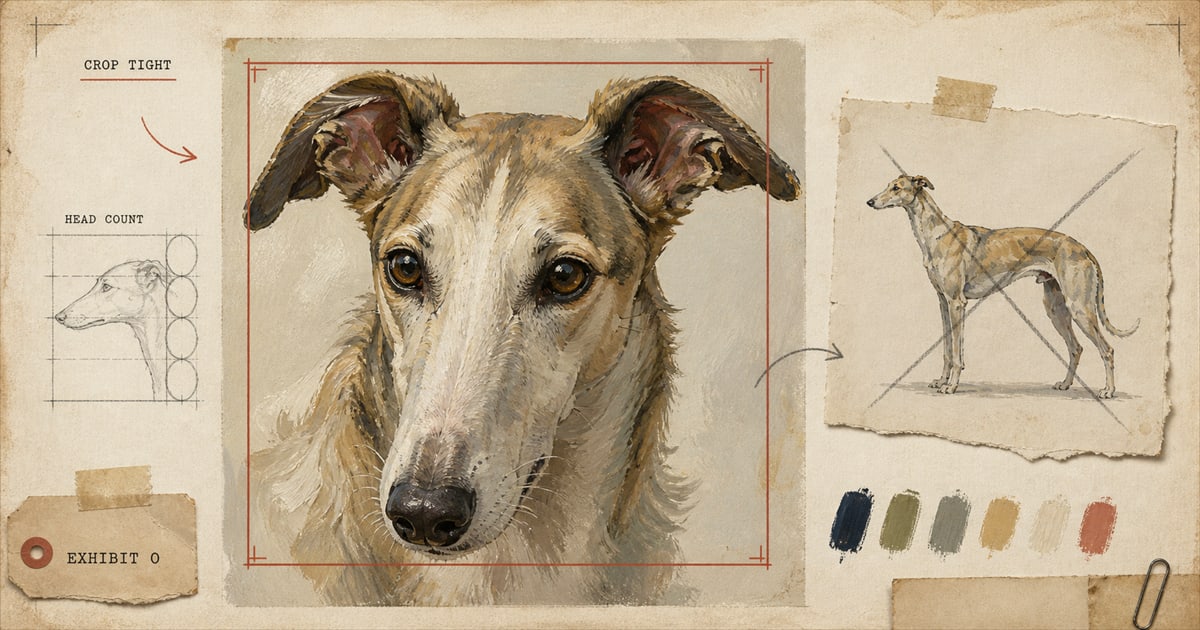
None of that uncertainty touches the part that actually matters for a portrait. Whatever is or is not happening inside a pet owner’s fusiform gyrus, the practical fact sits plainly in the drawing itself: anime’s proportion system has an enormous amount of built-in room to move in the body and almost none in the face. A commissioned anime portrait cropped in tight, head and upper shoulders, close enough that the ear shape, the eye set, the exact placement of a blaze or a patch of white fur fill most of the frame, is working with the part of the style that was built to be precise. A portrait that stretches a full-body anime pose across a photo where the pet’s actual stance and proportions do not map cleanly onto tōshin conventions is fighting the one axis, the body, where anime was never trying to be exact to begin with.
This is also, not coincidentally, the direction that suits a first anime commission best. A tight, expressive anime portrait built around the face tends to read as confidently finished on the first proof, in a way a stretched full-body composition rarely does. A full-body scene, a dog mid-run or a cat holding down a favorite spot on the couch, is a real option worth discussing with the artist working on your proof, not a rule against it, just a reason to expect the body to take another revision pass or two while the face gets it right the first time. If anime is still competing against the studio’s other five styles for a particular pet, the style comparison guide is a reasonable next stop, alongside the companion piece on what anime’s character design language was actually built to do, which gets at why the style handles a face this well in the first place.
A face-swap illusion built on a photograph of a British prime minister, a Japanese proportion chart with a name written in kanji, and two labs that spent decades disagreeing about dogs all point at the same narrow fact from three different directions: faces get treated differently from everything attached to them, by the art form and, most likely, by the eye looking at it. Nobody has proven exactly why. The drawing works anyway.
Sources
- Robert K. Yin, “Looking at Upside-Down Faces,” Journal of Experimental Psychology, 81(1), 1969
- Peter Thompson, “Margaret Thatcher: A New Illusion,” Perception, 9(4), 1980
- Nancy Kanwisher, Josh McDermott, Marvin M. Chun, “The Fusiform Face Area,” Journal of Neuroscience, 17(11), 1997
- Rhona Diamond & Susan Carey, “Why Faces Are and Are Not Special: An Effect of Expertise,” Journal of Experimental Psychology: General, 115(2), 1986
- Rachel Robbins & Elinor McKone, “No Face-Like Processing for Objects-of-Expertise in Three Behavioural Tasks,” Cognition, 103(1), 2007
- Chibi (style), Wikipedia
Welcome perk
Free expedited delivery on your first portrait
Get your digital proof in 1-2 business days instead of 2-3, free on your first portrait. Normally a $10 upgrade.
No spam. Just the perk and the occasional new style or guide.
Check your inbox for your code.