
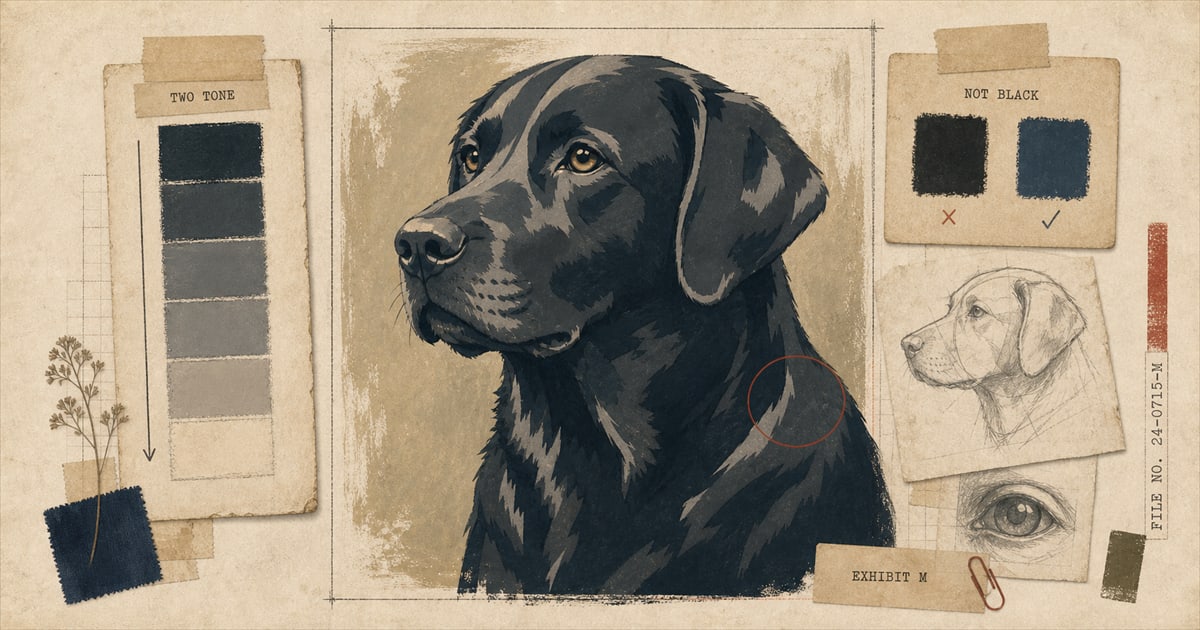
Arisa Komatsu color-designs anime at Wit Studio, and in November 2024 she described a specific technical headache to Anime News Network. One character in the series Nokotan has hair built from two gradations, “one at the top and one in the middle,” and getting them to sit together without looking wrong was a genuine fight. “It’s very difficult to blend them and make them look nice,” she said. That is the exact problem an anime portrait style runs into every time it meets a dark coat, described from the inside by someone whose job is to solve it before a viewer ever notices there was a problem.
A black coat has almost nothing to shade
A coat with real color gives an artist plenty to work with. A golden retriever’s warm red-gold, a calico’s black-orange-white patchwork: every patch of light and shadow across that coat still carries hue, so the eye has color gradients to read as form before anyone adds a highlight. A black coat throws almost all of that away. There is one surface color across the entire animal, and it reflects little light back in any direction. Whatever three-dimensional shape the coat has, whatever tells a viewer this is a head turning away from a shoulder rather than a flat cutout, has to come from somewhere else.
That somewhere else is specular reflection, not diffuse shading. Charles E. Gardner, a professional animal photographer, has spent years photographing exactly this problem, and his own account of what a hair shaft actually is settles why: “It is light hitting those tiny mirror-like surfaces and reflecting back into the camera which gives hair its luster and illusion of volume.” For furry subjects he recommends direct light instead of the large diffused sources portrait photographers use on people, because “specular reflections are an important component for creating the illusion of 3D shape” in fur. On a light-colored coat, that highlight is one contributor among several. On a black coat, it is the only one. Take it away and what is left is a silhouette.
Vision scientists have found something adjacent to this in a more general setting. In a 2017 study in the Journal of Vision, te Pas and colleagues tested how people judge an object’s lighting and shape, and found that highlights and cast shadows, not the smoothness of a shading gradient, are what the visual system actually leans on. A soft gradient is a nicety. A highlight placed in the right spot is the information.
Cel shading removes the gradient on purpose
This is where cel shading, the technique that gives anime its name, makes the black-coat problem worse before it makes it better. Cel shading, sometimes called toon shading, takes continuous lighting and quantizes it down to a small number of flat, hard-edged tone blocks instead of a gradient, the way traditional animators painted separate cels of celluloid for a base color and a shadow shape rather than blending paint on one surface. Researcher Panthavma, writing on toon-shading technique, describes the standard structure as a base color, a shadow band placed as its own flat shape where the form turns from the light, and sometimes a highlight band or a second, deeper shadow used sparingly. Two to three tones is the working default. A fourth shows up in more elaborate character work, not as a codified rule so much as a range colorists settle into depending on the job. Komatsu’s two gradations on that Nokotan character sit right inside that range, and her point stands regardless of the exact number: doing it with two or three flat shapes and having the result still read as hair is hard, even when the base color has real hue to spend.
Point that same system at a black coat and the safety margin disappears. A colorist shading an orange tabby has orange to lean on in every band: a warm highlight, a cooler mid-tone, a saturated shadow. Each flat block still reads as recognizably that cat even if a boundary lands slightly wrong. A colorist shading a black dog has one value to distribute across two or three flat shapes, and if the shadow band and the base band read too close together, the whole coat collapses into a single dark mass with a highlight floating on top of it: the exact silhouette problem Gardner described in photography, just rendered in flat color instead of through a lens. There is no gradient left to soften a bad edge. The edge is the whole drawing.
Color is one way a coat can starve this system of information. Texture is another: wrinkles, cording, deep folds. Anime style has its own list of breeds it fights with for that second reason, and it has nothing to do with how dark the coat is.
Why anime black hair is never actually black
Watch for it and the pattern shows up constantly: hair described as black in the manga or light novel a series is adapted from almost never renders as true black once it is on screen. Misato Katsuragi in Neon Genesis Evangelion, Rei Hino in Sailor Moon, and Faye Valentine in Cowboy Bebop are all written as black-haired characters whose hair reads on screen as a visibly dark, desaturated purple. Inosuke Hashibira in Demon Slayer has hair described as solid black in the source material and appears on screen with blue-tinted strands worked through it. None of this is a rendering accident or a quirk of a screen’s color profile. It is a working answer to the exact shortage the shading math creates. Paint the coat at true black and there is no room left to place a shadow band that reads as darker than the base, because a dark shape drawn on top of an already-dark shape at the same value disappears. Push the base color off pure black into a dark blue or purple instead, and there is suddenly a range to work inside again. The highlight can sit above it, the shadow can sit below it, and the hair keeps its edges instead of dissolving into the line drawn around it.
The same shortage, solved with paint instead of blocks
Every medium that renders a black coat is solving the same shortage of information with different tools. Oil painters have their own workaround: mixing black from complementary darks like ultramarine and burnt umber rather than reaching for a tube of black pigment, then placing highlights structurally at the muzzle bridge, brow ridge, shoulder, and hip rather than wherever looks nice. We’ve written about that process in detail. The oil painter still has a gradient to work with, so their version of the black-coat problem is chromatic: which cool and warm darks to mix into the shadow. The cel-shaded version is structural: exactly where to draw the one hard edge that has to do a gradient’s worth of work by itself.
It also starts before any artist touches the piece. Getting a usable reference photo of a black or dark-coated pet is its own fight against a camera meter that wants to brighten every dark coat toward gray, and a reference photo that has already lost its highlights hands a colorist nothing to place a tone break on. Anime portraits live or die on the same information every other black-coat medium needs. Not more black. A highlight, in the right place.
What the file can’t invent
There is a coda to this that shows up after the art is finished, in the print itself. Commercial printers have long known that a large solid area of pure black ink tends to print weaker than people expect, reading as flat charcoal rather than true deep black, which is why denser black work usually gets built from more than one ink layer instead of a single channel pushed to its maximum. The exact mechanics vary by press and process, but the principle behind it carries straight back to the file: a print can only reproduce tonal information that was there to begin with. If a shadow gets painted at the file’s absolute floor value with nothing held in reserve, there is nothing left for the print to build depth from, no matter how good the printer is downstream.
That is the same rule underneath everything above: the blue-purple trick, the two hard-won gradations Komatsu was fighting with on a deadline, the highlight Gardner chases with a direct light instead of a softbox. A black coat is not a color problem. It is an information problem, and every version of it, film, oil paint, or a flat vector shape, comes down to deciding where to put the one piece of information a coat with almost no diffuse light has left to give.
Sources
- Cel shading, Wikipedia
- Panthavma, “Toon Shading Fundamentals”
- Anime News Network, “The Complicated Process of Color Design in Anime, an Interview with Nokotan’s Arisa Komatsu”
- te Pas, S.F., Pont, S.C., Dalmaijer, E.S., & Hooge, I.T.C., “Perception of object illumination depends on highlights and shadows, not shading,” Journal of Vision 17(8):2 (2017)
- Charles E. Gardner, “Photographing Furry Critters”
- Printkeg, “When Rich Black Is the Wrong Choice for Printing”
Welcome perk
Free expedited delivery on your first portrait
Get your digital proof in 1-2 business days instead of 2-3, free on your first portrait. Normally a $10 upgrade.
No spam. Just the perk and the occasional new style or guide.
Check your inbox for your code.