
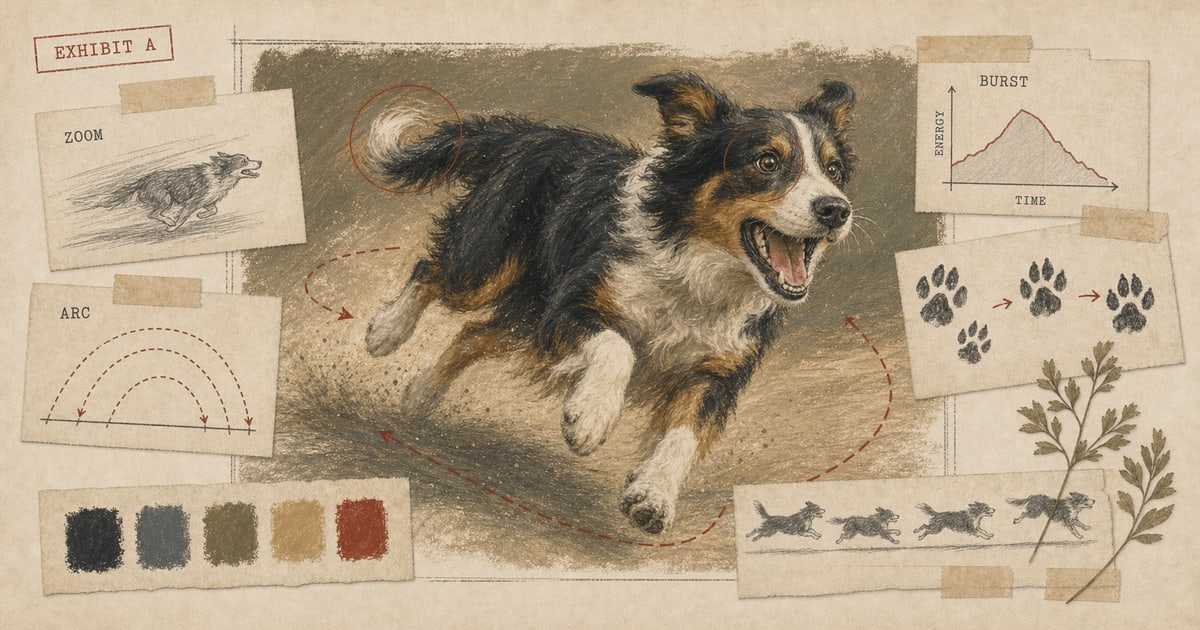
The post-defecation sprint is one of the stranger reliable facts about domestic dogs. A significant proportion of dogs, immediately after a bowel movement, erupt into what can only be described as a victory lap. Haunches tuck, eyes go wide, and the animal tears around the yard in a tight loop with the expression of someone who has just made a critical decision. This is one of the more universal triggers for what applied animal behaviorists call FRAPs: Frenetic Random Activity Periods. The common name is zoomies. The post-poop version has its own nickname in online dog communities: the “poo-nado.”
Nobody has published a peer-reviewed study on the poo-nado specifically. This is a gap in the literature.
What researchers have studied is the broader category: brief, intense, apparently spontaneous bursts of running, usually circular, usually in a known space, usually self-limiting. The behavior is normal, harmless in most contexts, and reflects something real about how dogs manage their arousal states. It is also genuinely funny, and the fact that it is funny does not make it less worth understanding.
What the FRAP actually is
The motor signature of a FRAP is distinct enough that behaviorists can identify it reliably. The dog drops into a partial crouch or exaggerated play-bow. The hindquarters may swing wide in the half-second before launch, like a car spinning its rear tires before accelerating. Once moving, the dog enters a curved, looping circuit, often organized around a fixed landmark: the couch, the kitchen island, a particular tree in the yard. The tail is usually high or curved. The mouth is open. The eyes are wide.
This is not panic. The motor signature of fear-running is different: it is more linear, disorganized, and typically involves body-lowering and avoidance. The FRAP is exuberant rather than reactive. Most dogs check in visually with their owner mid-zoomie, making brief eye contact during the loop before going around again. A terrified dog does not pause to share the experience.
The event typically lasts thirty seconds to two minutes. It ends when it ends, usually abruptly, with the dog flopping down and looking only mildly embarrassed.
The arousal-release model
The prevailing behavioral explanation is that FRAPs are an acute discharge of accumulated arousal. The dog has been in a state of heightened physiological activation, for whatever reason, and the body finds a route to express it. Running in circles is energetically extravagant and spatially pointless, which is precisely the point. The goal is not locomotion. The goal is to use up the energy of arousal in a way the body recognizes as satisfying.
Patricia McConnell, in The Other End of the Leash, discusses arousal regulation as a constant background project for social mammals. Dogs that are chronically under-stimulated or recently over-stimulated both face arousal management problems, and physical movement is one of the mammalian body’s primary solutions. The zoomie is the body’s version of a pressure release valve.
This explains the trigger clustering. Baths are the most reliable FRAP trigger documented in dogs, and the mechanism involves multiple contributing factors: the physical discomfort of being wet, the strange sensory experience of wet fur against the skin, relief at being released from a confined and aversive situation, and the physical stimulation of a towel-dry, which can itself initiate the sequence. All of these simultaneously push the dog’s arousal state past whatever threshold triggers the behavior.
The post-elimination trigger makes sense in this framework too, though the specific mechanism is murky. The vagus nerve, which runs through the gut and is involved in the parasympathetic response, may play a role: the post-defecation state involves a physiological shift, and some researchers have suggested that vagal stimulation during defecation may produce a brief neurological cascade that expresses as locomotion. This is plausible but not demonstrated in dogs specifically.
Evening and morning timing is the most consistently observed pattern after the bath trigger. Crepuscular activity peaks in domestic dogs parallel those of their wild canid relatives. Patricia McConnell and other behaviorists note that dogs naturally have arousal windows around dawn and dusk that map onto ancestral hunting schedules. A dog that seems to reliably lose its mind every evening at 8:47 is not being random. It is following a biological rhythm.
What the neurochemistry probably isn’t
The popular explanation that zoomies are caused by a dopamine rush is frequently repeated and completely undemonstrated. Dopamine is involved in anticipatory pleasure and motivated behavior in mammals, and it would be surprising if movement and play did not involve dopaminergic signaling in dogs. But no study has measured dopamine or other neurotransmitter levels in dogs before, during, or after FRAPs. The dopamine explanation is a reasonable inference from general mammalian neuroscience, applied speculatively to a specific behavior.
This is worth flagging because popular dog science has a tendency to import neuroscience terminology to make observations sound more mechanistic than they are. “Dopamine rush” sounds precise. It is actually a placeholder. The honest version is: the neurochemistry of FRAPs is unknown. The behavior exists, it is real, and we can describe when it happens and what it looks like without knowing exactly what is happening at the molecular level.
John Bradshaw makes a similar point in Dog Sense about the gap between behavioral observation and neurological explanation in animal behavior research. The gap is especially wide for dogs because they are behaviorally well-studied and neurologically under-studied.
Breed differences that nobody has actually documented
Anecdotally, breed differences in FRAP frequency and duration are real and substantial. Border Collies are notorious for zoomies deep into middle age. Terriers are enthusiastic. Greyhounds, whose athletic capacity is extraordinary, produce FRAPs of such speed and commitment that they have a breed-specific nickname: “brindle lightning.” Large, slow-maturing breeds like Saint Bernards and Newfoundlands tend to FRAP primarily as puppies and largely stop by adulthood.
The problem is that none of this is in the peer-reviewed literature. Breed differences in FRAPs are owner-reported, anecdotal, and not systematically studied. The pattern seems real. It has not been confirmed. If you work in comparative ethology and want a publishable gap to fill, this is one.
When the zoomies mean something else
The routine FRAP: normal, self-limiting, socially engaged, ends with the dog lying down. Not worth concern.
The zoomie that is worth a second look has different qualities. A dog that zoomies for extended periods, multiple times per day, every day, and cannot seem to settle even after the episode, may be chronically under-exercised. The zoomie is not the problem in this case. It is a symptom. The appropriate response is more real exercise, specifically off-leash movement and play, before concluding that the dog is constitutionally hyperactive.
A dog that zoomies on hardwood floors with abandon is a genuine injury risk, particularly for large breeds, senior dogs, or animals with any orthopedic history. Cruciate ligament tears in dogs are sometimes attributable to exactly this scenario: a high-arousal sprint on a slick surface, the dog cuts wrong, and a $4,000 surgery follows. Runners and area rugs are a reasonable preventive measure if you have a dog that consistently goes hard on a slippery floor.
Repetitive, ritualized circling that does not have the exuberant social quality of a FRAP, that is difficult to interrupt, that does not terminate naturally, and that seems driven by anxiety rather than joy, is closer to a compulsive behavior. This is rare, but it is also categorically different from the FRAP and worth a veterinary behaviorist’s input if you are seeing it.
Senior dogs who develop new circling behavior, especially if disoriented, are showing a possible sign of cognitive dysfunction syndrome or vestibular disease. These are neurological events, not behavioral ones, and the movement looks qualitatively different from the exuberant FRAP of a young dog.
What to do with a zooming dog
Mostly: move out of the way. Especially for large breeds, the dog has committed, and redirecting mid-FRAP is like redirecting a comet with a tennis ball. If the behavior is happening in an unsafe space (a kitchen with hard tile and sharp corners, near a road, around small children who may get knocked down), the practical solution is management before the trigger rather than intervention during it. Learn your dog’s reliable triggers and provide a safer outlet before the bath or the evening arousal window hits.
There is also no need to stop it, unless the environment makes it risky. A FRAP is the dog’s body doing what it needs to do. It is self-limiting. It is, from the dog’s perspective, obviously and completely satisfying. The dog that has just finished a full-speed circuit of the living room and is now lying on the floor, sides heaving, looking at you with no discernible expression, has done something it needed to do.
The zooming dog is essentially impossible to photograph well. The motion blur problem is real: you need a shutter speed of at least 1/1000 second, good natural light, and to aim for the brief mid-loop pause when the dog checks in with you rather than the full-speed transit. That check-in moment, ears back, mouth open, weight on the front legs, eyes locked on you with a look that says “are you seeing this,” is one of the most genuinely expressive shots you can get of a dog’s face. A custom pet portrait made from a sharp reference like that captures something vivid and specific about who your dog is when nobody told it to sit still.
Sources
- McConnell, P. B. The Other End of the Leash: Why We Do What We Do Around Dogs. Ballantine, 2002.
- Bradshaw, J. Dog Sense: How the New Science of Dog Behavior Can Make You a Better Friend to Your Pet. Basic Books, 2011.
- Overall, K. L. Manual of Clinical Behavioral Medicine for Dogs and Cats. Elsevier Mosby, 2013.
- American Kennel Club. “Why Do Dogs Get the Zoomies?”
- Berns, G. S., Brooks, A. M., and Spivak, M. “Functional MRI in awake unrestrained dogs.” PLOS ONE 7, no. 5 (2012): e38665.
- VCA Animal Hospitals. “Frenetic Random Activity Periods in Dogs.”
Welcome perk
Free expedited delivery on your first portrait
Get your digital proof in 1-2 business days instead of 2-3, free on your first portrait. Normally a $10 upgrade.
No spam. Just the perk and the occasional new style or guide.
Check your inbox for your code.