
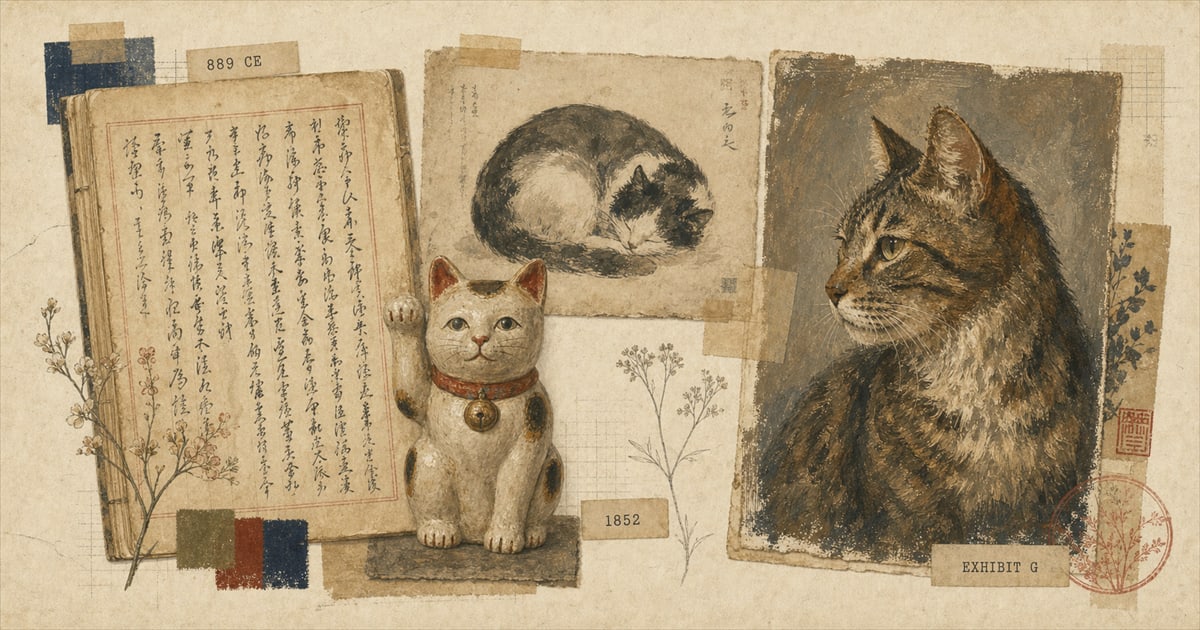
The oldest cat bones found in Japan turned up in a trash heap. Archaeologists digging at the Karakami site on Iki Island, a small stretch of land between Kyushu and the Korean peninsula, pulled thirteen bone fragments out of a shell midden in 2008: the hind legs of two young cats, discarded among fish bones and broken pottery. A single adult radius bone, found in 2011 and confirmed through analysis at the Nara National Research Institute for Cultural Properties, which examined 723 fragments out of a larger 1,882-piece assemblage recovered from the site, pushed the timeline further back. The layer dates to the late Yayoi period, roughly the first to third centuries CE. If the identification holds, cats were living alongside ordinary fishing and farming families on a small island close to two thousand years ago, more than five hundred years before the story most people repeat about how cats got to Japan.
That familiar story says Buddhist monks brought cats over from China or Korea sometime in the Nara or Heian period, specifically to protect sutras from rats on the boat. It appears in Edo-period essays and in nearly every casual retelling of Japanese cat history since. What it does not appear in is a primary record: no ship’s log, no named monk, no date anyone can point to. It survives as tradition, not as documented fact. Even the Karakami bones come with a caveat. At least one Japanese specialist has questioned whether fragments this small can be reliably told apart from the wild leopard-cat relatives native to nearby islands, so “oldest known domestic cat in Japan” is the leading theory here, not a closed case.
A cat with a name attached to an emperor, not a legend
The physical evidence and the written record do not meet for centuries. When the written record finally arrives, it comes with an actual person attached to it: Emperor Uda, writing about his cat on the sixth day of the second month of Kanpyō 1, which converts to March 11, 889.
Uda was about twenty-two, several years into a reign that would run from 887 to 897, keeping a diary in kanbun known today as the Kanpyō Gyoki, the oldest surviving Japanese court diary of any kind. Only fragments of it survive, something like fourteen pages in modern printed editions; most of the rest was lost centuries later in the Ōnin War. The cat entry is one of the pieces that made it through. Uda describes fur so black it looked dyed, a body that curled at rest into the shape of a grain of black millet, and a stretch he compared, admiringly, to a drawn bow. He had received the cat as a gift, reportedly from his father, the retired Emperor Kōkō. And in the middle of all that description sits the actual point of the entry: Uda’s cat was better than other cats at catching mice at night. That is the claim he wanted on the record.
That is not, however, the version of the diary that circulates now. Search for it and a more ornamental quote comes back, one that has the cat’s cry expressing what the Smithsonian’s own retelling calls “profound loneliness, like a black dragon floating above the clouds.” A line-by-line comparison against the original text, done by a translator checking the popular English version against the source, found that the dragon line actually describes the cat’s movement, not its cry; that the “bow around its neck” some versions mention is a comparison between the stretched cat’s shape and a drawn bow, not an object tied around it; and that the cat’s length is given as one shaku five sun, about eighteen inches, not the five sun, about six inches, that some retellings shorten it to. Nobody sat down and fabricated an emperor’s diary. The quote just got more poetic every time somebody repeated it, until the internet’s Uda was writing noticeably better prose than the actual Uda. The real entry is plainer than that, and stranger for being plainer: a twenty-two-year-old logging his cat’s hunting record like a man keeping a ledger.
The lucky cat’s paper trail is shorter than its legend
Skip forward almost a thousand years and Japan’s most exported cat image, the raised-paw maneki-neko sitting on shop counters worldwide, turns out to have a documented birth year and two competing origin stories, and only one of those three things is actually verifiable.
The documented anchor is 1852. That year, the Bukō Nenpyō, a chronology of Edo, records an entry referencing beckoning-cat figures, and Utagawa Hiroshige’s print Jōruri-machi Hanka no Zu shows a marushime-neko, a maneki-neko variant, being sold as street merchandise near Sensō-ji Temple. The lucky cat, in other words, was already a commercial tourist object in Edo before Japan had opened to the West, decades before the Meiji era, well before it became the fixture of restaurant counters that people now assume is either much older or much newer than it actually is.
The two legends that claim to explain where the figure came from are both undated to any verifiable year, and both belong to institutions with a direct interest in owning the story. At Gōtoku-ji temple in Tokyo, the tale involves a cat named Tama beckoning Ii Naotaka, lord of the Hikone domain, in from a thunderstorm, saving him from a lightning strike that hits the tree he had been standing under. The legend’s own tellings cannot agree on when this happened, some setting it in the early 1620s, others in 1633. At Imado Shrine, the tale involves a poor widow who could not afford to feed her cat, let it go, and grew wealthy afterward selling clay figures of it once the cat appeared to her in a dream. Both are explicitly folklore, not history. Gōtoku-ji’s own recorded, non-legendary history undercuts its version further: the temple was founded as Kōtoku-in in 1480, became the Ii clan’s family temple only when Hikone domain took control of the area in 1633, and was not renamed Gōtoku-ji until 1659, using the posthumous Buddhist name of the same Ii Naotaka after he died that year. That timeline is real and documented. It has nothing to do with cats. The lightning story got layered on at some point nobody can pin down, the way a good tourist legend usually does.
Two monster cats, and only one of them started as a monster
Not every cat in Japanese art and writing was a beloved pet or a marketing mascot. Some were killers, or at least accused of it.
The oldest reliable record of a nekomata, a two-tailed cat monster from Japanese folklore, comes from the diary of the poet Fujiwara no Teika, the Meigetsuki, in an entry for the second day of the eighth month of Tenpuku 1, the year 1233. Teika describes a nekomata near Nara with eyes like a cat and a body as large as a dog’s, killing several people in a single night. It reads less like a ghost story than an incident report. Some modern folklorists have wondered whether the real event behind it was an escaped exotic animal, maybe a tiger from an imported menagerie, or something more mundane misidentified in the dark. Either way, something frightening and unexplained happened near Nara in 1233, and by the time anyone wrote it down, it had already become a cat.
The bakeneko, a shape-shifting cat spirit usually credited with one tail rather than the nekomata’s two, is a younger and much more specifically economic phenomenon. It rises alongside the Edo-period silk industry, when households kept cats in real numbers specifically to protect silkworms and stored silk from rats, and it takes off from the mid-eighteenth century on, with stories of cats transforming into courtesans in Edo’s pleasure districts recorded from around 1781. A monster invented to explain a genuine pest problem eventually became a monster people told stories about purely for entertainment, which is an ordinary path for folklore to take, and a useful reminder that not every cat in Japanese visual culture was there to be adorable. Some of them were there to be a warning.
A cat as a specific animal, not a symbol
By the twentieth century, Japanese and Japan-trained artists were treating individual cats the way a portrait artist treats a sitter: as somebody in particular, not a category.
Takeuchi Seihō, a leading Kyoto painter working in the Nihonga tradition, wanted one particular cat for his 1924 painting Tabby Cat, now held at the Yamatane Museum of Art with Important Cultural Property status. He found the animal at a vegetable shop while traveling through Numazu, traded one of his own paintings for it on the spot, brought it home to Kyoto, and spent time photographing and sketching it repeatedly before he started painting. The finished work is not a generic tabby. It is that cat, observed closely enough that Seihō could get its particular slouch and its particular stripes right.
Léonard Foujita, working in Paris through the 1920s, made cats his signature subject across a well-documented run of dated paintings: Youki and a Cat in 1923, Striped Cat in 1924, Red Cat on a Blue Background in 1925, and eventually a 1930 book of twenty etched cat plates that rare-book dealers now describe as one of the most sought-after cat books ever printed. Foujita explained the appeal himself, in a line quoted consistently enough across sources to trust: he liked cats because they carried two characters at once, a wild side and a domestic side, and that combination was what made them interesting to him. That observation is close to what the Meigetsuki entry and Uda’s diary and the Gōtoku-ji legend are all circling, from wildly different centuries: a cat that is simultaneously known and unknowable, kept and untamed.
Where the line actually leads
None of this proves a straight technical line runs from a Heian emperor’s diary to a modern anime cat’s oversized eyes and expressive posture. Nobody has documented that kind of transmission, and claiming otherwise would mean inventing a connection the sources do not support. What the record does show is a habit that keeps resurfacing across more than a thousand years of Japanese art and writing: cats get treated as individuals worth describing precisely, not as a stand-in for cats in general. Uda logged his cat’s specific mousing record. Seihō traded away one of his own paintings for one specific animal and sketched it from life before he trusted himself to paint it. The lucky cat at Gōtoku-ji has a name, Tama, even though nobody can prove she ever existed.
Utagawa Kuniyoshi, who filled his own studio with real cats a few decades after that 1852 maneki-neko record, and folded fifty-five of them into a pun on Hiroshige’s Tōkaidō series, belongs to a later chapter of the same habit. By the time anime picked up the convention of a cat with an outsized personality on screen, built on exaggerated eyes and clean linework, it was inheriting something that had already been running for well over a thousand years: draw the cat like it is somebody specific, and the rest tends to follow. That is still the whole job, and it is what every cat in the portfolio is measured against.
Sources
- Kanpyō Gyoki, Wikipedia.
- Zack Davisson, “Japan’s Love-Hate Relationship With Cats,” Smithsonian Magazine, September 11, 2020.
- Nippon.com, “‘Waneko’ Studies: A Journey into Japan’s Cat Lore.”
- Maneki-neko, Wikipedia.
- Agency for Cultural Affairs / Japan Cultural Expo, “Takeuchi Seihō’s Tabby Cat and Animal’s Paradise.”
- Daily Art Magazine, “Tsuguharu Foujita: The Cat Master.”
Welcome perk
Free expedited delivery on your first portrait
Get your digital proof in 1-2 business days instead of 2-3, free on your first portrait. Normally a $10 upgrade.
No spam. Just the perk and the occasional new style or guide.
Check your inbox for your code.