
The easy version of this story is that Walt Disney Studios sat down at some point and decided, as a strategy, to make Mickey Mouse’s eyes bigger and his head rounder, because cute merchandise sells better than menacing merchandise. That version is wrong, according to the person who actually got out a ruler and measured the drawings, and the real version is stranger.
In 1979, the paleontologist and essayist Stephen Jay Gould published an essay called “Mickey Mouse Meets Konrad Lorenz” in Natural History magazine, later reprinted as “A Biological Homage to Mickey Mouse” in his 1980 collection The Panda’s Thumb. Gould did something almost nobody had bothered to do: he lined up official Disney reference art of Mickey across five decades, starting with the scrappy, rat-faced star of 1928’s Steamboat Willie, and tracked the proportions change frame by frame.
By Gould’s account, Mickey’s eyes grew from around 27 percent of his head length to around 42 percent. His head grew from about 43 percent of his body length to about 48 percent. His cranial vault, the rounded skull area above the eyes that reads as young rather than adult, expanded from roughly 72 percent to roughly 96 percent of the measurement Gould used to track it. None of this happened in a single redesign meeting. It happened across fifty years of small adjustments made by different animators who, as far as Gould could tell, were not working from a shared brief that said make him cuter.
Gould’s own words on this are worth keeping intact: “I am not sure that the Disney artists themselves explicitly realized what they were doing, since the changes appeared in such a halting and piecemeal fashion.” He read the whole fifty-year drift as an unconscious rediscovery, one small adjustment at a time, of a principle the Austrian ethologist Konrad Lorenz had formally named in 1943 and that Disney’s artists had almost certainly never read: Kindchenschema, or baby schema, a bundle of features, large head, high forehead, big low-set eyes, round cheeks, short limbs, a soft build, clumsy movement, that reliably pulls an affectionate response out of an adult observer. That same bundle gets examined from a different angle, including what it does in a modern MEG scanner, in a companion piece on this site about anime eyes and puppy eyes.
Fifty years is a long time to not notice a pattern
This isn’t manipulation in the boardroom sense of the word. It’s closer to a slow selection process. Each animator, without necessarily naming what they were doing, kept whichever version of a frame felt more appealing and adjusted the next one from there. The accumulated choices, decade after decade, bent the character toward Lorenz’s bundle the way water finds a drain, without anyone at the top signing off on a plan. Gould’s point wasn’t that Disney’s artists were secretly brilliant biologists. It was closer to the opposite: they didn’t have to understand Kindchenschema to keep reaching for it, because whatever felt more appealing to a room full of humans was Kindchenschema, whether or not anyone in the room had a name for it.
Something structurally similar happened to a living animal over roughly the same stretch of the twentieth century, except nobody got to redraw a wolf from a blank page. Breeders worked with an actual skull, actual soft tissue, and actual genetics, one litter at a time.
What breeders actually changed, and what they didn’t
One part of that story is well confirmed, and it’s covered in more detail in the companion piece linked above: dogs carry a facial muscle, the levator anguli oculi medialis, that lets them raise the inner eyebrow and enlarge the apparent size of the eye, a movement gray wolves can barely produce. That’s a real, dissected, measured difference between dogs and their wild relatives, not a folk observation.
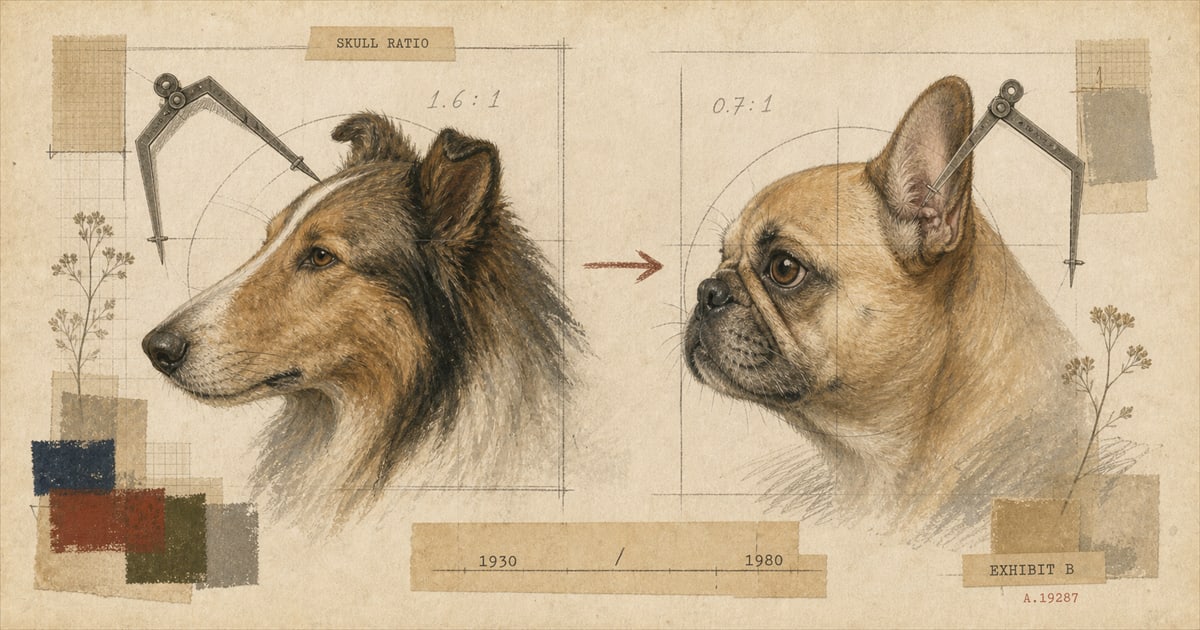
A second, more visible change happened to specific breeds’ faces directly, and there’s a paper trail for it. The French veterinary anatomist Claude Guintard, who sits on breed-standard commissions for the international canine federation, and Hélène Denis tracked what they call the craniofacial index, a ratio of muzzle length to skull, using photographs of champion Bulldogs, Pugs, and Dogue de Bordeaux from dog shows dating back to the late 1800s. In Bulldogs, the index held fairly steady, fluctuating between roughly a quarter and a third, through the nineteenth century and into the early twentieth. Then, in the 1950s, it dropped sharply, down to somewhere between a tenth and a sixth, and the deliberate push toward extremely short-faced, “hypertyped” dogs picked up from the mid-1960s onward. Pugs went through the same drift more gradually across the century, and champions with an elongated muzzle had essentially vanished from the show ring by the 1980s. The Dogue de Bordeaux never fully followed; longer-faced dogs kept winning there even after a more brachycephalic type entered competition.
That research came out through French Kennel Club channels rather than a peer-reviewed journal, which matters for how much weight to put on the exact percentages. It matters less for the basic trend. Anyone who has set a photograph of a Bulldog from 1900 next to a Bulldog standing in a show ring today has already seen the finding. Guintard and Denis just put a number and a decade on what was otherwise an impression.
Where the comparison actually breaks
It would be a clean story to say dogs are simply permanent juvenile wolves, wolf puppies who never had to grow up, kept that way on purpose because humans like how it looks. Versions of that idea show up constantly in popular writing about dogs, including in the biologist Raymond Coppinger’s influential theory that dogs domesticated themselves by scavenging at human dumps rather than being tamed by hand. His book Dogs: A New Understanding of Canine Origin, Behavior, and Evolution devotes a chapter to arguing that domestic dogs are, in shape and behavior, essentially arrested-development wolves. Coppinger’s dump-scavenging theory is one interpretation among several in a field nobody has fully settled, not a closing argument.
A 2017 study in Scientific Reports tested the arrested-development claim directly, at the level of the skull, and complicated it. Madeleine Geiger and colleagues CT-scanned 110 crania, 39 wolves and 71 dogs, including archaeological dog skulls from Neolithic and Iron Age sites, and mapped 34 landmark points on each one. If domestic dogs were simply juvenilized wolves, a young dog’s skull should resemble a young wolf’s skull, held at that stage for life. What they found instead was messier: some features did shift on a wolf-like developmental timeline, with young dogs resembling a younger wolf stage in certain respects, but other features were genuinely novel, present in dog skulls from shortly after birth and never seen in a wolf skull at any age, juvenile or adult. Dog skulls, in other words, aren’t young wolf skulls held in stasis. They’re partly that and partly something that never existed in a wolf skull at all.
What Mickey never had to survive
That distinction matters more than it first sounds, because of what it does to the two halves of this comparison.
A custom portrait made from an actual photograph doesn’t get Disney’s fifty-year luxury of gradual revision. It works from one real animal, with whatever face that animal actually has, whether that’s a Bulldog’s heavily selected muzzle or a mixed-breed dog’s entirely unselected one. The job is capturing the face that’s actually there, not the one a breed standard, or eighty years of show-ring judging, might have preferred.
Mickey Mouse’s fifty-year drift toward a bigger head and larger eyes cost him nothing. He’s a drawing. Every version of him, from the 1928 original to the one on a lunchbox today, is still technically alive and licensed somewhere right now. Redrawing a cartoon toward the bundle of features that makes an adult brain go soft is close to free.
A Bulldog’s drift toward that same bundle was not free. Selecting champion dogs generation after generation for a shorter muzzle, from a craniofacial index near a third down to something closer to a tenth, produced a real, physical airway on a real skull, the same kind of airway behind the breathing problems well documented in extremely brachycephalic dogs today. Mickey got cuter for nothing. The dog paid for it in cartilage.
Sources
- A Biological Homage to Mickey Mouse, essay text, Stephen Jay Gould, reprinted in The Panda’s Thumb, W. W. Norton, 1980.
- Neomorphosis and heterochrony of skull shape in dog domestication, Geiger et al., Scientific Reports, 2017.
- Facial morphology of brachycephalic breeds: evolution since the end of the XIXth century, Guintard & Denis, Société Centrale Canine, reproduced by DogWellNet.
- Dogs: A New Understanding of Canine Origin, Behavior and Evolution, Raymond and Lorna Coppinger, University of Chicago Press.
- Die angeborenen Formen möglicher Erfahrung, Konrad Lorenz, Zeitschrift für Tierpsychologie, 1943.
Welcome perk
Free expedited delivery on your first portrait
Get your digital proof in 1-2 business days instead of 2-3, free on your first portrait. Normally a $10 upgrade.
No spam. Just the perk and the occasional new style or guide.
Check your inbox for your code.