People assume that if you own the yard, you can bury what you want in it. That assumption is wrong often enough that it’s worth checking before you dig, not after.
In Missouri, a pet can be buried on private property, but the statute is specific about where: at least 50 feet from a property line, 300 feet from any well, surface water intake, public water supply lake, spring or sinkhole, 300 feet from a neighboring residence, more than 100 feet from a stream, lake or pond, out of any flood-prone low ground, and no deeper than six feet. In Los Angeles, the same act, backyard burial of a pet, is not permitted within city limits at all. There is no single US federal rule governing any of this. It is set state by state, and then narrowed again by city and county code, which is how the identical decision can be routine in a rural county and illegal a few miles away.
What burial actually requires, depending on where you live
The United Kingdom’s Environment Agency draws a distinction that’s easy to miss: garden burial of a small pet, a dog or a cat, carries no minimum groundwater distance requirement at all under current guidance. The rules tighten sharply once the animal is larger or the burial is commercial. A horse or similar-sized animal buried on private land needs to be at least 50 metres from a well, borehole or spring used for drinking water or food production, 30 metres from any other spring or watercourse, and 10 metres from field drains, with a metre of soil over the body and a metre of clearance above the water table.
Registered pet cemeteries answer to a different, stricter standard again: burial at least half a metre below the surface, sited more than 250 metres from a drinking-water well, 30 metres from any other spring or watercourse, and over 200 metres from a protected wildlife site. That distinction matters because the two figures get conflated constantly. The strict cemetery numbers are not the rule for a cat buried under the roses. They’re the rule for a business burying other people’s pets at scale.
None of this changes what burial means to the person doing it. It changes only what’s actually permitted, and that part is worth five minutes with your local county or council website before you pick a spot.
That five minutes is worth taking because the variation is real, not theoretical. A pet buried on a rural Missouri property might sit well inside every setback the statute lists. The same animal, buried the same way inside an incorporated city limit two counties over, could be a code violation nobody enforces until a new owner buys the house and finds out during a permit search. Some jurisdictions classify animal remains as solid waste, which pulls burial into the same regulatory category as anything else you’re not supposed to put in the ground untreated. None of this is written down in one place. It’s scattered across state statutes and municipal codes that were mostly written for other purposes and happened to sweep pets in.
Cremation, and the two categories nobody explains upfront
Ask a crematory what “cremation” costs and you’ll usually be offered two options without much explanation of what separates them: communal and individual. Communal cremation means multiple animals are cremated together, and the ashes aren’t separable or returned to any one owner. Individual, sometimes called private, cremation means your pet is cremated alone or in a partitioned tray, and what comes back is specifically theirs. Neither term is defined by a regulator. There’s no government body that sets the line between them. It’s simply the terminology the pet aftercare industry has settled on, consistently enough across providers that it functions as a standard, even without one behind it.
Demand for both is large and still growing. The Cremation Association of North America describes pet aftercare as one of the fastest-growing segments of the death care industry in the US and Canada, a fact tied directly to how many households have a pet to lose: 66 percent of American homes, 86.9 million of them, by CANA’s count. That scale is why the industry built formal training for it. CANA runs a joint Certified Pet Crematory Operator program with the International Association of Pet Cemeteries and Crematories, a credential that didn’t need to exist a few decades ago and now does.
What happens to communal ashes afterward is worth asking about directly, since it varies by provider and isn’t always volunteered. Communal remains are typically scattered or interred together in a shared memorial site maintained by the crematory or cemetery, not held for any individual family. If having your specific pet’s remains back matters to you, that’s the question that decides which option you want, not the price difference between them, which is usually the smaller factor.
The paw print, made before the loss
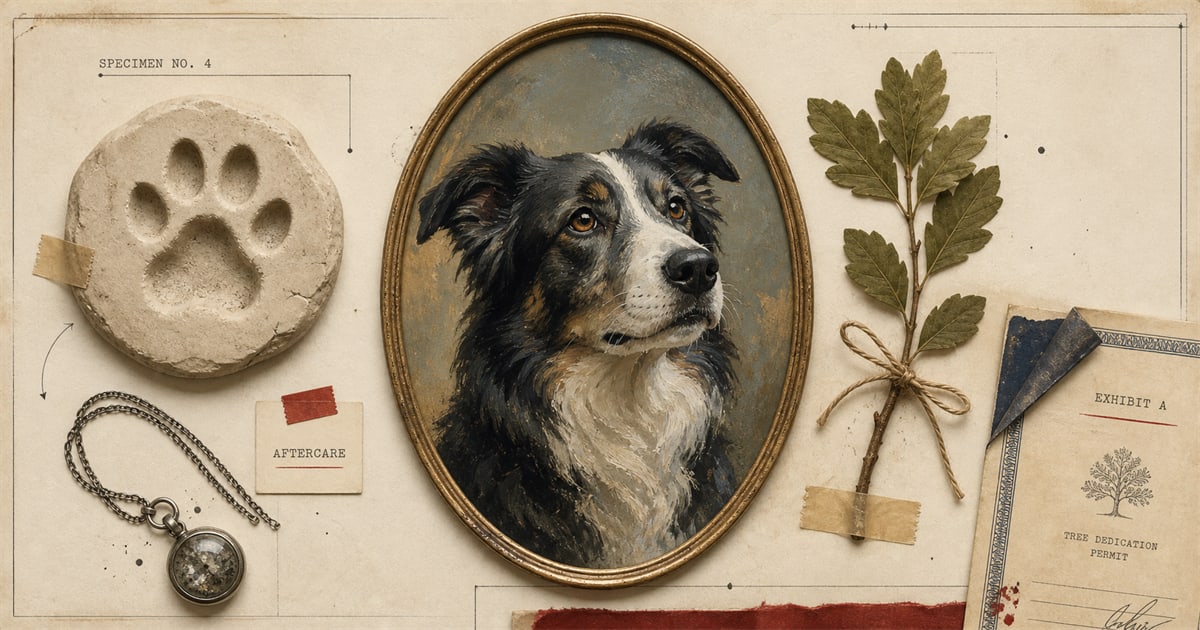
A paw print impression is the one item on this list that a family can arrange before the pet has died. ClayPaws, a kit made by World by the Tail, Inc. in Fort Collins, Colorado, has supplied veterinary practices for twenty-five years, and increasingly it’s used proactively, offered to a family before a scheduled euthanasia or a risky surgery so they have, in the company’s own phrase, something to hold on to. That timing detail changes what the object is. It isn’t only a keepsake made after the fact. For a lot of families it’s the last thing made while the animal was still there to press its foot into the clay.
A tree instead of a stone
Two organizations run this as a formal program rather than a private gesture. The Woodland Trust, the UK’s largest woodland conservation charity, offers individual tree dedications starting at £20, which includes a certificate with a personal message plus a map and information sheet for the specific wood the tree stands in. A dedicated bench or marker post costs considerably more. In the US, the Arbor Day Foundation runs Trees in Memory: a donation plants trees in national forests damaged by wildfire or other disaster, the dedication is logged in an official Tree Registry, and a card or certificate goes to whoever the gift is for. The Foundation’s own language for this is that trees carry healing attributes, which is a claim, not a fact, but it explains why the program exists at all.
What’s left unregulated
Cremation jewelry, ash-set pendants, lockets, rings, sits in a gap nobody has filled. There’s no rule found anywhere in US or UK law governing what proportion of ash the piece has to contain, whether that content has to be disclosed, or how it has to be verified. It is, functionally, an unregulated product category, which isn’t a reason to avoid it so much as a reason to buy from someone whose other work you trust, since the honesty of the process is entirely on them.
Paw print casting, by contrast, is about as low-risk as a memorial choice gets. There’s no burial code to check, no crematory contract to read closely, no jewelry maker’s honesty to take on faith. It’s clay, and a foot, and five minutes, which is part of why ClayPaws has been able to sit inside veterinary end-of-life protocols quietly for a quarter century without needing to become anything more complicated than that.
None of these choices rank above the others. Every one of them, the tree, the print, the stone, the pendant, exists because enough people wanted a specific, physical answer to the same problem: that a photograph on a phone doesn’t feel like enough, and a decision has to be made about what does. A memorial portrait sits alongside all of this rather than above it. It doesn’t require a permit, a distance from a well, or a training credential. It just requires a photo you still have.
Sources
- Environment Agency / DEFRA. “Animal burials: prevent groundwater pollution.” GOV.UK, updated 2023. gov.uk
- GOV.UK. “Pet cemeteries: where you can build them and how to register.” gov.uk
- Missouri Revised Statutes §269.020. revisor.mo.gov
- Cremation Association of North America. “Pet Aftercare.” cremationassociation.org
- Veterinary Wisdom / ClayPaws. “About ClayPaws Kits.” veterinarywisdom.com
- Woodland Trust. “Dedicate a Tree, Bench or Woodland.” woodlandtrust.org.uk
- Arbor Day Foundation. “Plant Trees in Honor of Your Loved Ones.” arborday.org
Welcome perk
Free expedited delivery on your first portrait
Get your digital proof in 1-2 business days instead of 2-3, free on your first portrait. Normally a $10 upgrade.
No spam. Just the perk and the occasional new style or guide.
Check your inbox for your code.