
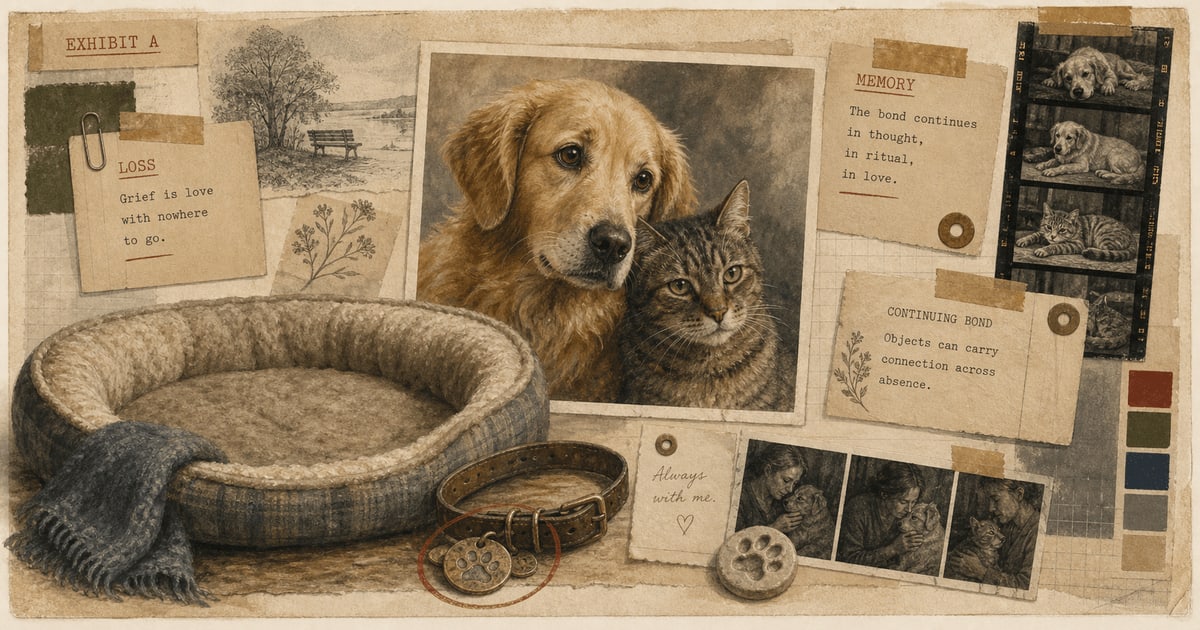
The hard part of pet grief is that the world often treats it as smaller than it feels. The house does not. The house knows exactly what changed.
Pet grief can feel like losing a family member because the pet often functioned as one in daily life. The loss is not only emotional. It is practical, spatial, sensory, and routine-based. The walk stops. The bowl stays clean. The sound at the door does not happen. The house keeps presenting evidence.
The useful version of this question lives in bereavement psychology. That is good news, because it means we do not have to choose between syrup and shrugging. We can look at the evidence, keep the part that is true, and leave the decorative nonsense on the curb where it can think about what it has done.
The Evidence Is More Interesting Than the Myth
Packman and colleagues discuss continuing bonds in pet loss, including the ways people maintain connection through memory and objects.
Cordaro describes pet loss as a form of disenfranchised grief, meaning grief that may not receive full social recognition.
Cornell veterinary grief resources note that grief after pet loss can be intense and complicated by routine disruption and social minimization.
Taken together, the research points toward a middle answer. The pet behavior is real. The human interpretation is partly real. The tidy internet explanation is usually where the furniture starts sliding around.
That matters because pets live in the overlap between biology and household meaning. A dog is not a moral slogan with paws. A cat is not a tiny philosopher paid in chicken. But both animals live close enough to people that biology, learning, culture, and projection get braided together. Pull on one strand and the whole household starts making comments.
What People Usually Get Wrong
Pet grief is not identical to every human bereavement, and comparing losses can become pointless fast. The useful claim is that pet grief is real, socially meaningful, and often underestimated.
The mistake is not affection. Affection is fine. The mistake is turning affection into a shortcut explanation. People do this constantly with pets because pets make us feel things quickly. A soft look, a paw on the hand, a cat choosing the one clean sweater, and suddenly the human brain is drafting a thesis with no peer review.
A better approach is slower. Ask what the animal is actually doing. Ask what the human is adding. Ask what the household has taught the animal to expect. Then ask what the culture has trained us to see. Usually the answer is not one thing. Pets are excellent at making one behavior do several jobs at once.
What the Research Can and Cannot Say
Research gives us useful boundaries. It can show patterns, test claims, compare species, document history, and puncture the more confident myths. It can tell us that dogs use human pointing in unusual ways, that cats can form attachment bonds, that pet-directed speech has measurable features, or that grief after pet loss is not a sentimental invention.
What research cannot do is fully explain your individual animal from across the room. Studies deal in samples and methods. Homes deal in one dog who refuses the expensive bed, one cat who trusts only the quiet person, one rabbit with strong views on baseboards, one old animal whose routine has become part of the architecture. The paper gives you a map. The animal is still the territory, and the territory is currently on the laundry.
That is not a weakness. It is the point. Good pet writing should let evidence sharpen attention, not replace attention. The best question is not, what does every pet do? It is, what does this evidence help me notice about the pet in front of me?
The Household Is Part of the Data
Laboratory studies are useful because they strip away noise. Homes are useful because they put the noise back in. The kitchen, the sofa, the door, the leash hook, the food bowl, the carrier, the laptop, the bed, and the person with the suspiciously emotional voice are all part of the animal’s real environment.
That is why pet research can feel both precise and incomplete. A study can tell us what dogs or cats did under controlled conditions. It cannot fully capture the private weirdness of one home, one animal, one person, and years of repeated routines. The science gives us guardrails. The household gives us texture. Both matter.
This is also why the best pet writing should not flatten animals into symbols. The dog in the study is not automatically your dog. The cat in the paper is not automatically your cat. But the research can help you see your animal with a little more accuracy and a little less folklore. That is not a small improvement. Folklore has been running unsupervised for centuries.
Why This Matters for Portraits
Memorial portraits help because they turn scattered absence into one calm object. They do not fix grief. They give memory a place to sit.
Portraits are not research papers. Thank mercy. But a good portrait still depends on accurate observation. If the article is about attention, the reference photo should show attention. If it is about attachment, the expression should feel socially directed rather than randomly cute. If it is about history or culture, the setting, object, or posture may carry more meaning than a generic pretty background.
That does not mean every portrait needs props, symbols, or a visual lecture. Usually it needs the opposite: one clear face, one honest expression, and a few details that belong to the actual animal. The science helps because it tells us which details might be doing real work. The art helps because it knows which details can stay and which ones need to sit quietly in the notes.
When you choose a reference photo, look for evidence rather than polish. Which photo shows the animal’s real social posture? Which one shows the eyes the family recognizes? Which one captures the habit people will miss? Which object, if any, belongs because it actually lived with the pet rather than because it would look cute in a product listing?
Those questions do more for a portrait than vague praise. “He was sweet” is true, maybe, but not very paintable. “He watched the door every evening at 5:10” gives the artist a world.
The Practical Takeaway
If you want the least sentimental version, here it is: pet grief feeling like family loss is not a cute side topic. It is a small doorway into how humans and animals learned to live together, read each other, misunderstand each other, and make meaning out of ordinary behavior.
That is why people keep clicking on these questions. They are not only asking about pets. They are asking why the pet feels so important, why the behavior lands so hard, and why a creature with no opinion on most human institutions can still rearrange a person’s day, house, memory, and camera roll.
The answer is rarely magic. It is usually better than magic: biology, history, learning, attention, culture, and love doing their ordinary work in a room with fur on the floor.
Sources
- Wendy Packman et al., Continuing Bonds and Psychosocial Adjustment in Pet Loss, Journal of Loss and Trauma, 2011
- Millie Cordaro, Pet Loss and Disenfranchised Grief: Implications for Mental Health Counseling Practice, Journal of Mental Health Counseling, 2012
- Cornell University College of Veterinary Medicine, Grieving the loss of a pet
Welcome perk
Free expedited delivery on your first portrait
Get your digital proof in 1-2 business days instead of 2-3, free on your first portrait. Normally a $10 upgrade.
No spam. Just the perk and the occasional new style or guide.
Check your inbox for your code.