
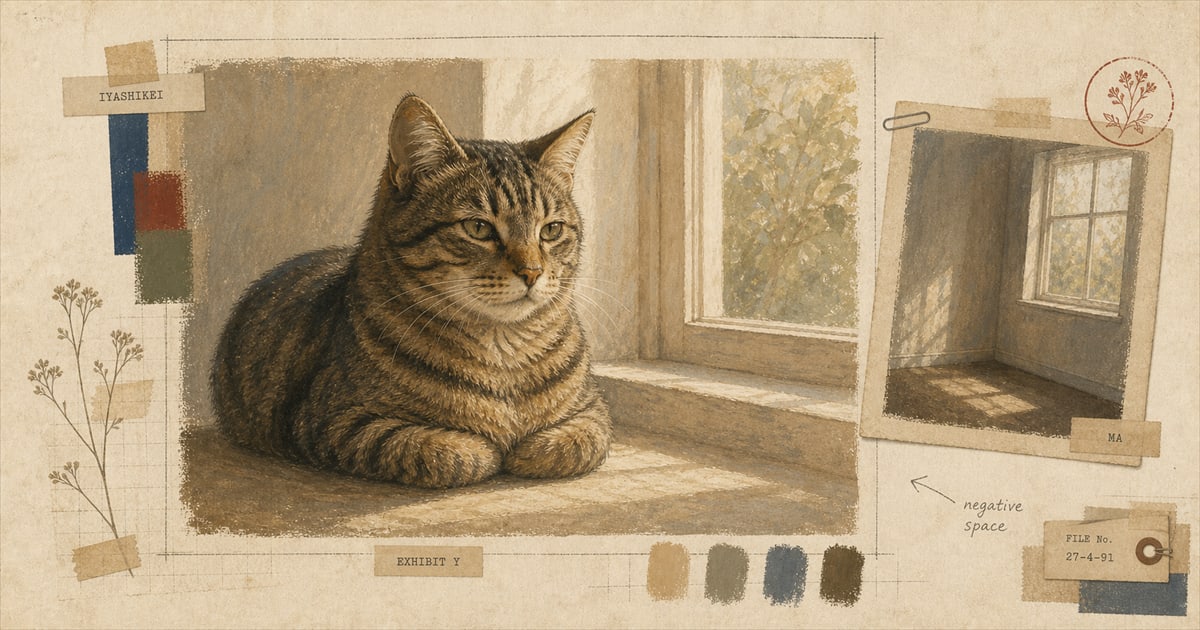
Iyashikei, the word critics use for anime built around healing rather than plot, is generally dated as a distinct subgenre to 1995. That is the same year as the Great Hanshin earthquake in Kobe and the Tokyo subway sarin gas attack, two of the worst shocks to hit postwar Japan, five months apart. A genre of anime about nothing happening in particular, a shopkeeper watering plants, a train pulling into a station on schedule, was named into existence the same year those two events landed on the same country.
MIT scholar Paul Roquet, in his 2016 book Ambient Media: Japanese Atmospheres of Self, ties the timing directly to what he calls Japan’s postwar “healing boom,” the iyashi trend: an entire media economy of ambient, low-stakes content built to regulate mood during a hard stretch, compounded by the recession running through the decade. By 1999, iyashi itself was named Japan’s buzzword of the year. This is not ancient aesthetic wisdom dressed up as a genre. It has a birth year, and the birth year is not a peaceful one.
What Actually Happens in an Iyashikei Story
Wikipedia’s definition is plain: iyashikei portrays “characters living out peaceful lives in calming environments,” built to have a healing effect on the audience. Critic Shaenon K. Garrity, writing for Otaku USA, put it more precisely: the genre focuses “less on character and plot, more on worldbuilding and creating an immersive visual setting.”
Aria: The Animation (Hal Film Maker), which premiered October 5, 2005, follows apprentice gondoliers training in Neo-Venezia, a future city built to resemble Venice, across thirteen episodes where the plot event of an episode is often just: someone learns to read the water properly. Yokohama Kaidashi Kikō, serialized in Monthly Afternoon from 1994 to 2006 by creator Hitoshi Ashinano before its first OVA adaptation by Ajia-do Animation Works in 1998, is set generations after civilization has quietly wound down, and it is explicitly built around mono no aware, the pathos of things passing. A world that has already ended, rendered gently instead of dramatically, is about the clearest possible argument that the quiet register is not the absence of stakes. It is a different relationship to stakes. And Laid-Back Camp, which began airing in January 2018, had a measurable effect outside the screen: the real campgrounds it depicted saw visitor numbers roughly triple after the show aired. Nobody made that decision because a character fought something. They made it because a character sat by a fire, made tea, and the fire looked like somewhere worth being.
Non Non Biyori (Silver Link), which began airing October 8, 2013, is set around a five-student, multi-grade schoolhouse in the fictional rural village of Asahigaoka. Nothing about that premise sounds like it should sell manga volumes. By December 2015, the source material had sold more than 1.3 million copies. That is a genre finding an audience precisely because the plot refuses to escalate, not despite it.
Journalist Patrick Lum, writing in the Guardian, has admitted the honest downside: iyashikei can look “boring” from the outside, because the plot genuinely is minimal. What it offers instead, he argues, is the comfort of watching wholesome, ordinary activity done well. That is not a consolation prize. It is the entire design goal.
The Word for the Space Between
Anime criticism, and Japanese art criticism generally, has a term for negative space used as an active compositional choice rather than empty leftover: ma (間), literally gap, interval, or pause. It shows up in discussions of ink painting, flower arrangement, even the spacing of a karate stance, and in anime specifically it describes the held shot: a train pulling away with nobody talking, three seconds on a teapot, a pause before a line of dialogue that a faster edit would have cut.
The popular version of this story treats ma as ancient, essentially and eternally Japanese, a piece of wisdom handed down unchanged since some unspecified distant century. The checkable history is more recent and, honestly, more interesting than that. Scholars Michael Lucken and Miriam Rosen, writing in the Journal of World Philosophies in 2021, trace ma’s status as a defining “Japanese” aesthetic concept to a much narrower timeline: philosopher Nakai Masakazu was theorizing it as early as 1929, in direct dialogue with German phenomenology, and the idea did not reach wide international attention until architect Günter Nitschke’s 1966 article, “MA: The Japanese Sense of Place,” introduced it to Western architectural discourse. What gets sold as timeless Japanese silence is, more precisely, a twentieth-century critical idea that got cast as ancient once it started traveling well. That does not make it less real as a working tool. Anime that holds a shot three seconds longer than convention allows is doing something specific and namable. It just was not called that before roughly 1929, and nobody in the West was calling it that before 1966.
What the Quiet Register Actually Matches
Ask someone what they picture when they say they want an anime portrait of their dog, and the image that comes up first is rarely the dog asleep on the rug. It is the dog mid-motion, backlit, rendered in the crisp cel-shaded style Pet on Canvas’s anime portraits actually use for that register: a hero shot. That instinct is not wrong. It is just aimed at only half the genre.
Most of what a dog or a cat actually does, most of the actual hours logged inside a household, is the iyashikei half: a cat in a sunbeam that has moved four feet across the floor since morning, a dog watching the door at the same time every evening, an animal doing nothing so specifically that the nothing has a shape to it. The genre built to depict a shopkeeper watering plants and a train arriving on schedule is, structurally, built to depict exactly that. Iyashikei does not need a dramatic pose because pets do not spend their lives in dramatic poses. They spend it in ma, in the gap, in the held shot nobody is rushing through to get to the next scene.
We have written elsewhere about why the ordinary photos are the ones people actually keep, working from memory research and the history of pet photography rather than from anime history. Different evidence, same shape of conclusion: the undramatic moment is not a lesser version of the relationship. For a large share of pet ownership, it is the relationship, just rendered without an event to justify it.
Ordering the Quiet Version
If you want this register specifically, say so plainly: a still pose, ordinary light, no action, no dramatic backlighting. That is a real, specific request, not the absence of one, and it should change which reference photo you send. The photo that works here is rarely the best one in the album. It is the mediocre one, slightly off-center, the cat mid-blink, lit by an actual window instead of a studio setup. That photo carries the ordinary information a quiet-register piece is built to hold, in the same way Yokohama Kaidashi Kikō needed a world that had already ended rather than one about to.
An anime portrait starts at $24.99 as a digital file, with a proof back in two to three business days and unlimited revisions before anything is final, whether the request is a dramatic hero shot or your cat doing nothing in a patch of light on a Tuesday afternoon.
Both of those are anime. Only one of them is actually how you spend most of your time with the animal.
Sources
Welcome perk
Free expedited delivery on your first portrait
Get your digital proof in 1-2 business days instead of 2-3, free on your first portrait. Normally a $10 upgrade.
No spam. Just the perk and the occasional new style or guide.
Check your inbox for your code.