
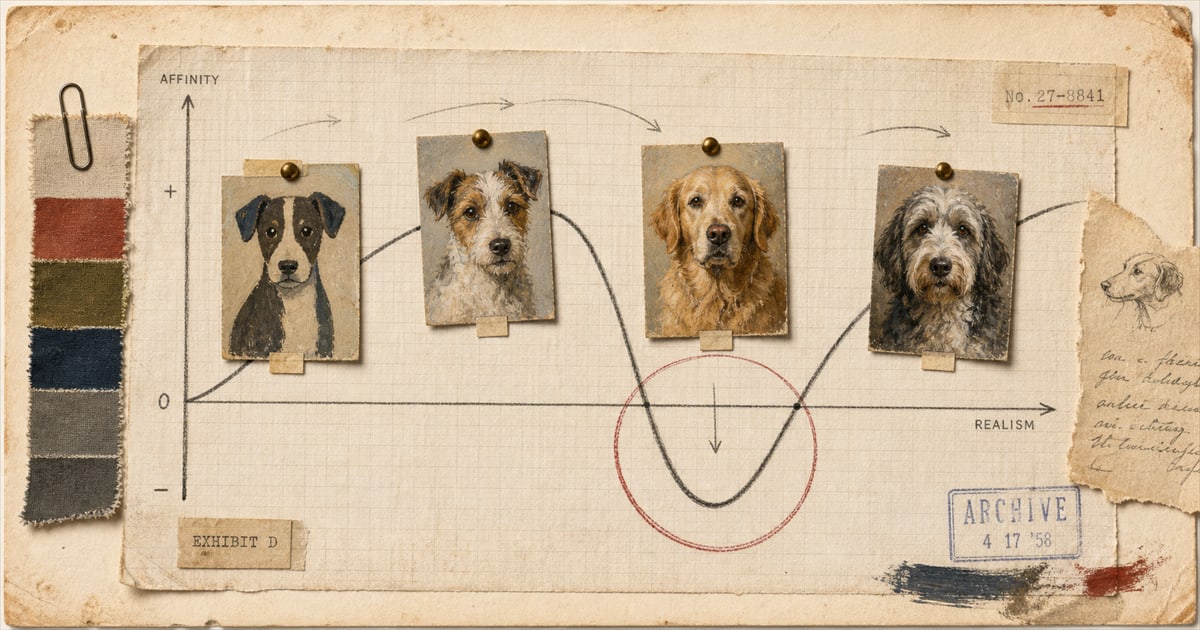
Masahiro Mori’s original 1970 graph plots two things against each other: how closely a form resembles a human being, and how much affinity we feel toward it. Off to the left, harmless and low on both axes, sits an industrial robot, all right angles and no face. One step up the first hill, ahead of an ordinary doll and a Bunraku puppet, well before the valley opens up, sits a stuffed animal.
Not a photograph of a pet. Not even a puppy. A stuffed toy, the kind that ends up wedged into a crib. Mori put it there on purpose, on the safe side of the chart. What he was measuring had nothing to do with whether the object on the page was human. It had to do with how close the representation came to photographic reality, and how badly that closeness exposed its own flaws.
A Stuffed Animal Beat the Robots
Mori published the essay in Japanese in 1970, in a journal called Energy, under the title Bukimi no Tani. The word he used for the feeling, shinwakan, does not translate cleanly. The first English version, in 2005, rendered it “familiarity.” The authorized 2012 translation, by Karl MacDorman and Norri Kageki for IEEE Robotics & Automation Magazine, settled on “affinity.” The now-standard English phrase “uncanny valley” was not even Mori’s coinage. It came from Jasia Reichardt’s 1978 book Robots: Fact, Fiction, and Prediction, and the translators borrowed it because English readers already knew it.
Reading Mori’s chart left to right along the still-object curve: industrial robot, stuffed animal, ordinary doll, Bunraku puppet, then the drop, then prosthetic hand, then healthy person climbing the far side. The stuffed animal sits next to “toy robot,” not off in a category of its own. Mori’s model treats a cute, unrealistic toy animal exactly the way it treats a cute, unrealistic toy robot. Species was never the variable he was tracking.
The Footnote Where He Almost Said It
Mori does gesture at animals once, in a footnote, while explaining why the eerie feeling exists at all. He frames it as an inherited threat-detection instinct: “The sense of eeriness is probably a form of instinct that protects us from proximal, rather than distal, sources of danger. Proximal sources of danger are corpses, members of different species, and other entities we can closely approach.”
He puts “members of different species” in the same clause as “corpses” and moves on. He never returns to it. He never asks whether a near-photographic painting of a dog could sit in the valley the way a near-photographic android does. For decades, the field mostly did not ask either. Then, in 2013, somebody checked.
Dogs Fall Into the Valley Too
Yamada, Kawabe, and Ihaya had already shown that people rate morphed human faces (blends sliding from clearly human toward clearly not) as more unsettling right around the point where the viewer can no longer tell what category they are looking at. That is the category-uncertainty account of the uncanny valley: the discomfort tracks the ambiguity, not the human-ness of the subject. In a second study, described in a 2015 review by Wang, Lilienfeld, and Rochat in Review of General Psychology, Yamada and colleagues ran the same design on morphed dog faces and got the same dip. The review’s own summary of the result: “By showing that it is not limited to androids, this replication supports Ramey’s (2006) idea that the uncanny phenomenon is linked to general categorization uncertainty arising at any category boundary.”
Any category boundary. Not the human one specifically. A dog face sliding from photograph toward abstraction can trip the same wire a human face does, at the same point in the slide: not at “obviously real,” not at “obviously not real,” but somewhere in the ambiguous middle where the brain cannot finish sorting the image.
A Result That Did Not Survive Contact
The dog study is not the only place researchers went looking for the valley outside humans, and the record is messier than a tidy story would prefer. In 2009, Steckenfinger and Ghazanfar published a widely cited finding in PNAS: macaque monkeys looked longer at real monkey faces and at obviously unrealistic synthetic ones than at synthetic monkey faces that were realistic but slightly off, the same avoidance pattern researchers associate with the uncanny valley in humans. It got covered as evidence that the valley was not a human-specific glitch at all.
Thirteen years later, a team led by Carp ran a more controlled direct replication in rhesus macaques and published the result in Scientific Reports: “We largely found no support that rhesus monkeys perceive an uncanny valley when viewing our stimuli.” Wang, Lilienfeld, and Rochat’s review of the human literature alone reaches a similarly unresolved verdict: “Whether the uncanny valley exists is still an open question.” Nobody involved in this research is claiming a settled answer, for monkeys or for us. What is settled is narrower and more interesting: whatever is happening, it was never fenced off to one species.
Mori’s Actual Advice Was Never “Stay Human”
Here is what makes the misreading strange: Mori’s own prescription runs the opposite direction from how “the uncanny valley” gets used today. He does not tell designers to keep pushing toward realism until they clear the valley. He tells them to stop trying. His phrase is “a moderate degree of human likeness,” and his example of successful design is eyeglasses: a pair of lenses does not resemble a real eyeball in any way, and nobody finds that eerie, because eyeglasses were never trying to pass as eyeballs in the first place.
PARO, the therapeutic seal robot used in dementia wards, was built on the same logic on purpose. Its designer picked a baby harp seal specifically because almost nobody has handled one and formed an opinion about what a real one feels like, according to IEEE Spectrum’s reporting on the robot’s development. No reference point, no mismatch to notice.
Compare that to two 2019 films that chased the opposite strategy. Disney’s photorealistic Lion King remake gave its lions a fully rendered coat and skeleton and then had them sing show tunes with a human’s range of facial expression, and critics reached for “uncanny valley” almost immediately. Cats went further and fused human faces onto feline bodies, a literal blend across the species line rather than a photorealistic rendering of one. Scholars Kate Cantrell and Lorna Hawkes later gave the backlash a full academic treatment in The Journal of Popular Culture, tracing the audience’s discomfort back to exactly this kind of anthropomorphic blending and the uncanny valley effect it produces. The pattern fits Mori’s logic: it was not that the film depicted cats. It was that it could not decide what it was depicting.
None of this is a rule about dogs, cats, monkeys, or people specifically. It is a rule about commitment. A representation that fully commits to being a stylized object, whether that is a stuffed toy, a pair of glasses, or a seal nobody has ever petted, does not ask to be measured against the real thing. A representation that gets most of the way to photographic and stalls does.
That is the actual logic behind why a stylized anime portrait of your dog reads as charming rather than off, and a near-photographic render with one flat eye or a slightly wrong ear can read as unsettling even though it sits closer to a photograph. The valley was never checking which side of the species line the subject stood on. If you are weighing which style commits hardest to being art rather than a stand-in for a photograph, the style guide walks through what each one is actually doing, and the portfolio has enough range across styles to see the pattern for yourself.
Mori drew that graph in 1970 with a stuffed animal sitting comfortably near the top, next to a toy robot, nowhere near the valley. Decades and a shelf of replications later, the closest thing to a consensus is that he was right for a reason nobody fully appreciated at the time. The valley was never checking your species. It was checking your commitment.
Sources
- Mori, M., MacDorman, K. F., & Kageki, N. (2012). “The Uncanny Valley [From the Field]”, IEEE Robotics & Automation Magazine, 19, 98-100.
- Wang, S., Lilienfeld, S. O., & Rochat, P. (2015). “The Uncanny Valley: Existence and Explanations.” Review of General Psychology, 19(4), 393-407.
- Steckenfinger, S. A., & Ghazanfar, A. A. (2009). “Monkey visual behavior falls into the uncanny valley.” PNAS, 106(44), 18362-18366.
- Carp, S. B., et al. (2022). “Monkey visual attention does not fall into the uncanny valley.” Scientific Reports, 12, 11760.
- Cantrell, K., & Hawkes, L. (2021). “Empathy, Anthropomorphism, and the Uncanny Valley Effect: Why Audiences Strayed Away from the Film Adaptation of Cats.” Journal of Popular Culture, 54(3), 571-593.
- Ackerman, E. (2020). “Cuddling Up to the Prickly Subject of Robot Baby Seals”, IEEE Spectrum.
Welcome perk
Free expedited delivery on your first portrait
Get your digital proof in 1-2 business days instead of 2-3, free on your first portrait. Normally a $10 upgrade.
No spam. Just the perk and the occasional new style or guide.
Check your inbox for your code.