A pet portrait can be technically neat and still not look like your pet. This is the part people notice immediately, even if they cannot explain it.
The portrait might look like a golden retriever. It might look like a cat. It might even look like a very nice cat, the kind of cat who would have excellent credit if cats participated in financial systems. But if it does not look like your specific pet, it misses the point.
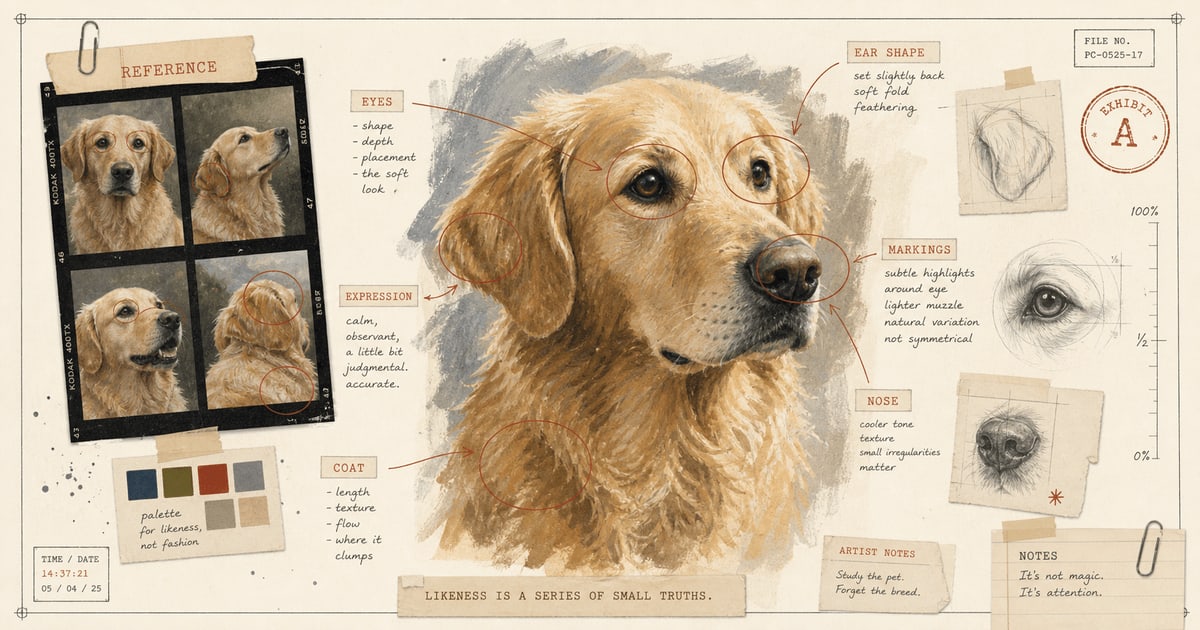
Likeness is a stack of small truths.
Breed Is Only the Starting Point
Breed gives the artist a general map. A pug has a different face structure than a whippet. A Maine Coon carries fur differently than a Siamese. A golden retriever has a different head shape than a German shepherd. Useful information.
Breed is not identity.
Two dogs of the same breed can look completely different. One has a broader muzzle. One has softer eyes. One has an ear that refuses order. One looks permanently cheerful. One looks like it has read the lease and found issues.
Custom art should not stop at breed resemblance. “Looks like a Labrador” is fine for a search result. It is not enough for the wall.
The Eyes Do Most of the Work
The eyes are usually the first thing people check. Not because humans are poetic geniuses, though congratulations to us for noticing faces. It is because the eyes carry expression, attention, and recognition.
A good artist studies:
- Eye shape
- Eye spacing
- The angle of the gaze
- The catchlight
- The softness or intensity of the expression
- The darker rim around the eye, if the pet has one
Small changes matter. Eyes too round, the pet looks surprised. Eyes too sharp, the pet looks stern. Catchlight wrong, the eyes look flat. There is no polite way to say this: flat eyes are where portraits go to lose the plot.
This is why your reference photo matters. If the eyes are dark, blurry, closed, or hidden under shadow, the artist has less to work from. Use the clearest eye photo you have, even if another photo has a better pose. Ideally, send both.
Expression Is Not Decoration
Expression is the difference between “a dog” and “my dog waiting for me to acknowledge that dinner is allegedly late.”
Some pets look gentle. Some look alert. Some look skeptical. Some look deeply unserious. The artist needs to understand that emotional temperature.
This does not mean exaggerating the face into a cartoon. It means preserving the expression that made you choose the photo in the first place.
If your pet was shy, the portrait should not force them into fake confidence. If your cat looked judgmental in the photo, that may be historically accurate and should be handled with respect. If your dog had a soft, open, slightly worried face, that is part of the likeness too.
The best portraits keep the pet’s social presence intact. A small phrase in the order notes helps: gentle, goofy, alert, regal, anxious, sleepy, mischievous, calm. The artist does not need a memoir. A useful adjective is plenty.
Markings Are Not Optional Details
Markings are often where the family recognition lives.
The white patch on the chest. The darker stripe near the nose. The little freckle. The uneven socks. The one eyebrow spot that makes the dog look concerned about the economy.
Automated or template-based portraits often smooth these things away. That is a mistake. Small irregularities make the portrait feel specific.
When you tell the artist what matters, mention markings that should stay accurate. Do not assume they are too small to matter. If you would notice it missing, it is worth saying.
Useful notes:
- Please keep the white chin
- The left ear has a darker edge
- Her eyes are amber, not brown
- The front paw has one white toe
- His nose has a small pink spot
None of this is fussy. It is the job.
Head Shape and Proportion Matter More Than People Think
People tend to focus on color first. Artists have to look at structure.
The length of the muzzle, width of the head, distance between the eyes, angle of the ears, size of the nose, slope of the forehead, and shape of the cheeks all affect likeness. Get the color right but the head shape wrong, and the portrait will feel off.
This is why extreme camera angles are risky. A photo taken from above can make the head look oversized and the body small. A close phone photo can stretch the nose. A side angle can hide the facial width. Your phone is useful. It is not innocent.
The safest reference photo is at eye level, with the face clear and the lens not too close. If you have one straight-on photo and one three-quarter photo, send both. That gives the artist structure and personality.
Fur Direction Is Part of Likeness
Fur has direction, density, and shape. Texture is only the surface.
A golden retriever’s chest fur falls differently from a husky’s neck fur. A poodle’s curls do not behave like a short-haired tabby coat. A wiry terrier has different edges than a smooth dachshund. If the artist paints generic fur texture everywhere, the portrait starts drifting away from the pet.
Good fur work follows the animal’s form. Around the eyes, the strokes get tighter. Around the cheeks, they may soften. On the chest, they may flow outward. On short coats, restraint matters. Painting every hair is not realism. Sometimes it is just panic with a brush.
This is another reason natural light helps. It shows fur direction and color shifts without making the coat look like one flat mass.
The Best Reference Is Usually a Combination
One photo rarely explains everything.
The best expression might be in a slightly softer photo. The best coat color might be in another. The best markings might show up in a full-body shot. The artist can use those together, as long as you explain what each photo is for.
Try this:
Photo 1 has his best expression. Photo 2 shows the coat color better. Photo 3 shows the white chest patch.
That one note saves guesswork. Guesswork is where details go to become average.
What a Custom Portrait Adds
A custom portrait does not just copy the image. It interprets it with care.
It decides what to sharpen, what to simplify, what to soften, what to remove, and what to preserve exactly. A distracting background can be cleaned up, a harsh flash corrected, attention brought back to the eyes, and the markings that make the pet recognizable kept.
That is the difference between a custom portrait and a filter. A filter applies one effect to everything. A custom portrait makes decisions specific to your pet. Quiet distinction. Large consequences.
Every Pet on Canvas portrait is custom made from your photo, with a proof in 2 to 3 business days and unlimited revisions before final approval. Digital portraits start at $24.99, and custom canvases start at $49.99.
For the best result, start with a clear photo, send a few supporting references, and add one or two notes about the details that matter. You can start your portrait here, or read our reference photo guide first if your camera roll needs a small intervention.
A good portrait looks like the pet your household has been quietly organized around for years.
Welcome perk
Free expedited delivery on your first portrait
Get your digital proof in 1-2 business days instead of 2-3, free on your first portrait. Normally a $10 upgrade.
No spam. Just the perk and the occasional new style or guide.
Check your inbox for your code.