
Twenty four dogs went through a test that varied two things independently: whether a person in the room was visibly paying attention to them, and whether food was present. Only one of those two variables changed the dogs’ faces. When the person’s attention was on the dog, the inner corner of that dog’s eyebrows lifted at more than twice the rate it did when the person looked away, 0.121 compared with 0.056, a difference the study reports at p < 0.0001. Food, whether present or not, made no measurable difference on its own. The dogs were reading the audience, not the treat.
That movement has a name in the coding system researchers use to catalog dog facial expressions: AU101, the inner brow raise, the same muscle behind what everyone already calls puppy dog eyes. We’ve covered the muscle itself elsewhere; what the 2017 study by Juliane Kaminski and colleagues adds is that dogs deploy the movement selectively, aimed at whoever is watching, not as a fixed resting expression. It’s closer to a sentence than a face.
That’s the actual starting point for figuring out which pets suit an anime portrait, and it’s a better question than the one people usually ask, which is about ear shape. The honest answer isn’t erect ears versus floppy ears. It’s which parts of a given animal’s face can physically move, and anime, more than any of the studio’s other five styles, is built to reward whichever parts those turn out to be.
Ears Are a Channel, Not a Verdict
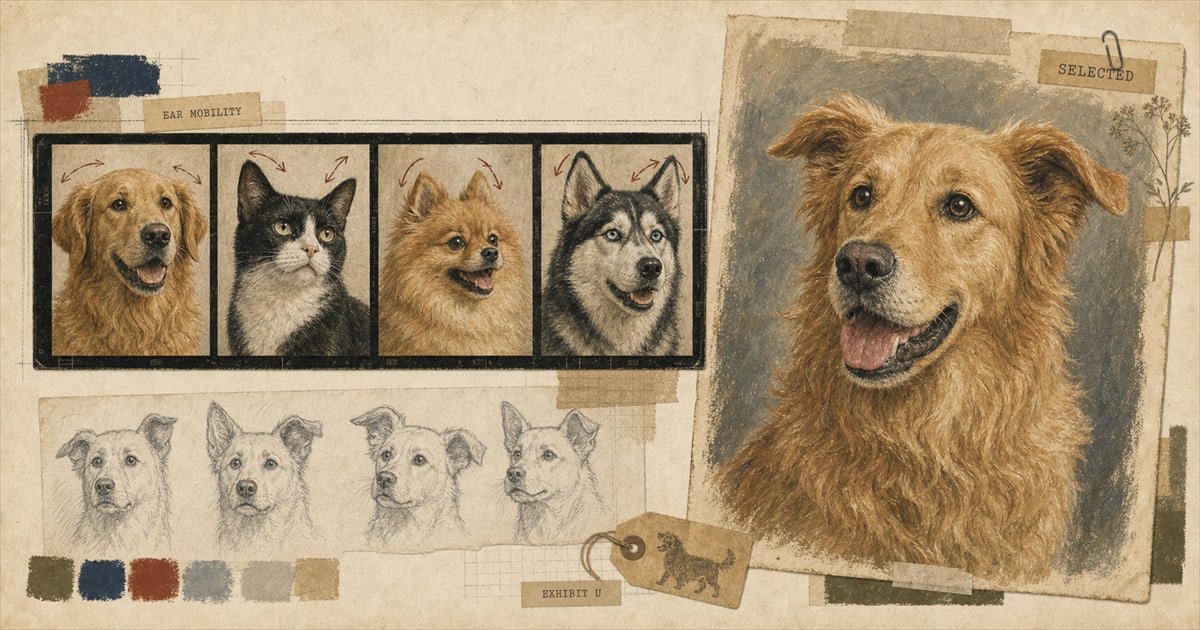
The common assumption is that a dog with pointed, upright ears has a more expressive face than a dog with ears that hang, and that assumption is close enough to true that it’s worth being precise about where it breaks. A team led by the Italian researcher Marcello Siniscalchi spent years cataloging what dog ears actually do, and their 2018 review in the journal Animals lays out a real vocabulary for it. Ears drawn back against the skull can signal simple appeasement, or, pressed flatter and harder, real fear or threat. Pinned so flat they nearly vanish, the paper calls it “seal ears,” reserved for extreme fear. Held out sideways, neither forward nor back, it’s “airplane ears,” a genuinely conflicted state. Ears held forward and slightly raised mean interest and approach. None of that is available to an ear that doesn’t move.
Here’s the part that undoes the tidy erect-versus-floppy story: Siniscalchi’s team specifically notes that dogs with permanently erected ears, meaning ears that are anatomically fixed rather than flexible, lose part of that same behavioral repertoire. A rigid, upright ear that can’t lift, flatten, or swivel is no more useful for signaling than a heavy drop ear that barely moves at all. The variable is mobility, not shape.
This is where a German Shepherd earns its reputation honestly. The breed’s ears are erect by default, but they’re also constantly working: swiveling toward sound, flattening under submission, angling forward in focus. A rendering of a Shepherd has a second signal to draw alongside the eyes: the erect silhouette is only where it starts. The same is true of a Pembroke Welsh Corgi, whose oversized ears read as alertness almost independent of what the rest of the face is doing, or a Pomeranian, whose small fox-shaped ears are rarely still, or a Border Collie, whose semi-erect ears tip and rotate constantly during the fixed, intense stare the breed was bred to hold on livestock. In each of those faces, the ears aren’t decoration sitting on top of the real expression. They’re a second channel running alongside it, and a style built on visible, exaggerated linework has real material there to work with.
When the Ears Go Quiet, the Eyes Take Over
Plenty of pets don’t have that second channel available, and it has nothing to do with how expressive they actually are. A Cavalier King Charles Spaniel’s ears are long, heavy, and structurally built to hang. They don’t swivel or flatten in any way a viewer can track. The same is true of a Golden Retriever, a Labrador Retriever, and a Dachshund, whose long, low-set ears frame the face without ever moving through it.
None of that makes those faces quieter. It relocates the signal. The eyebrow muscle behind AU101 sits above the eye, not in the ear, and every dog that has it, floppy-eared or not, can still use it. A dog whose ears are off the table simply puts visibly more of its expressive effort into the eyes and mouth, because that’s what’s left to work with. A Cavalier’s large, dark, forward-set eyes and a Golden’s open, relaxed mouth aren’t incidental to those breeds’ reputations for warmth. They’re doing the job the ears can’t.
Some mouths carry information too, separate from any facial muscle research. Samoyeds have naturally upturned corners at the mouth, the so-called “Sammy smile,” an anatomical quirk that evolved to keep drool off the coat in cold climates rather than to look friendly, though it reads as exactly that. It’s breed trivia, not a peer-reviewed finding, but it’s a reminder that the eyes aren’t the only place a still-eared face keeps talking.
Anime is arguably the one portrait style built specifically to meet that shift. Its whole visual grammar runs on the eyes: layered, lit, rendered in more visible detail than anything else on the face, while everything else gets simplified into clean line and flat color. A dog whose ears can’t help isn’t a harder case for the anime style. It might be an easier one, because the expressive load is already sitting exactly where the style is built to put its attention.
Cats Run a Different System
None of the research above involves cats, and that’s not an oversight so much as an accurate reflection of how differently cats evolved to communicate. Cats have their own dedicated facial coding system, called CatFACS, developed by researchers including Catia Caeiro and Bridget Waller. The underlying finding isn’t that cats have a smaller emotional vocabulary than dogs. It’s organized on a different principle.
A 2023 study by Lauren Scott and Brittany Florkiewicz observed 53 adult domestic shorthair cats at CatCafé Lounge in Los Angeles and found that what separated a friendly facial expression from an unfriendly one wasn’t how many individual movements a cat used. It was which movements got combined. Cats build expressions compositionally, the way a small set of letters builds a large number of words, rather than by keeping one dedicated face for one dedicated feeling.
That matters for a portrait because a cat’s face gives an artist less mobile geometry than a dog’s face to start with. Cat ears do move and do carry information, but a cat’s most legible channel tends to be the eyes themselves, specifically pupil size, which shifts fast and reads clearly even in a photograph. A tabby cat rendered mid-dilation, pupils blown wide against a dramatic backdrop, isn’t an exaggeration invented for the portrait. It’s the single most legible thing that animal’s face was already doing. You can see the actual example in the portfolio.
The Photo Matters More Than the Breed
None of this adds up to a breed list, because the same breed produces individual animals whose ears are stiffer or looser, whose eyes carry more or less of the load, whose particular face has settled into its own habits over years in one household. What the research actually hands a pet owner is a better question to ask before ordering: not “does my pet’s breed suit anime,” but “what is my pet’s face already doing in the photos I already have.”
A reference photo that catches a dog’s ears mid-motion is genuinely useful information for an anime portrait. So is a photo that catches nothing from the ears at all but gets the eyes wide open and lit. Neither is the worse photo. They’re different instructions to the artist about where that particular animal’s real signal lives. Digital anime portraits start at $24.99, with a proof back in 2 to 3 business days and unlimited revisions before anything is finalized, which matters here mainly because a photo that nails the eyes but misses the ears, or the reverse, isn’t a one-shot gamble.
If you’re weighing anime against the studio’s other five styles, the style guide walks through what each one actually asks of a reference photo. And if your dog happens to be a husky, the complication is coat, not expression, which is its own separate argument.
The dogs in that 2017 study didn’t know they were being scored. They lifted an eyebrow because someone was looking, the same muscle a Cavalier’s ears will never let it use any other way, the same muscle a Corgi barely needs because its ears are already saying most of it. Whatever channel your particular pet has left available, it’s been running that signal, unpaid and mostly unnoticed, for the entire time you’ve owned a camera.
Sources
- Kaminski, Hynds, Morris, Waller, “Human attention affects facial expressions in domestic dogs,” Scientific Reports, 2017
- Kaminski, Waller, Diogo, Hartstone-Rose, Burrows, “Evolution of facial muscle anatomy in dogs,” PNAS, 2019
- Siniscalchi, d’Ingeo, Minunno, Quaranta, “Communication in Dogs,” Animals, 2018
- Scott, Florkiewicz, “Feline Faces: Unraveling the Social Function of Domestic Cat Facial Signals,” Behavioural Processes, 2023
- Caeiro, Burrows, Waller, “Development and application of CatFACS,” Applied Animal Behaviour Science, 2017
- AnimalFACS project (DogFACS, CatFACS, and related species-specific coding systems)
Welcome perk
Free expedited delivery on your first portrait
Get your digital proof in 1-2 business days instead of 2-3, free on your first portrait. Normally a $10 upgrade.
No spam. Just the perk and the occasional new style or guide.
Check your inbox for your code.