
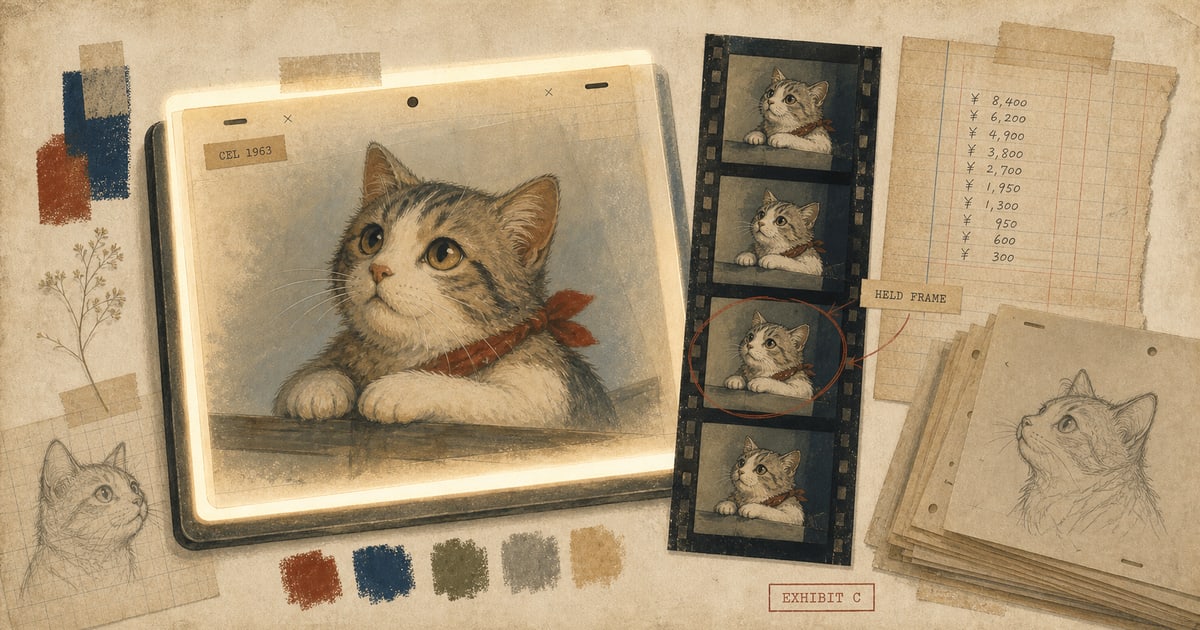
In the fall of 1962, a producer named Ichiro Kimura offered Osamu Tezuka 300,000 yen per episode to turn his manga Tetsuwan Atomu into a weekly television show. Tezuka said no, that was too low. Meiji Seika and Fuji TV came back with a real offer: 1,200,000 yen per episode, four times the original ask. Tezuka looked at that number and did something nobody expects from this story when they hear it secondhand. He lowered it himself, to 550,000 yen, less than half of what was already on the table.
He wasn’t being cheap by accident. He was pricing out the competition. If no other studio could make a weekly animated series for that little money, no other studio would try to take the slot. It worked. Tetsuwan Atomu, known to American audiences as Astro Boy, premiered on Fuji TV on January 1, 1963, made by Tezuka’s own studio, Mushi Production, and nobody else was positioned to compete for the format. The number that gets repeated in almost every retelling of this story, 500,000 yen, treats that lowball as a fact of the world Tezuka was stuck with. It wasn’t. It was a number he chose, to win a fight he started.
The problem is that 550,000 yen was never close to what the show actually cost. The first episode ran roughly 1,300,000 yen, more than double the contracted rate. The second cost around 900,000. Later episodes settled between one and two million. Mushi Production was losing money on broadcast fees from the beginning, and Tezuka knew it going in. His actual business model was to eat the loss on the weekly episode and make it back on merchandising and on foreign licensing. That spring, he sold 52 episodes to NBC for the American market at 3,000,000 yen per episode, more than five times his own domestic asking price. The low number was the loss leader. The eyeglasses and lunchboxes were the business.
The Shortcuts Were Real, Even If the Budget Myth Isn’t
None of that changes what the animators in the room had to do with the time and money they actually had. Whatever the true cost per episode, it was not enough to animate a weekly television series the way Disney animated a feature film, and the staff at Mushi Production, many of them Tezuka’s own founding team, built an entire toolkit to make a show anyway.
Eiichi Yamamoto, one of Mushi Production’s original five employees, later cataloged the tricks. Characters moved “on threes,” meaning a new drawing every third frame instead of every frame, which works out to roughly 8 drawings per second instead of a standard 24. Some scenes ran even slower, four to six frames per second. When a character needed to talk, the studio didn’t redraw the whole face. It cut the mouth into its own piece of cel, laid over a static head, and cycled through three mouth positions: open, half open, closed. Everything else on the character held still. Yamamoto called this “sectioning,” animating one part of the body while the rest of the drawing does nothing.
There was also a cel bank: a library of stock poses, walk cycles, and reaction shots that could be pulled and reused across different episodes instead of drawn fresh every time. As the series ran longer, the reuse got bolder. Episode 120 spliced in footage from episode 11 and episode 68. Episode 138 pulled from nine earlier episodes. A couple of later episodes were near-total remakes of stories the show had already told, dressed up as new installments. None of this was hidden from the staff. It was the plan.
Tezuka had already been working this way before Astro Boy existed. His 1962 short Aru Machikado no Monogatari, released about a year before the TV series, has been described by film historians at the British Film Institute as limited animation “at its crudest,” with characters moving jerkily and plotlines looping on themselves. The instinct to do more with less didn’t arrive with the TV budget. The TV budget just gave it a mass audience.
What Wasn’t the Budget: The Flat Color
Here is where the story usually gets one thing wrong, and it’s worth being precise about it, because the wrong version is the more popular one. Anime’s flat, outline-and-fill color look, the thing people usually picture when they picture the medium, was not a Tezuka innovation and not a product of the Astro Boy budget crunch. It’s just what cel animation looks like.
Cel animation works by inking a character’s outline on the front of a clear sheet of celluloid and painting flat, opaque color on the back of it, a technique called opaquing. That process produces flat, brushstroke-free color fields by physical necessity, and every studio using cel animation did it that way, including Disney, going back to the late 1930s. Snow White has flat cel color too. Nobody was cutting corners to get it. What Mushi Production actually cut wasn’t color rendering, it was motion: fewer drawings, less movement per second, more reused footage. The flat look and the limited motion get bundled together in the popular telling of this story, but they came from different places entirely, and only one of them was a budget decision.
There’s an even stranger wrinkle here. The idea that flat, stylized, non-naturalistic animation could be treated as a legitimate artistic choice, not a cost-cutting compromise, was pioneered in the United States, a full generation before Astro Boy aired, by animators trying to get away from Disney on purpose. United Productions of America, founded in 1941, built its identity on rejecting Disney’s full, photorealistic animation in favor of flat, graphic, stylized design. Their 1945 short Brotherhood of Man is described by film historians as being “in complete defiance of the Disney approach.” Their 1950 short Gerald McBoing-Boing won an Academy Award using the same sparse, minimal style. That happened thirteen years before Astro Boy premiered. The West invented flat, limited animation as an artistic statement first. Japan’s television industry adopted a version of it a decade later mostly because it had to.
The flat faces and thrifty mouths from this era left one feature conspicuously untouched: the eyes, which kept getting more detailed even as everything around them got cheaper to draw. That’s a separate story about attention and abstraction rather than economics, but the two habits, cutting everywhere except the eyes, grew up in the same underfunded studios at the same time.
The Myth, and the Man Who Started It
The claim that Tezuka’s 550,000 yen figure personally suppressed animator wages across the entire Japanese industry for decades traces to one specific moment: a 1989 interview with Hayao Miyazaki, given shortly after Tezuka’s death. Miyazaki said that because Tezuka set the price so low in 1963, anime production budgets had been low ever since. It is a striking claim, delivered by one giant of the medium about another, at the moment of the older man’s death, and it has been repeated as settled history for over three decades.
It is also disputed, directly and by name. In a 2020 book reviewed by the anime historian Jonathan Clements, Yusuke Nakagawa argues the real founding figure was 550,000, not 500,000, that Tezuka based it on live-action production costs of the era rather than pulling it from nowhere, and that Tezuka raised the rate to 1,550,000 yen once it became clear the original number didn’t work. Nakagawa places the blame for the industry’s later wage problems elsewhere: on rival studios TCJ and Toei Animation, who underpriced their own work and signed away merchandising rights to broadcasters, the exact trap Tezuka had structured his own deal to avoid.
Mushi Production itself went bankrupt in 1973, undone in part by the same underpricing strategy that made it famous. The studio that supposedly broke the industry’s wages ran the same playbook into the ground on itself first.
There’s no confirmed quote of Tezuka expressing regret about any of this. What exists instead is a decade of behavior: he raised his rates, he leaned harder into merchandising and licensing, and he kept working within a set of technical limits his own studio had helped invent. Whether that adds up to regret or just adaptation is a question historians are still arguing about, which is a strange thing to be able to say about a cartoon that first aired in 1963.
If you want to see what the visual language born from all of that looks like applied to something other than a robot boy, our anime portrait style draws on the same clean linework and bold color fields this whole argument produced, minus the frame-rate compromises. You can browse the portfolio or see how the process works before deciding if it’s the right style for your pet.
Sources
- Osamu Tezuka Responsible for Low Anime Wages? Maybe Not, Says Author, Otaku USA Magazine, 2020.
- Foundation of the Anime Nation (book review), Jonathan Clements, 2020.
- The History of Mushi Pro – 01 – The Road to TV Anime (1960-1965), Animétudes, 2023.
- Looping around limitations: the experimental shorts of Tezuka Osamu, BFI Sight and Sound.
- United Productions of America, Wikipedia.
- Mushi Production, Wikipedia.
Welcome perk
Free expedited delivery on your first portrait
Get your digital proof in 1-2 business days instead of 2-3, free on your first portrait. Normally a $10 upgrade.
No spam. Just the perk and the occasional new style or guide.
Check your inbox for your code.