Put a costume on a pet for a portrait, so the common wisdom goes, and the animal’s actual face gets traded for a joke. The eye goes to the costume first and the pet second, and the entire point of a portrait was the pet. That instinct is mostly right. It is not right about a set of Japanese picture scrolls that are roughly eight hundred years old, eleven meters long, and hold National Treasure status, which spend their entire length dressing frogs and rabbits in the robes of Buddhist monks, and get funnier, not weaker, for it.
Chōjū Jinbutsu Giga, usually shortened to Chōjū-giga, is a set of four handscrolls made across the late Heian and early Kamakura periods, roughly the twelfth into the thirteenth century, held by Kōzan-ji temple in Kyoto and carrying Japan’s National Treasure designation. The scrolls have their own story, including a very public argument over whether they count as the first manga. What matters for a piece about costuming is a narrower detail from the same scroll set: alongside the famous wrestling rabbits, some of the animals are dressed, specifically, as Buddhist monks, robes and all. The historian George Bailey Sansom, writing in 1931, put it plainly: “His pictures of animals disporting themselves in the garb of monks are alive with satirical fun.” The costume, in other words, is the joke. Dress a rabbit as a monk and the rabbit does not disappear into the robe. The rabbit becomes a specific, pointed comment on actual monks.
The same trick, worked by cats
Utagawa Kuniyoshi ran a version of the same move seven centuries later, using actual cats. Working in Edo through the 1840s under a shogunate that periodically banned print depictions of kabuki actors, he found that a cat, drawn in an actor’s exact stance, could suggest precisely which performer was being lampooned without technically depicting a human being at all. The full story of what Kuniyoshi’s cats were doing, and why his studio was full of the real thing, is its own post. What matters here is narrower: the costume was never decorative. It pointed at something specific and true, a particular actor’s particular pose, and it worked only because the artist understood exactly how a cat’s body moves well enough to make the substitution readable at a glance.
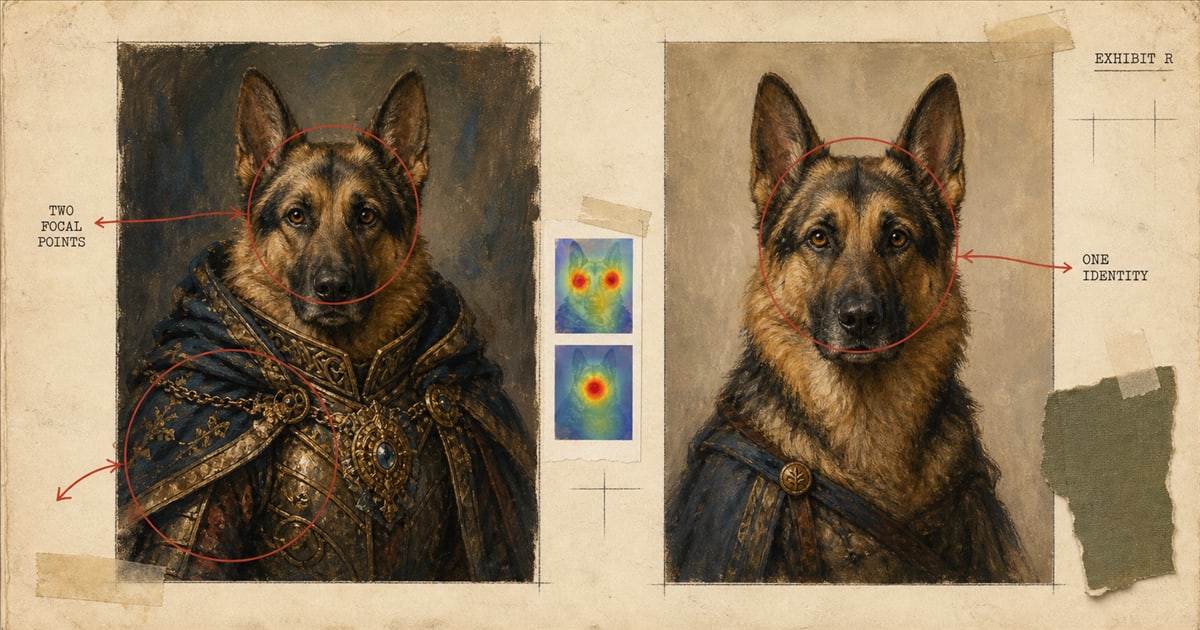
That is the difference a costume needs to survive: a costume that references something real about the animal wearing it sharpens a portrait. A costume that could belong to anyone, human or animal, competes with it.
Why the eye leaves the face
There is a reason costuming a pet is such a persistent impulse, and it has a documented explanation. Psychologists Nicholas Epley, Adam Waytz, and John Cacioppo published a three-factor theory of anthropomorphism in Psychological Review in 2007, arguing that people project human traits onto animals for three overlapping reasons: because they lack solid knowledge of what the animal is actually thinking and fill the gap with something familiar, because understanding an unpredictable creature through human categories makes it feel more manageable, and because reaching for connection is easier through categories the human brain already knows how to use. A costume leans hardest on that third factor. Dressing a dog as a soldier, a knight, a student, or an anime hero pulls the animal into categories that are more socially legible than “my dog, as my dog.” That is not a flaw in the owner. It is what the theory predicts almost anyone would reach for.
The trouble is that the same costume making the animal legible in human terms also makes it visually competitive with the face, and that mechanism has a name too. In 1933, the psychologist Hedwig von Restorff ran the experiment that gave the isolation effect its name: an item that stands out from everything around it gets noticed and remembered out of proportion to the rest of the scene. A cape, a full-body uniform, a helmet, anything that changes an animal’s outline, is exactly this kind of isolated element, and it pulls the eye toward itself by the same mechanism that makes it memorable. Portrait photographers have understood this without needing the citation for a long time: keep the eyes and face in sharp focus, let everything else go soft, use shallow depth of field specifically so nothing competes with the one thing the image is actually about.
What the welfare research actually says
It would be convenient here to add that costuming stresses the animal, and plenty of pet-care writing implies exactly that. It should not, because the research is not there to support it. A search of the literature on dog clothing and stress, cortisol, or behavior turns up almost nothing specific to decorative costuming. The one directly relevant, current, peer-reviewed study, published in Animals in 2026 by Tamlin Wang and colleagues, looked at overnight coat use in outdoor-housed working farm dogs in New Zealand: eight dogs, a crossover design, coat versus no coat. The dogs slept more with a coat on, 48.1 percent of the night compared with 40.0 percent without one, especially on cooler nights. That is a study about functional, weather-appropriate coats improving comfort for working dogs left outside overnight. It says nothing about a costume worn for one photo, and it should not be stretched to say otherwise. The honest state of the science is that decorative pet costuming has not been studied for stress or welfare in any way this piece can point to. Better to say that plainly than to borrow authority the evidence has not earned.
The test that actually holds up
None of this adds up to a case against costumes generally. It adds up to a case against one particular kind: the costume that could belong to any dog. A stock cape, a generic armor set pulled from a template, a uniform with no connection to anything true about the animal wearing it, competes with the face for no reason beyond decoration, and loses nothing by being cut. That is a real cost with no offsetting benefit.
A costume that references something specific and true about the animal is a different object, closer to what the Chōjū-giga frogs and Kuniyoshi’s cats were actually doing. A dog who is genuinely, daily, a couch-bound tyrant who has never done anything heroic in his life, wearing a hero’s cape, is a joke that lands precisely because everyone who knows the dog recognizes exactly how untrue it is, which is its own kind of specificity. A dog who actually works, wearing a vest that reflects the actual job, is not costuming at all. It is documentation, the same argument this site has made before about collars: include what belongs to the animal, not what was attached to them because it looked good in a template. The test is not costume versus no costume. It is whether the outfit is telling the truth about this one animal, or borrowing a stranger’s outfit and hoping the personality comes along for free.
Anime as a style raises the stakes on this test rather than lowering them, because the genre’s visual language runs on legible archetype. A hero’s silhouette is built to be instantly recognizable across a thousand different characters, which is close to the opposite of what a portrait is supposed to do. A costume pulled straight from that archetype toolkit fights the one job the portrait actually has. A costume built around what is true of the animal underneath it does the opposite: it gives the archetype somewhere specific to land.
The frogs in the Kyoto scroll are not funny because they are frogs wearing robes. They are funny because whoever drew them understood monks well enough to know exactly what to exaggerate. That rule held in Edo in the 1840s, and it holds now, whether the reference photo is a golden retriever in a cape or a cat who has genuinely never done anything heroic in her life.
Sources
- Chōjū-giga, Wikipedia.
- Utagawa Kuniyoshi, Wikipedia.
- Epley, N., Waytz, A., & Cacioppo, J. T. (2007). “On Seeing Human: A Three-Factor Theory of Anthropomorphism.” Psychological Review, 114(4), 864-886.
- Von Restorff effect, Wikipedia.
- Wang, T., et al. (2026). “Accelerometry-Based Assessment of Overnight Coat Use on Dog Sleep, Activity, and Nutrient Digestibility.” Animals.
Welcome perk
Free expedited delivery on your first portrait
Get your digital proof in 1-2 business days instead of 2-3, free on your first portrait. Normally a $10 upgrade.
No spam. Just the perk and the occasional new style or guide.
Check your inbox for your code.