
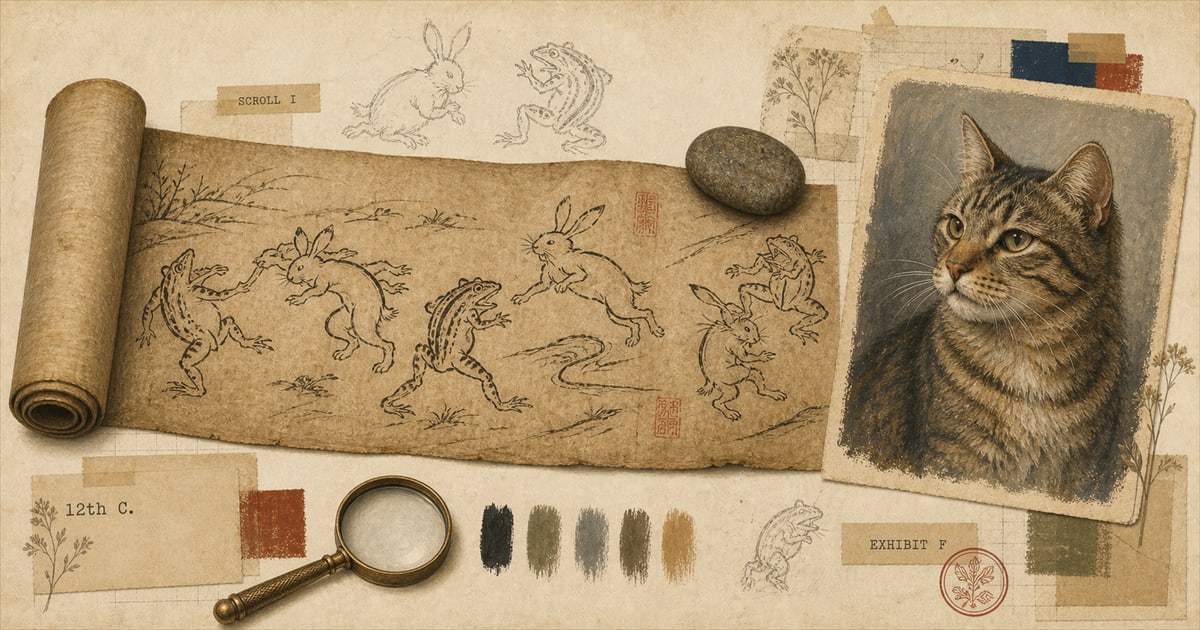
Section 10 of a twelfth-century handscroll shows a rabbit and a frog locked in a sumo hold, one flipping the other onto its back while foxes and monkeys watch from the margin. A few sections over, a frog sits enthroned as a Buddha figure, worshipped by rabbits and monkeys bowing in front of it the way acolytes bow at a real temple ceremony. The University of Michigan’s library holds a catalogued copy of both scenes, dated to the late twelfth century, filed under nothing more dramatic than “Scroll 1, Section 10.” There’s no caption anywhere on the paper. There never was one. The joke reads perfectly fine eight hundred years later without a single word of text.
The scroll is one of four, together called Chōjū Jinbutsu Giga, usually shortened to Chōjū-giga, Scrolls of Frolicking Animals and Humans. They belong to Kōzan-ji, a temple in Kyoto’s Ukyō ward, and they carry Japan’s National Treasure designation, its highest protection for a cultural work. The temple doesn’t actually keep the originals on site. Scrolls 1 and 2 are entrusted to the Tokyo National Museum, Scrolls 3 and 4 to the Kyoto National Museum, and what a visitor sees at Kōzan-ji’s own Sekisui-in hall are reproductions.
Call Chōjū-giga the first manga and you get agreement from the most famous cartoonist Japan has ever produced, and disagreement from most of the historians who study manga for a living. Neither side is being careless. The disagreement itself, who gets to decide what counts as the ancestor of a modern medium, turns out to be the more interesting story than either flat answer.
Four scrolls, probably not one hand
The scrolls were made across a span running from the late Heian period into the early Kamakura, roughly the twelfth into the thirteenth century, and no source agrees on a single completion date because there likely isn’t one. The brushwork changes noticeably scroll to scroll, in ways that read less like one artist’s evolving hand and more like several different hands working across decades. Tradition credits the whole set to Toba Sōjō, a monk also known as Kakuyū, who lived from 1053 to 1140. It’s a tidy attribution, and an unlikely one. Some sections are dated into the thirteenth century, which would put brush to paper roughly a hundred years after the man supposedly holding it had died. No document survives naming him as the artist. The credit is closer to a folk tradition than a signature.
The “about rabbits” reputation belongs specifically to Scroll 1, the one with the wrestling match and the frog-Buddha. Scroll 2 is a different project entirely: no jokes, no satire, just a careful procession of sixteen kinds of animals, real ones like oxen, horses, and dogs alongside fantastical ones like dragons and qilin-like creatures, arranged more like a reference sheet than a story. Scroll 4, in noticeably thicker line work than the rest, drops the animals almost entirely and shows humans gambling and moving through court and religious ceremony instead, in scenes that read like the earlier animal jokes translated back onto people. Whoever assembled these four scrolls over however many decades wasn’t making one book. They were making at least three different kinds of book and binding them under a single name.
Scroll 3, the least discussed of the four, moves through its own mix of court ceremony and monks going about ordinary business, continuing the drift away from animals that Scroll 4 completes. Read all four in the order they’re numbered and the ratio of animal to human keeps sliding, scroll by scroll, until the animals are gone entirely and whatever the original joke was ends up aimed at people instead.
The label is younger than the scroll by about eight centuries
“First manga” sounds like the kind of claim that accretes over centuries until nobody remembers who said it first. It isn’t. It has a named author and a publication date. Hosokibara Seiki, whom later Japanese scholars describe as the country’s first manga historian, made the case explicitly in his 1924 book Nihon Manga Shi, “History of Japanese Manga.” The claim is a twentieth-century historian’s argument about a twelfth-century object, made a little under a hundred years ago by someone with an obvious stake in giving the still-young medium of manga a deep, respectable lineage.
Tezuka watched it and called it the spirit of manga, on television
The version of the claim that actually shaped public opinion came fifty-eight years later, from Osamu Tezuka, the cartoonist behind Astro Boy and Black Jack and the person most responsible for manga looking the way it looks today. On November 21, 1982, NHK’s arts program Nichiyō Bijutsukan aired an episode called “Chōjū-giga and Me: Tezuka Osamu,” built around Tezuka sitting with the scrolls and talking about them on camera. He told viewers the work was, in his words, the root of today’s manga and the spirit of manga itself. He described first seeing the complete scrolls around 1955 and thinking that manga hadn’t changed at all since the twelfth century. NHK judged the episode significant enough to remaster it in 4K and rebroadcast it on February 29, 2024, more than four decades after it first aired and thirty-five years after Tezuka’s own death.
The historians who came after him mostly disagree
Manga critic and novelist Ōtsuka Eiji pushes back directly in his 2018 book Manga de Wakaru Manga no Rekishi, arguing that the visual grammar of modern manga, the paneling, the motion lines, the exaggerated expressions, traces more plausibly to the arrival of Disney-style animation in Japan during the twentieth century than to a scroll made seven hundred years earlier. Yomiuri Shimbun writer Kanta Ishida is blunter still, stating flatly that there is no connection between the traditions of Chōjū Jinbutsu Giga and contemporary manga. Nobody has produced a documented technical chain, a specific panel convention or drawing habit that modern manga artists borrowed directly from the scrolls, that would settle the argument either way. What exists instead is one genius’s retrospective, televised endorsement on one side, and the working historians who had to reckon with it on the other.
That’s not a fight between an ignorant public and a settled scholarly consensus. It’s a fight between the single most influential cartoonist of the twentieth century and the historians who came after him. Both readings survive because both have a real name attached, not because one is folklore and the other is fact.
Chōjū-giga wasn’t the last time a Japanese artist put an animal where a human face would have caused a problem. Six hundred years later, Utagawa Kuniyoshi drew cats in kabuki actors’ exact stage poses to slip satirical prints past shogunate censors, the animal’s face standing in for a specific performer’s, plausible deniability built right into the whiskers. Whoever drew the frog-Buddha wasn’t hiding from anyone. The satire in Chōjū-giga aims straight at Buddhist ritual itself, using the imagery of the temple against the temple, in a work that temple has held and protected for eight centuries since.
No page of any of the four scrolls carries a single word of text. Whatever narrative or joke is happening runs entirely through sequence and the posture of the bodies on the paper, which either makes this an eight-hundred-year head start on a visual habit that describes a large share of what a modern comic panel still does, or it’s a coincidence dressed up as a lineage by people who wanted Japan’s most popular export to have deep roots. The anime style now sitting alongside watercolor and oil painting in the studio’s own lineup is several centuries downstream of that argument either way, close enough to the Tezuka side of the debate that it’s worth knowing the debate exists at all.
After eight hundred years, the only party in the dispute who never got a vote is the rabbit. Section 10 still has it mid-throw, still winning the match, whichever history turns out to be true.
Sources
- Kōzan-ji Temple: Chōju Jinbutsu Giga (Scrolls of Frolicking Animals)
- Tokyo National Museum: Masterpieces of Kōsan-ji Temple, The Complete Scrolls of Chōjū Giga
- University of Michigan Library Digital Collections: Scroll 1, Section 10, Frogs and Rabbits Wrestling
- Tokyo Weekender: Tracing the Origins of Japanese Comics With Toba Sōjō
- Da Vinci Web: On Hosokibara Seiki’s 1924 origin theory and Ōtsuka Eiji’s counterargument
Welcome perk
Free expedited delivery on your first portrait
Get your digital proof in 1-2 business days instead of 2-3, free on your first portrait. Normally a $10 upgrade.
No spam. Just the perk and the occasional new style or guide.
Check your inbox for your code.