
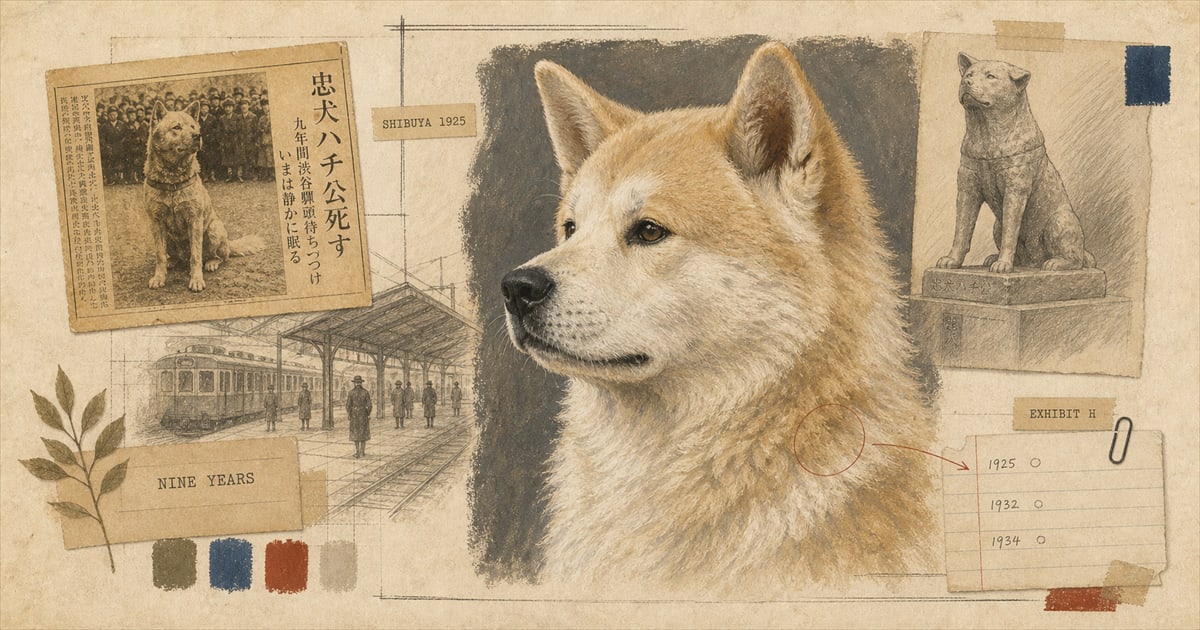
Hidesaburō Ueno left for Tokyo Imperial University on the morning of May 21, 1925, the way he had most mornings that year, and his young Akita walked partway with him before turning back toward the house, the way the dog always did. Ueno never came home. He suffered a cerebral hemorrhage at work and died that day. Hachikō did not know that. He kept showing up at Shibuya Station in the evening, at roughly the hour his owner’s train used to arrive, for close to ten years: Ueno died in May 1925, Hachikō died on March 8, 1935, nine years and ten months apart. That part of the story is true, and it is the part carved into the plaque outside the station. It is also not the most interesting part.
The interesting part is what happened to the story after the dog stopped waiting, because a specific person, a specific newspaper, a national ministry of education, and a specific war all put their hands on it afterward. One claim that circulates about Hachikō is that he changed how Japanese artists draw dogs: line work, posture, the character-design habits that later show up in manga and anime. That claim does not hold up. There is no art-historical record of an Akita from Shibuya changing how anyone in Japan holds a brush or a pen. What Hachikō actually changed was stranger and better documented: what a Japanese dog story is about, and who gets to decide that.
A Purebred Survey Found Him First
Hachikō was not discovered as a legend. He was discovered as data.
Hirokichi Saitō founded the Nihon Ken Hozonkai, the Society for the Preservation of Japanese Dogs, in May 1928, concerned that the country’s native breeds were being crowded out by the Western dogs that had become fashionable in Japanese cities. Running a survey to count how many purebred Akitas were left, he found an old, poorly kept dog sitting at a train station in Shibuya and recognized him as one of the animals worth saving. He documented Hachikō in July 1928 and published what is generally treated as the first written record of him in the society’s registry that August.
The loyalty story and the purebred-preservation story are, underneath it all, the same story. Most retellings keep only the first half.
The Headline Got the Number Wrong, and It Still Made Him Famous
Hachikō stayed a local curiosity for four more years. What made him a national figure was the Asahi Shimbun, which ran a piece on October 4, 1932, under the headline “Tale of a Poor Old Dog: Patiently Waiting for Seven Years for the Dead Owner.” Saitō corrected some of the article’s looser facts a month later, on November 5, but the headline had already done its work. It was, technically, accurate for the day it ran: 1932 minus 1925 is seven.
Hachikō kept coming back to the station for almost three more years after that headline made him famous, which means the version of the story most people know today, nine years, is already an update on the version that actually went viral in 1932. The dog outlasted his own headline.
A Textbook Decided What the Story Meant
Hachikō died on March 8, 1935. That same year, his story was accepted for a second-grade morals textbook for the incoming school year, used to teach loyalty, kindness, and gratitude to Japanese schoolchildren. That is the moment the story stopped being local reporting and became curriculum: a fixed lesson handed to seven-year-olds with a meaning already attached to it, that a dog does not abandon a debt of loyalty, and neither should you.
Textbooks do not choose their lessons by accident. Selecting Hachikō for a national morals class, the same year he died, meant someone had already decided what kind of loyalty his waiting was supposed to represent.
The Same Loyalty, Pointed at the Emperor
That someone kept deciding, for the next decade. Hachikō’s fame arrived in Japan during a period when the state was actively looking for stories that modeled loyalty to the Emperor, and his story was folded into that project: his devotion to Ueno served, at least informally, as a stand-in for the devotion citizens were meant to feel toward the imperial institution. This pattern is well attested across historical accounts of the period, though it comes down through general scholarship rather than a single signed decree, so treat it as a real and repeated framing rather than an official order.
It left a mark. After the war, officials were reportedly reluctant to rebuild Hachikō’s statue at all, specifically because his loyalty had become entangled with wartime nationalism. When Japan did rebuild it, the meaning was deliberately walked back. Postwar retellings reframed Hachikō as a symbol of ordinary personal devotion, not political loyalty. The dog never changed. What the dog was made to mean changed twice, once during the war and once after it, and both changes were choices made by people, not by the animal waiting at the station.
The Skewers Weren’t What Killed Him
For decades, the popular version of Hachikō’s death involved yakitori skewers found lodged in his stomach, a detail that fit the story’s melancholy shape almost too well: even in death, something ordinary and human had hurt him. In a re-examination around 2011, decades after his death, a plainer story emerged. Hachikō had terminal cancer and advanced filariasis, the parasitic heartworm infection his original 1935 autopsy had already noted without connecting it to his death. The skewers were there. They were not what killed him.
That is the same move the whole story keeps making, once you look for it. The sentimental detail is the one that survives the retelling. The mundane, biological, well documented one is the one that actually happened.
Two Sculptors Named Andō, and Everyone Who Copied Them
The bronze statue outside Shibuya Station today is not the original. The first one, unveiled in 1934 while Hachikō was still alive to be photographed beside it, was made by a sculptor named Teru Andō. It was melted down for scrap metal during the war in 1945. The replacement, unveiled August 15, 1948, was made by Teru Andō’s own son, Takeshi Andō. Two sculptors, one family, one dog, thirteen years apart.
Once a template exists, other people build from it, openly. A 2015 bronze at the University of Tokyo’s Yayoi campus, by sculptor Tsutomu Ueda, shows Ueno and Hachikō reunited. A 2012 replica purchased through eBay stands in Woonsocket, Rhode Island. A 2016 pair of statues at a pet memorial park in Lafayette Township, New Jersey, are direct copies of the Tokyo original. None of these present themselves as independent local legends. They are acknowledged copies of one dog’s statue, standing in for loyalty in general, the way a saint’s image gets repeated on other churches.
Even fiction reaches for the same shape. In the manga One Piece, the dog character ChouChou guards a location and waits faithfully, in a way that has been read directly as an echo of Hachikō’s story: the template is durable enough that a different medium, decades later, in a different genre, still recognizes it as the correct shape for a loyal dog to take. Japan’s own anime portrait style inherited that shorthand without anyone needing to spell it out. A dog that waits reads as devoted before the artist has drawn a single expression on its face, because the story already decided what waiting means.
None of this changed how anyone draws a dog. It changed what a dog story in Japan is allowed to be about. An Akita or a Shiba Inu carries that history whether an owner asked for it or not: both breeds hold Japan’s Natural Monument designation, a legal category usually reserved for old trees and scenic gorges, the Akita since 1931 and the Shiba Inu since December 1936, both pushed through by the same preservation society that first wrote Hachikō down. The loyalty was real. So was the machinery that decided, more than once, what it should mean.
The loyalty in most dog quotes people actually repeat tends to flatten into something clean and greeting-card sized. Hachikō’s real story resists that. It has a founding survey, a corrected headline, a textbook, a war, a postwar correction, and two sculptors from the same family. The dog just kept showing up. Everyone else kept deciding what that meant.
Sources
- Hachikō, Wikipedia.
- Akita (dog), Wikipedia.
- Shiba Inu, Wikipedia.
- Time Out Tokyo, “Everything You Ever Wanted to Know About Hachiko, Japan’s Favourite Dog.”
Welcome perk
Free expedited delivery on your first portrait
Get your digital proof in 1-2 business days instead of 2-3, free on your first portrait. Normally a $10 upgrade.
No spam. Just the perk and the occasional new style or guide.
Check your inbox for your code.