
In 1987, Gillian Rhodes, Susan Brennan, and Susan Carey ran an experiment that should not have worked the way it did. They took photographs of familiar faces, generated three versions of each one, and asked people to identify them as fast as they could. One version was accurate, a straightforward line drawing. One was a caricature: a computer had measured how each face differed from an averaged, generic face, then pushed those differences further in the same direction. The third was an anticaricature, pushed the opposite way, toward the bland average. If a stylized drawing were simply a degraded copy of a photograph, the accurate version should have won. It did not. People identified the caricatures faster than the accurate drawings, and identified the accurate drawings faster than the anticaricatures.
That result has held up for almost forty years because it points at something specific about how faces get remembered. A mental picture of someone you know is not a photograph. It is closer to a list of what makes that particular face different from an average face: these eyes are set a little wider, this nose is a little longer, this jaw comes to more of a point. Exaggerate the right differences and you are not distorting the face, you are sharpening the parts a viewer’s memory was already keying on. Push the face toward the average instead, and you erase the information recognition depends on. Same mechanical process, opposite direction, opposite result.
The exaggeration has to point the right way
The caricatures in the original study came from Susan Brennan’s Caricature Generator, a program built two years earlier that measured a target face against a computed norm and amplified the gap, point by point. It is a mechanical, almost boring definition of exaggeration: not “make it weirder,” but “make it more itself.” That distinction matters more than it sounds like it should, because it is the difference between a good stylized portrait and a bad one. An anime rendering of a dog is not neutral simplification, the way a blurry photo is neutral degradation. It is a series of choices about which differences to keep and which to discard, and the caricature research says the direction of those choices determines whether the result reads as more recognizable or less.
This is also where the finding needs a caveat, because it is easy to oversell. The caricature advantage applies to faces the viewer already knows. Nobody in the Rhodes, Brennan, and Carey study was meeting these people for the first time; they were being asked to name someone already stored in memory. A stylized portrait of your own dog works on the same principle for you and the people who already know that dog. It is not a general claim that distortion always helps, and it does not mean more exaggeration is automatically better. The anticaricature condition sat in the same experiment as proof that exaggeration in the wrong direction actively hurts.
Where a face keeps its identity
If some features are worth exaggerating and others are not, the next question is which ones. Face recognition research gives a fairly consistent answer, and it is not “the whole face equally.” James Tanaka and Martha Farah showed in 1993 that a feature like a nose is identified more accurately when it appears inside the context of the full face than when it is shown alone, evidence that people process faces as an integrated whole rather than a checklist of parts. Daphne Maurer, Richard Le Grand, and Catherine Mondloch later broke that whole-face processing into three separable pieces: reading the basic layout of two eyes over a nose over a mouth, binding the features into one gestalt, and tracking the precise spacing between features, how far apart the eyes actually sit, how long the distance runs from eyes to mouth. That third piece, the spacing, turns out to carry an outsized share of identity information.
Within that whole-face system, the eye region does most of the work. Studies that occlude parts of a face and measure recognition accuracy find that hiding the eyes costs a viewer more than an unbiased statistical accounting of the eyes’ information content would predict. People do not just weight the eyes heavily because the eyes happen to be informative. They weight the eyes beyond what the raw data justifies. That is a bias built into the visual system, not a matter of taste.
Put those two findings together and you get a rough anatomy of what a caricature, or any stylized rendering, needs to protect: the spacing relationships between features, and especially the eye region, before anything else.
Ears, not fur, are the load-bearing feature
None of the studies above were run on dogs or cats. That gap is worth naming plainly rather than papering over, because the honest version of this argument is stronger than the oversold one. What does exist for animals comes from a different field entirely: biometric identification, built to solve a practical problem, not to study perception. Researchers photographing 60 dogs across 18 breeds, at three separate points over nearly a year, found that canine nose prints are individually distinct and stable enough that a Gabor-transform matching algorithm could tell dogs apart with essentially zero errors across more than 16,000 comparisons. Separately, a team building an app to identify lost dogs from photographs, in a paper amusingly titled “Where Is My Puppy?”, found that face-recognition software built for humans performed far worse on dogs, topping out around 60 percent accuracy, than deep learning models trained specifically on dog faces, which reached close to 90 percent. Dog identity is not a reskin of human identity. It runs on its own feature logic, and generic tools built for one do not transfer cleanly to the other.
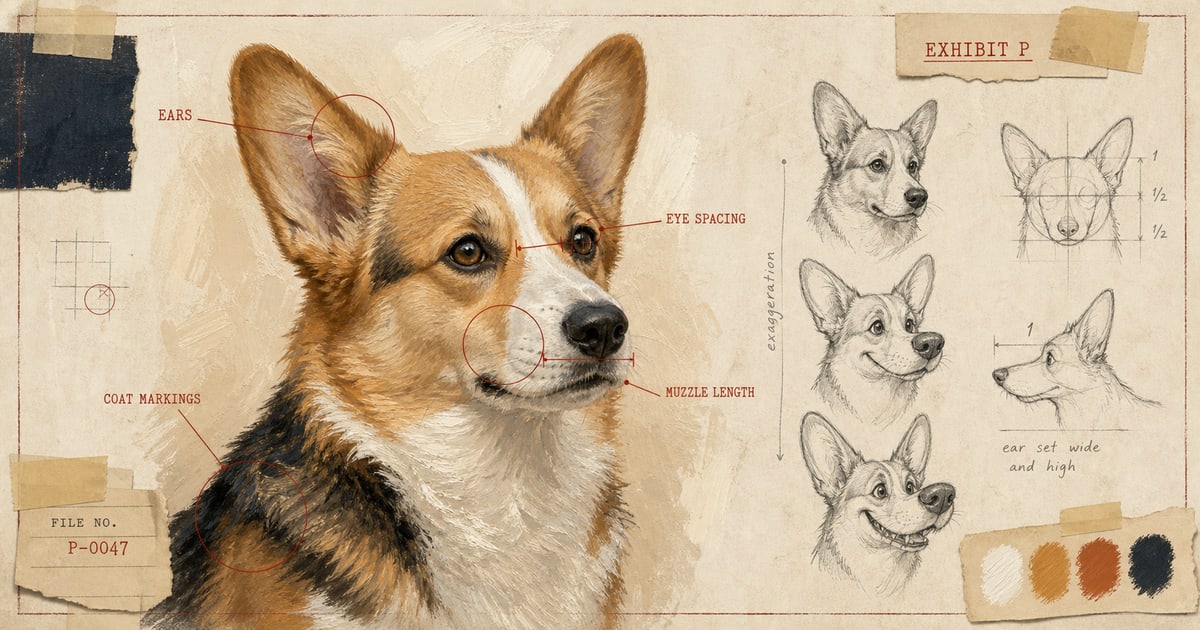
That animal-biometrics literature and the human caricature literature were never designed to talk to each other, but laid side by side they point at a consistent, reasonable inference rather than a directly proven fact: for an animal’s face, the features carrying stable individual identity are ear shape and set, eye shape and spacing, muzzle length, and the pattern of markings. Those are the pieces analogous to what the spacing and configural research found in human faces, and the pieces biometric systems lean on when they need to tell one dog from another without error. Fur texture, coat direction, subtle shading, none of that shows up in either literature as identity-bearing in the same way. It is the visual equivalent of skin texture on a human caricature: real, present in a photograph, and almost entirely absent from what makes someone recognizable at a glance. This is a narrower question than likeness in general, which covers what any portrait, photorealistic or not, needs to get right. The question here is specifically what a simplified rendering is allowed to drop without losing the animal underneath it.
That is precisely what a stylized medium like anime does to a face by design. Cel shading flattens gradation into blocks of color. Linework simplifies fur into clean contour. The texture that a photograph renders in exhausting, follicle-level detail gets thrown out first, because a cel-shaded style has no mechanism for keeping it and, more importantly, because throwing it out costs almost nothing. People who think they are paying for faithfully rendered fur are usually paying, without knowing it, for correct ear geometry and eye spacing. The fur is what a customer notices is missing in the abstract, before they see the portrait. It is almost never what they notice is missing once they are looking at their actual dog rendered with the right ears and the wrong number of whisker strands.
Emely, who runs the studio’s small collective in New York, put it this way when describing what the job actually is: “People want the portrait to look like their pet specifically, not a well-executed golden retriever. That’s the whole job. Getting the ears right, the way they hold their head, the expression they have in the photo you love. The style can be watercolor or oil or pop art, but the likeness has to be there first.” That holds for anime portraits exactly as much as it holds for a more literal style. The style you pick changes the surface. It should not change which features the artist is protecting underneath it.
None of this makes stylization a compromise. Rhodes, Brennan, and Carey’s caricatures were not degraded photographs, they were faster to recognize than accurate ones, because they pushed harder on the features memory already relied on. An anime portrait that gets the ear set and eye spacing right is doing the same thing a good caricature does: making a bet about which differences are load-bearing, then committing to them instead of trying to preserve everything at reduced fidelity. A photograph tries to keep it all. A stylized portrait cannot, and the research on what a face actually needs to stay recognizable suggests it does not have to. You can see the range of what that bet looks like across styles in the portfolio, where the same underlying features get carried through six different treatments of the same animals.
Sources
- Gillian Rhodes, Susan Brennan, Susan Carey, “Identification and Ratings of Caricatures: Implications for Mental Representations of Faces,” Cognitive Psychology, 19(4), 1987.
- Susan E. Brennan, “Caricature Generator: The Dynamic Exaggeration of Faces by Computer,” Leonardo, 18(3), 1985: https://muse.jhu.edu/article/601398
- James W. Tanaka & Martha J. Farah, “Parts and Wholes in Face Recognition,” Quarterly Journal of Experimental Psychology, 46(2), 1993: https://journals.sagepub.com/doi/10.1080/14640749308401045
- Daphne Maurer, Richard Le Grand, Catherine J. Mondloch, “The Many Faces of Configural Processing,” Trends in Cognitive Sciences, 6(6), 2002: https://pubmed.ncbi.nlm.nih.gov/12039607/
- H.I. Choi et al., “Study on the Viability of Canine Nose Pattern as a Unique Biometric Marker,” Animals, 11(12), 3372, 2021: https://pmc.ncbi.nlm.nih.gov/articles/PMC8697952/
- Thierry Pinheiro Moreira, Mauricio Lisboa Perez, Rafael de Oliveira Werneck, Eduardo Valle, “Where Is My Puppy? Retrieving Lost Dogs by Facial Features,” Multimedia Tools and Applications: https://arxiv.org/abs/1510.02781
Welcome perk
Free expedited delivery on your first portrait
Get your digital proof in 1-2 business days instead of 2-3, free on your first portrait. Normally a $10 upgrade.
No spam. Just the perk and the occasional new style or guide.
Check your inbox for your code.