
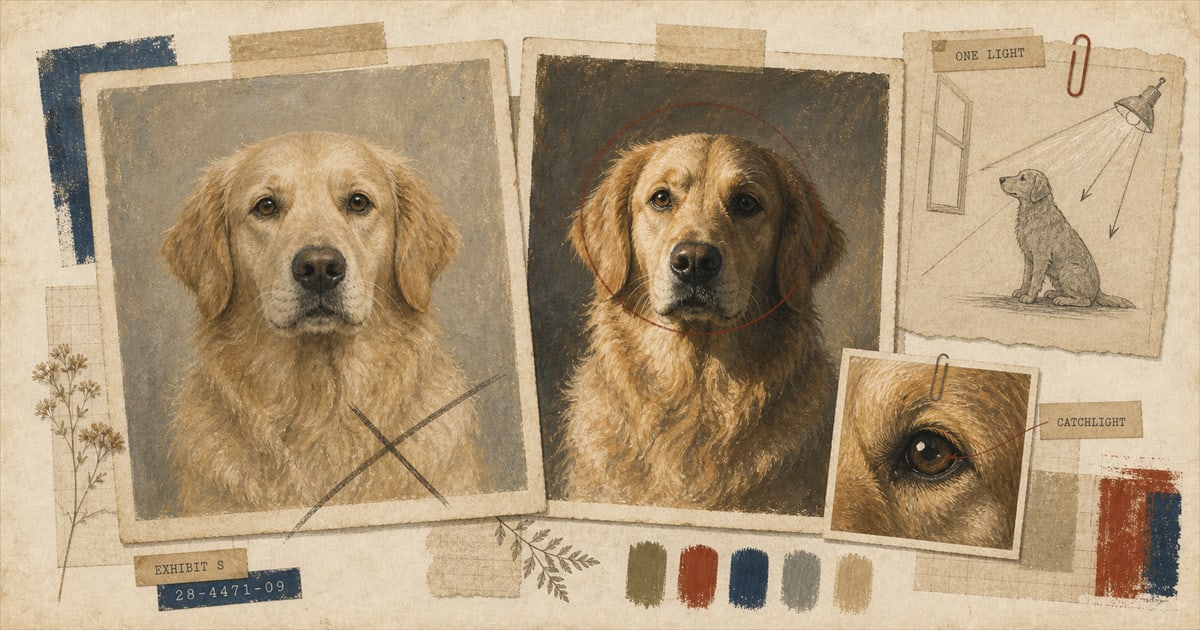
Cel shading tutorials usually teach the technique with a slider, because dragging it is the fastest way to see what the whole style is doing. Set it one way and a shadow falls across a rendered face the way light behaves in the world: a smooth gradient sliding from bright to dark with no visible edge anywhere in it. Set it the other way and that same gradient collapses into two flat shapes, a lit half and a shadowed half, separated by a hard line with nothing between them. Anime’s flat, graphic look isn’t a drawing style laid on top of ordinary lighting. It’s what happens when continuous light gets cut into a small number of pieces until the light looks like it made a decision.
That mechanism has a direct consequence for the photo you send us, and it’s a consequence that runs against most of the reference-photo advice we’ve already given.
The Shadow Has to Come From Somewhere
The math underneath cel shading is the same math underneath a photorealistic render: the angle between a surface and the light source, expressed as a single number, determines how bright that patch of surface should read. A realistic render turns that number into a smooth gradient, thousands of tiny steps between bright and dark. Cel shading sorts the same number into two or three buckets instead. Two buckets is the starkest version of the style: pure lit tone, pure shadow tone, nothing between them. Three buckets adds a middle band. Either way, the render needs an actual light direction to sort by, because that direction decides exactly where one bucket ends and the next one begins. The line itself has a name. Animators and shader artists call it the terminator, the edge past which the light stops.
None of that math runs without a light source to measure an angle from. A photo lit from one identifiable direction, a lamp off to the side, a window your pet is angled toward, hands an artist that direction for free: a real shadow already sitting on the fur, in the right place, at the right hardness, ready to be simplified into two clean tones. A photo lit from everywhere at once, or from nowhere in particular, hands over nothing to simplify. There’s no shadow boundary in the source material because there was no shadow to begin with. At that point the artist isn’t translating a terminator line. They’re inventing one, guessing where the light would have fallen if the photo had had any to work with.
Our Own Advice, Reversed
This is worth saying plainly instead of quietly working around it. We’ve written before, at /blog/best-time-of-day-to-photograph-your-pet, that soft, diffuse light is reliably the best choice for a reference photo, and that hard light, direct sun, a bare bulb, is a problem worth avoiding because it “exaggerates flaws, deepens shadows under the eyes and chin, and produces a harsh contrast that flattens fur detail.” That advice is correct. It’s correct for watercolor, oil painting, pencil sketch, pop art, and surrealist, every style built around continuous tone and soft transition. Anime is the one style on the roster where the same advice runs backward.
A cel-shaded portrait wants a real shadow with a real edge, because that edge is the entire visual language of the style. Soft, shadowless light, the kind that makes every other style easier, gives an anime render nothing to key its two tones off. This isn’t a case where the earlier advice was wrong. It’s a case where the earlier advice was written for a family of styles anime doesn’t belong to, and it took a second, more graphic style joining the lineup to make the boundary visible. Some directional hardness, enough that you can actually see a dividing line between a lit side of the face and a shadowed side, is a feature here instead of a flaw.
The Glint the Artist Can’t Invent
Catchlights, the small bright reflection of a light source in the wet surface of an eye, are already covered in general terms at /blog/perfect-pet-photo-tips: they’re what makes an eye read as alive instead of flat, and portrait photographers have chased them for as long as portrait photography has existed. What that post doesn’t need to cover, because it’s specific to a graphic style, is where exactly the catchlight has to sit.
Portrait convention treats the eye like a clock face and wants the catchlight sitting somewhere between roughly ten and two o’clock, matched in both eyes, produced by a light source positioned in front of and slightly above the subject. It’s a strangely precise rule for something so small, but a face reads as subtly wrong when it’s violated, even to viewers who couldn’t tell you why. An anime eye render makes that precision matter more, not less. The anime eye isn’t a naturalistic reflection built from soft ambient bounce. It’s a stylized convention of its own: a small number of hard-edged highlight shapes, placed deliberately, doing a specific job inside an already-simplified face. To place that highlight convincingly, the artist has to see where a real catchlight actually sat in your photo. A flat-lit reference with no catchlight at all, which is exactly what soft ambient light tends to produce, hands over nothing to work from. The glint gets invented instead of translated, the same way the shadow does.
The Photo That’s Already Lying to You
There’s a third problem, and most people don’t know they’re causing it, because their phone is causing it for them.
Modern phone cameras rarely capture one exposure anymore. Google’s Pixel line runs on an HDR+ pipeline described in a 2016 paper by Samuel Hasinoff and colleagues at Google: fire off a burst of several frames per shot, align them, and merge them, recovering shadow detail and highlight detail that no single exposure could hold at once. Other flagship phones run their own version of the same idea under different names. The tap of a shutter button on a modern phone is quietly a merge of several photos into one, tuned to look like a single, well-exposed, naturally lit image.
That’s a genuine engineering achievement, and it happens to be the wrong achievement for an anime reference photo. Merging a bright frame and a dark frame into one requires tone mapping, compressing the combined range back down to something a screen can display, and tone mapping does that by reducing the scene’s original contrast even as it pulls detail out of the shadows and highlights. The photo comes out looking calm, even, and pleasant. It also comes out with its shadow edge softened or erased by the same processing that made it look nice. For five of our six styles, that’s harmless, sometimes even helpful. For anime, it’s quietly removing the one piece of information the render actually depends on.
What to Send Instead
None of this needs special equipment. It needs the opposite instinct from most photo advice, including our own: instead of chasing the flattest, most even light in the room, let one lamp or one window be the only light source, angle your pet toward it, and resist the urge to fix the shadow that falls across their face afterward. If your phone offers a way to shoot a single frame instead of its default merged mode, use it for this one. Before you send anything, look at the eyes yourself. If you can see a small bright glint sitting in the upper part of the iris, in both eyes, the artist can see it too, and knows exactly where to put it.
This is the same idea our post on pencil sketch versus watercolor already established for a different pair of styles: the medium determines what the camera needs to capture, not the other way around. Anime just needed a photo willing to admit where its light actually came from. Send us that photo in anime or any of the other five styles, and the shadow the artist paints won’t be a guess.
Sources
- Samuel W. Hasinoff, Dillon Sharlet, Ryan Geiss, Andrew Adams, Jonathan T. Barron, Florian Kainz, Jiawen Chen, Marc Levoy, “Burst Photography for High Dynamic Range and Low-Light Imaging on Mobile Cameras,” ACM Transactions on Graphics (Proc. SIGGRAPH Asia 2016)
- Moonjump, “Game Dev Mechanics: Toon Shading (Cel Shading): How It Works.”
- StudioBinder, “What Is a Catchlight in Photography?”
Welcome perk
Free expedited delivery on your first portrait
Get your digital proof in 1-2 business days instead of 2-3, free on your first portrait. Normally a $10 upgrade.
No spam. Just the perk and the occasional new style or guide.
Check your inbox for your code.